Iran escalates conflict with attacks on ships and near Dubai

Iran intensifies attacks in the Persian Gulf, hitting global trade and challenging the international community.

Iranian pressure hits the world’s routes

The image is clear: the Thai cargo ship Mayuree Naree, hit and burned in the Strait of Hormuz. It is the postcard of a strategy that is no longer just rhetoric. Iran intensified its offensive this Wednesday, attacking commercial vessels and areas near Dubai International Airport.

Their objective is clear as Gulf water: to put pressure on the United States and Israel by strangling the global economic arteries. Blocking these routes is not an isolated act; It is a pulse calculated by regional control.

RelatedIran intensifies pressure with attacks on ships and airport

A blow to the heart of world trade

This campaign began after the Israeli and American bombings almost two weeks ago. The result is logistical chaos. Maritime traffic and energy supplies in the Persian Gulf are seriously disrupted.

Oil, gas, fertilizers… everything that leaves this area to the world has become slower, more expensive and much more dangerous. It is a crisis in slow motion for the global economy.

Meanwhile, the mystery persists about the new Iranian supreme leader, Mojtaba Khamenei. Israeli intelligence assessments suggest he was wounded in the same attack that killed his father. The Iranian authorities flatly deny this, ensuring that they maintain control.

“Iranian authorities have denied that the leader is in serious condition and assure that he maintains control of the government.”

The conflict already crosses borders. In Dubai, two drones crashed near its international airport, leaving several people injured. New clashes were also reported in Tehran and in areas of Lebanon linked to Hezbollah.

The international response: words against actions

The UN Security Council passed a resolution demanding an end to Iranian attacks. But China and Russia abstained, considering the text unbalanced. It’s a weak diplomatic victory, with no real teeth.

More tangible is the action of the International Energy Agency: it announced the release of 400 million barrels of strategic reserves to try to stabilize an oil market on the verge of panic.

The question now is not whether tensions will rise, but how much collateral damage the global economy will absorb before someone steps back.
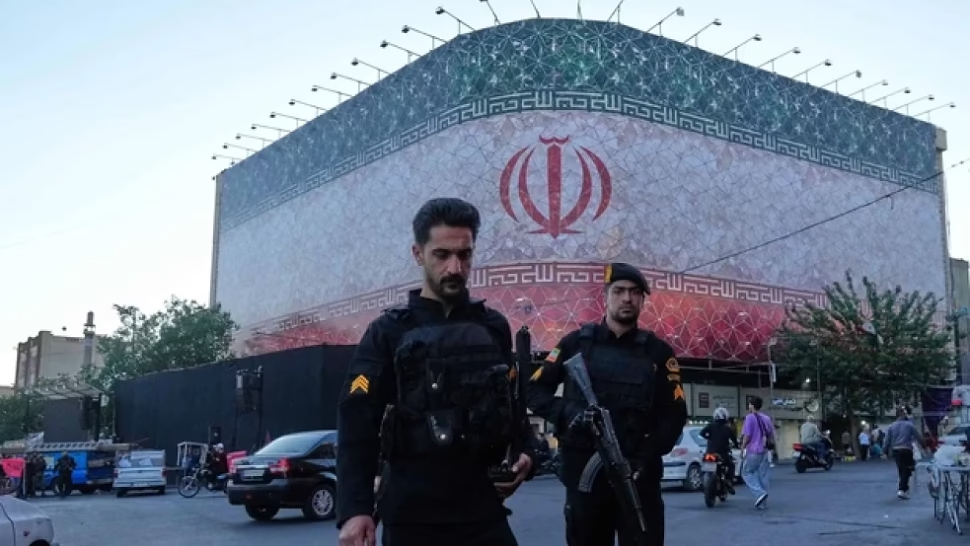
US and Iran reach provisional agreement to reopen Hormuz

The US and Iran agree to reopen the Strait of Hormuz and extend the truce.

The United States and Iran closed a provisional agreement that seeks to end the armed conflict and reopen the Strait of Hormuz, one of the most strategic maritime routes on the planet. The understanding also contemplates extending the fragile ceasefire in force in the region, amid years of military and political tension.

What does the pact contemplate?

The announcement opens the door to a formal signing next Friday in Switzerland, although authorities acknowledge that previous similar attempts have failed. As of Monday, the final content remained in dispute, especially on issues of regional security, nuclear verification and conditions for the lifting of sanctions.

The crisis between both nations has deep roots, from the Iranian nuclear program initiated with international cooperation to the Islamic Revolution of 1979. Since then, relations have been marked by diplomatic ruptures, economic sanctions and indirect clashes in the Middle East. The new agreement could mark a turning point, but doubts remain over its implementation.

Continue reading

Israel criticizes Netanyahu over US-Iran deal

The provisional pact between the US and Iran sparks internal criticism against Netanyahu for possible loss of influence.

Reactions in Israel

Israel is experiencing an intense internal debate after the provisional agreement between the United States and Iran. The pact has generated widespread criticism across the political spectrum, who consider it a strategic setback.

Prime Minister Benjamin Netanyahu has not yet issued an official position. Meanwhile, opposition figures, former officials and analysts react harshly. They point out that the Israeli government overestimated its ability to influence Washington’s strategy during the conflict with Tehran.

Another point of complaint is that the agreement could limit Israel’s freedom of military action, especially on the Lebanon front, where tensions with Hezbollah persist. Government sectors warn that resuming attacks could complicate the relationship with the United States.

International analysts point out that the pact alters the power dynamics in the Middle East. Israel would come under greater strategic pressure. Furthermore, the eventual partial lifting of sanctions on Iran would strengthen its economic and military capacity in the medium term.

Continue reading

Russian attack leaves 11 dead and damages cathedral in Ukraine

The massive bombing of kyiv and Kharkiv affected an 11th century temple.

A cathedral located in one of the oldest religious complexes in Eastern Orthodox Christianity was burned during a wide-ranging Russian attack on Ukraine. The Ukrainian government reported at least 11 people dead and dozens injured.

Details of the bombing

The attack occurred early Monday morning. Russia launched hundreds of drones and dozens of missiles against major Ukrainian cities, including kyiv and Kharkiv. Local authorities reported damage to residential buildings, markets and civil infrastructure.

Emergency teams work to rescue survivors from the rubble. President Volodymyr Zelenskyy condemned the bombing, calling it a new aggression against the civilian population and the country’s cultural heritage.

Continue reading