Inter Miami is reborn with young people and looks beyond the MLS

The MLS champion renews its squad and aims for new continental titles while managing the physical condition of its star.

A transformed team, with the same excessive ambition

Two years after the arrival of Lionel Messi, Inter Miami remained silent. MLS won. But the veterans who accompanied him on that initial adventure, like Busquets and Alba, have already retired. Now, the Herons are more dynamic. And younger.

“The challenge is to compete for everything, as we did last year,” said their coach Javier Mascherano. “And try to be a competitive team and continue obtaining titles.”

The winning mentality did not change. Just the team. And the objectives expanded.

RelatedInter Miami is reborn to defend its MLS crown

Not just defending the title: CONCACAF and a new stadium

Ambition no longer fits only in the MLS. They have their sights on the CONCACAF Champions Cup, where they will debut in March. And on the horizon shines the Miami Freedom Park, its new 350 million stadium that will open in April.

Meanwhile, they will start the season with five straight away games. An early test.

Mascherano already began to change the pieces in the last playoffs, giving more opportunities to young people like Tadeo Allende and Mateo Silvetti. The signing of forward Germán Berterame adds more offensive power.

The renovation is profound: Canadian goalkeeper Dayne St. Clair, full-backs like Sergio Reguilón (injured) arrived, and the purchase of midfielder Rodrigo De Paul became permanent.

The great unknown: managing the boss

The most delicate task for Mascherano is to measure Messi. The Argentine star, who will turn 39 this year, suffered a muscle strain on a tour of South America but is expected to play this Saturday against LAFC.

His participation in the next World Cup with Argentina seems a fact, although he has not officially confirmed it.

“Why not?” Mascherano responded when asked if Messi will play in the World Cup. “No one knows their body better than them… we have to try to find a balance.”

A unique context: the MLS before its World Cup

This will be the 31st season of the MLS, a league that was born after the 1994 World Cup in the USA. The next two years are key, with the momentum of the first World Cup organized by three countries: the United States, Mexico and Canada.

Starting in 2027, the league will change its schedule to align with Europe, playing between July and April.

“The World Cup will accelerate the growth of soccer in North America in a way never seen before,” predicted commissioner Don Garber.

Meanwhile, other teams also strengthened. James Rodríguez arrived at Minnesota United to find rhythm before the World Cup with Colombia. Timo Werner signed for the San Jose Earthquakes.

Almost a third of the teams have a new coach, including Gerardo Martino, who returns to Atlanta United.

The message is clear: Inter Miami reinvented itself to not settle for what it had achieved. The champion wants more.

Egypt comes back and advances to the round of 16 in the 2026 World Cup

Egypt reverses the score against New Zealand and approaches the round of 16.

Egyptian comeback in Group G

Egypt achieved a key victory against New Zealand, overcoming an adverse score to become the leader of Group G and secure its place in the round of 16 of the 2026 World Cup.

The match started uphill for the Africans. In the 15th minute, Finn Surman put New Zealand ahead with a goal that put the Oceanians in front. However, Egypt remained calm and found an equalizer in the second half.

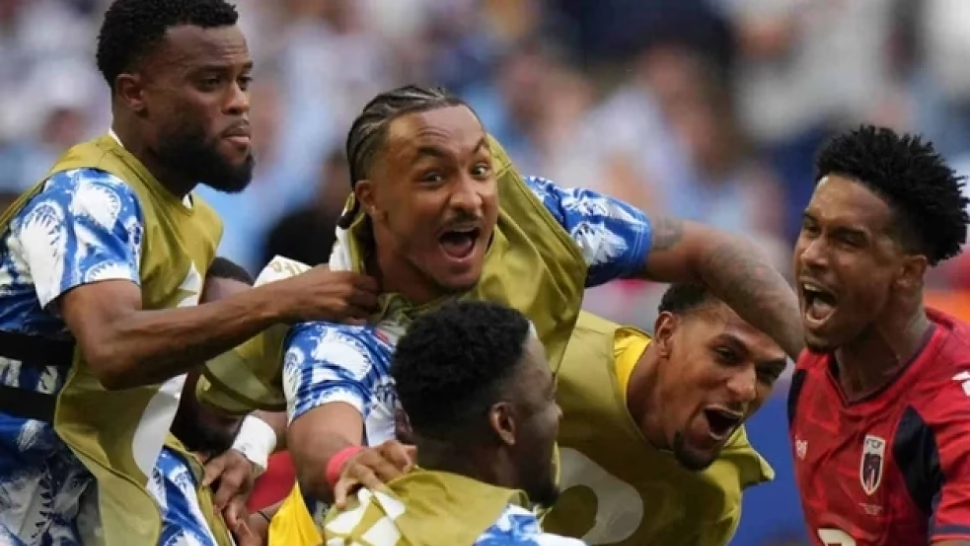
Mustafa Ziko equalized with a powerful header in the 58th, and shortly after, Mohamed Salah, with his offensive ability, put his team ahead. The Egyptian showed why he is one of the figures of the tournament.

Trézéguet sealed the victory in the 82nd minute, eliminating any possibility of a New Zealand reaction. The victory not only classifies Egypt, but also outlines it as a serious contender in the World Cup.

Continue reading

Cape Verde empathizes and dreams; Uruguay suffers from the World Cup surprise

Cape Verde achieves another historic tie; Uruguay gets complicated in Group H.

Two ties, two opposite faces

For Uruguay, two draws with the taste of defeat. For Cape Verde, two results that taste like triumph and mark a milestone in its first World Cup.

The team led by Marcelo Bielsa must now beat Spain to avoid a fiasco. Meanwhile, the African team, which had already surprised by drawing without goals against La Roja, did it again: it tied 2-2 against La Celeste in Miami.

Kevin Pina opened the scoring with a free kick that became Cape Verde’s first goal in a World Cup. Helio Varela, who came on in the second half, tied the game with a long shot that surprised goalkeeper Fernando Muslera.

The controversy and the statements

Maxi Araújo and Agustín Canobbio put Uruguay ahead with two goals in quick succession at the close of the first half. However, the advantage did not last. “The truth is that the goal is of no use… we should have taken care of the result,” said Araújo.

Bielsa took responsibility: “Organizational errors are always the coach’s responsibility. We pay a very high price for that.”

The match also had a special detail: it was the first World Cup match with two goalkeepers over 40 years old. Muslera, who turned 40 on June 16, and Vozinha, 40, faced off on the grass. Vozinha’s mother, who could not travel to the debut against Spain due to lack of visa, was in the stands this time.

Group H is reconfigured: Spain leads with 4 points, Uruguay and Cape Verde have 2, and Saudi Arabia closes with 1. Uruguay will risk their lives against Spain on Friday, while Cape Verde will face the Saudis with their hopes intact.

Continue reading

BMO Field: Toronto’s key stadium for the 2026 World Cup

BMO Field, with capacity for 30,000 attendees, will host the 2026 World Cup.

Key facts about BMO Field

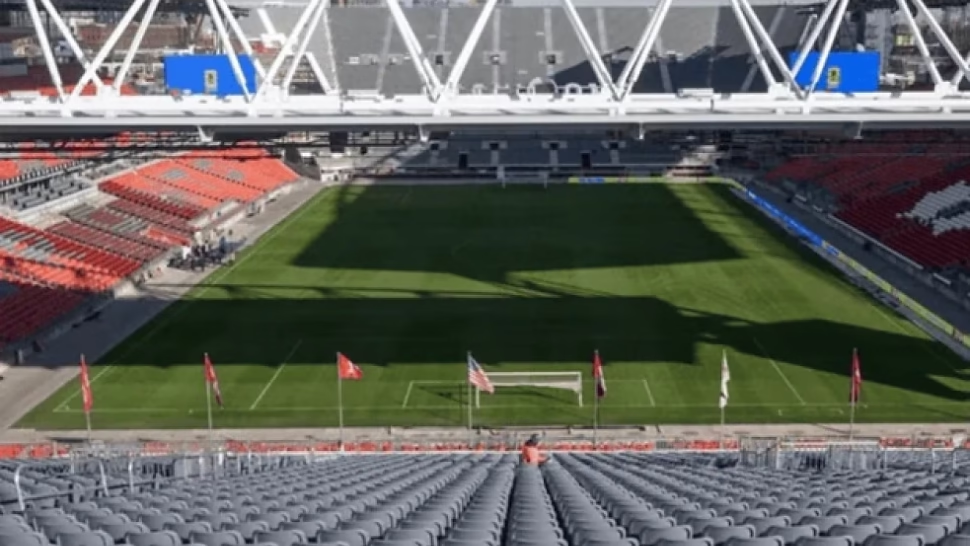
BMO Field is located in Toronto, Canada, and will be one of the venues for the 2026 World Cup. Its capacity of 30,000 spectators classifies it as a medium-capacity stadium, but its natural grass surface aligns it with the traditional standards of national team soccer.

The venue is owned by the City of Toronto, a relevant fact to understand its governance and decisions on adaptations for the tournament. It was inaugurated on April 28, 2007, with a construction cost of 72 million dollars, which places it as a relatively recent infrastructure in North America.

Its exact location (43°37’58″N 79°25’07″W) is key for the logistics of travel, security and access during the event. Although operational details are not specified, these basic elements define its role in the 2026 World Cup.

Continue reading