IMSS launches mega call for specialist doctors

The IMSS seeks to hire almost 10,000 specialists in a process that promises to speed up care, but will it be enough?

The IMSS wants to fill almost 10 thousand medical positions

Officially, it’s hopeful news. The Mexican Social Security Institute announces that it seeks to hire 9,616 health professionals. The stated goal is clear: strengthen its highly specialized hospitals and reduce waiting times that are so often a nightmare for patients.

But here comes my cynical side, the one who studied law and knows when something smells like a patch instead of a solution. Do you really believe that simply filling vacancies will fix a system that has been creaking everywhere for years?

RelatedIMSS hospital inaugurated in Chiapas for one million beneficiaries

A process with date and time

Registration will be from March 2 to 13 at the union’s Churubusco Center. Extended hours, from 9 AM to 9 PM, with appointments assigned according to specialty. It even sounds efficient.

The authorities indicated that the process aims to expedite the selection and assignment of places according to the needs of each medical unit.

Of course, because what is left over in the health sector are agile and transparent processes. Sorry, I missed the sarcasm.

Those interested must appear at one of the 10 tables enabled. There are four appointment times a day and another 10 tables to follow up on. It sounds like military logistics, not public procurement.

The question that no one asks: where will these almost ten thousand specialists come from if the medical brain drain is a documented fact? And the working conditions? Competitive salaries? That, curiously, is not in the call.

It’s like announcing that you are going to repair a building with structural cracks by hiring more painters. The new color will look good for a while, until everything falls off again.

Meanwhile, thousands will continue to wait months for a consultation or surgery. And the IMSS will be able to say that ‘it is doing something’. Memory is short, but patient files on the waiting list don’t lie.


Governor of Durango denies revocation of US visa

Esteban Villegas assures that he is only seeking to resolve a yellow alert for a namesake.

The governor of Durango, Esteban Villegas Villarreal, denied that his US visa has been canceled. He stated that he faces an administrative “detail” related to an alert during his last border crossing.

The details of the alert

Villegas said that on his last visit to the United States, immigration agents took him to an examination room, asked him questions, and then returned the document to him. “They told me that we have to resolve the issue of ‘something’, I don’t know, because there was a homonym perhaps, and they stop you every time it happens, and until the underlying issue is resolved,” he commented.

The president indicated that he went to the Mexican Consulate in Monterrey, where he received advice to eliminate that record. “Yes, I have a visa and they are reviewing why a yellow alert went off the last time I passed,” he insisted.

Villegas pointed out that he has never been prevented from entering and that he has not required to travel to the United States recently. However, he mentioned that he has flown to China and Spain without any setbacks. “When you have a restriction, they don’t let you fly because you go through the airspace and cross the United States. You have problems traveling to other countries if you go through the United States because there may be a problem,” he explained.

The governor announced that he will soon show his visa to clear up doubts and that he is considering traveling to the United States to “make all this calm down.”

Continue reading

Plenitude Crematorium: 251 bodies identified; 135 still unnamed

Prosecutor's Office identifies 251 bodies of 386 found in a crematorium in Chihuahua.

Advances in the Plenitude Crematorium research

The Chihuahua Prosecutor’s Office reported that, of the 386 bodies found on June 26 at the Plenitude Crematorium, 251 have already been identified. The property, located in the Granjas Polo Gamboa neighborhood, stored uncremated remains.

Ezequiel Montoya, coordinator of the Specialized Unit, detailed the legal actions: arrest warrants were requested against José Luis A. C., owner of the crematorium, and Facundo Teófilo M. R., who worked at the place and died in October while facing the judicial process. A red card was also arranged to capture the owner, who is a fugitive.

Identification and support for families

Alma Vázquez, coordinator of Public Ministries, reported that the Secretariat of Public Function was notified about possible administrative misconduct by public servants related to the case. Alejandra López, head of the CEAVE, highlighted the psychological care and support provided to the families of the victims, from identification to the delivery of the bodies.

Héctor Jácome and Fernando Solís, from Expert Services, explained that 35% of the bodies have yet to be identified. To speed up the process, Francisco Sáenz called on those who contracted cremation services with the Monte de los Olivos, Del Carmen, Protecto Deco, Luz Divina, Milagros, Latino Americana, Paraíso or Camino al Cielo funeral homes, between March 2022 and June 2025, to go to Servicios Periciales to take free genetic samples.

“Citizen participation is essential to identify the remaining 135 bodies and return them with dignity to their families,” said Sáenz.

Continue reading

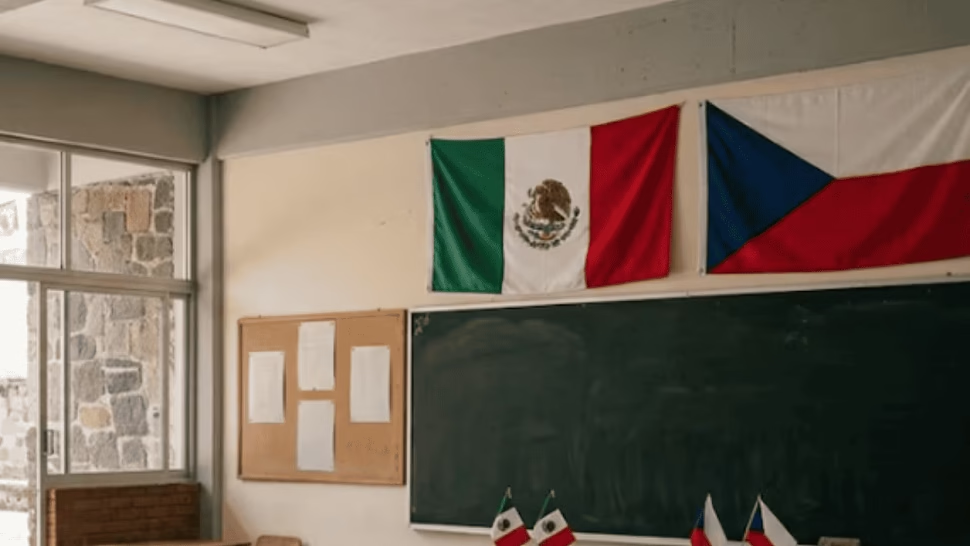
Classes suspended in CDMX due to Mexico’s match in the 2026 World Cup

CDMX Government suspends classes and recommends home office for Mexico vs Czechia match.

Suspension of classes and teleworking due to the party

On Wednesday, June 24, the match between the Mexican National Team and the Czech Republic in the 2026 World Cup not only generates expectation among fans, but also doubts about school and work activities. The Government of Mexico has already responded: there will be suspension of classes in the capital.

The measure applies to all educational levels—preschool, primary, secondary, high school and higher education—in both public and private schools, including morning and afternoon shifts. Although the SEP calendar did not contemplate this day as a rest, a special decree published in the DOF made the suspension official.

What happens to work centers?

Government agencies must implement teleworking, remote work or flexible modalities to reduce the physical presence of staff. The private sector was also urged to adopt the home office, with the aim of reducing vehicular traffic and avoiding complications due to the logistics of the game.

However, there are strategic sectors that will continue to operate in person. Among them: health services, hospitals, emergencies, civil protection, national and public security, immigration control and customs operations. All workers in these essential areas will not be able to benefit from the remote scheme.

The recommendation seeks to minimize impacts on the roads near the Mexico City Stadium and on the main routes of the city. The authorities are confident that the combination of school suspension and work flexibility will reduce the impact on mobility.

Continue reading