Classes suspended in CDMX due to Mexico’s match in the 2026 World Cup

CDMX Government suspends classes and recommends home office for Mexico vs Czechia match.

Suspension of classes and teleworking due to the party

On Wednesday, June 24, the match between the Mexican National Team and the Czech Republic in the 2026 World Cup not only generates expectation among fans, but also doubts about school and work activities. The Government of Mexico has already responded: there will be suspension of classes in the capital.

The measure applies to all educational levels—preschool, primary, secondary, high school and higher education—in both public and private schools, including morning and afternoon shifts. Although the SEP calendar did not contemplate this day as a rest, a special decree published in the DOF made the suspension official.

RelatedWorld Cup 2026: Group A defines its calendar and venues

What happens to work centers?

Government agencies must implement teleworking, remote work or flexible modalities to reduce the physical presence of staff. The private sector was also urged to adopt the home office, with the aim of reducing vehicular traffic and avoiding complications due to the logistics of the game.

However, there are strategic sectors that will continue to operate in person. Among them: health services, hospitals, emergencies, civil protection, national and public security, immigration control and customs operations. All workers in these essential areas will not be able to benefit from the remote scheme.

The recommendation seeks to minimize impacts on the roads near the Mexico City Stadium and on the main routes of the city. The authorities are confident that the combination of school suspension and work flexibility will reduce the impact on mobility.

Pemex and Petrobras: alliance that reduces years of exploration to months

Pemex and Petrobras sign agreement that accelerates deep water exploration and paves the way for biofuels.

President Claudia Sheinbaum reported that the memorandum signed between Pemex and the Brazilian Petrobras will allow strategic technological cooperation. The objective: explore new deposits in less time and advance in fertilizers and biofuels.

“This is an alliance between the two most important public oil companies in Latin America,” he highlighted in his morning conference.

Petrobras has developed advanced techniques in deep and shallow waters. According to Sheinbaum, they have managed to reduce the initial exploration-to-drilling process from ten years to about three years, or even months in some cases.

The collaboration is not unilateral. Petrobras showed interest in Pemex’s experience in fertilizers. The document, signed on June 23, lays the foundation for future specific agreements. It also contemplates joint projects in the Gulf of Mexico.

In alternative energies, Petrobras is advancing biofuels from biomass and sugar cane. Sheinbaum mentioned shared research on maguey biodiesel, a project that is also being studied in Yucatán.

The agreement opens a window for both companies to share scientific knowledge and reduce operating costs. However, definitions are missing regarding the specific agreements that will derive from this memorandum.

Continue reading

IMPI confirms that the Pato Merlín brand belongs to the Gómez family

The IMPI defines the ownership of the name of the famous duck in the face of external registration attempts.

Official resolution

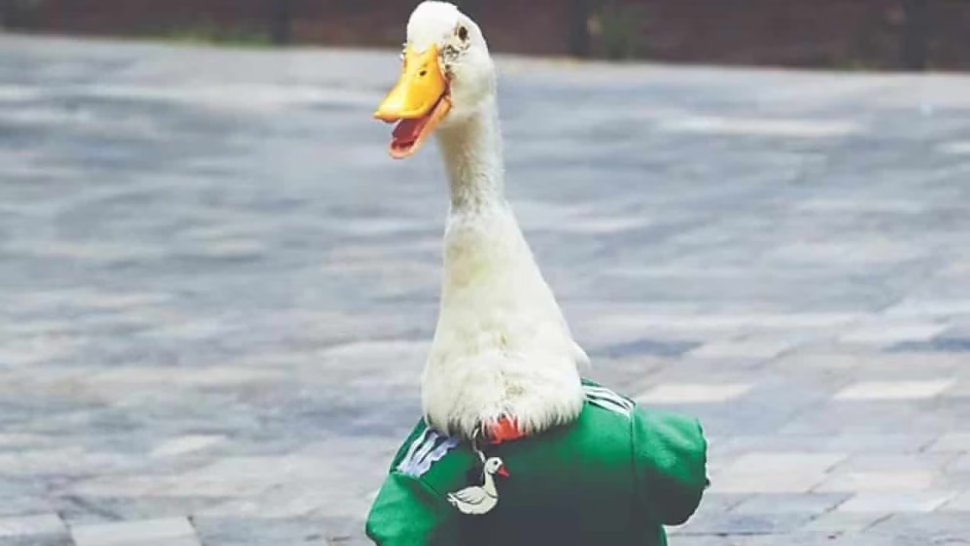
The Mexican Institute of Industrial Property (IMPI) determined that the registration of the “Pato Merlín” trademark belongs exclusively to the family of Carla Ivette Gómez, the original owner of the mascot.

The head of the IMPI, Vidal Llerenas Morales, stated through social networks:

“It is a public and well-known fact that Merlin Duck is a pet of the family of Carla Ivette Gómez, to whom the IMPI brand belongs.”

The Ministry of Economy supported this position.

A day earlier, the agency had reported on third-party requests to register the animal’s name. Among them, that of David Sides Fuentes, a resident of Yucatán, who intended to obtain the concession for 10 years along with the logo “El Pato Merlín. El Pato de la Lucky”, for political and commercial advertising purposes.

The IMPI clarified that each application follows the process provided for in the regulations and that it will issue a resolution in accordance with the Federal Law for the Protection of Industrial Property.

For her part, Carla Ivette Gómez declared that her only objective in protecting the name is to prevent external corporations from profiting from her mascot. It opened the possibility of collaborating in the future with the Corporativo Pascual cooperative.

Continue reading

Sheinbaum will meet with King Felipe VI at the National Palace

Sheinbaum will explain to King Felipe VI the importance of indigenous recognition.

Key meeting between Sheinbaum and the king of Spain

President Claudia Sheinbaum will meet this Thursday at 4:00 p.m. with King Felipe VI at the National Palace. The meeting took place after the monarch attended Mexican cultural exhibitions in Spain, a gesture that the president described as positive.

Sheinbaum stated that he wants to explain to the head of the Spanish State the relevance of the recognition of indigenous peoples and their cultural greatness. “These are issues that I want to talk to him about and tell him why it is important for Mexico, beyond the moment of requesting forgiveness,” he declared in his morning conference.

Context of the diplomatic relationship

Former president Andrés Manuel López Obrador sent a letter to the Spanish Crown apologizing for the wrongs committed during the Conquest. According to Sheinbaum, the Spanish government took the request “as an offense” and then waged a campaign against López Obrador.

For this reason, when Sheinbaum assumed the presidency he did not invite the king to the swearing-in ceremony. However, the president stressed that relations were never broken. “The relationship continued in tourism, trade… with Spain and with the Spanish government as well, with President Sánchez,” he clarified.

The turn occurred when Felipe VI visited the exhibitions of the Museum of Anthropology and indigenous women, and took photographs with representatives of indigenous peoples. “It was a very important gesture and we consider it,” added the president.

Issues on the bilateral agenda

Sheinbaum described the meeting as “cordial” and announced that sports issues will be addressed within the framework of the 2026 Soccer World Cup. The president stressed that she will also talk about the constitutional changes that guarantee full recognition of the rights of indigenous peoples.

“What I want to explain to you is what that means for Mexico, the recognition of the native peoples of their cultural greatness,” he reiterated. The meeting represents a new chapter in the Mexico-Spain relationship, marked by previous tensions but with a clear intention of diplomatic rapprochement.

Continue reading