Hit to steel maquiladoras for irregular imports

The government cancels permits for 350 steel companies for alleged illegal practices in a massive operation.

The curtain falls for 350 companies in ‘Operation Cleanup’

The Ministry of Economy has just given a change of direction that will shake the sector. Canceled the permits of 350 maquiladoras and steel marketers for alleged illegal practices in imports and operations. These companies are simply left without their maquiladora program and without authorization to bring in supplies.

The measure responds to information provided by the National Chamber of Iron and Steel, which allowed the identification of a total of 750 firms with possible irregularities.

And this is just the first act. Another 400 companies are under the microscope at the moment, with inspections underway here and abroad. The objective is clear: to verify if they comply with the rules of origin for importing and exporting steel products. If they find something, more suspensions will come.

RelatedThe United States carries out a military operation and captures Maduro in Venezuela

A script written by multiple dependencies

This ‘Operation Cleanup’ is not a monologue. It is a collective work involving the Digital Transformation Agency, the SAT and the Mexican Customs. Together they analyze the legality of operations to combat smuggling and the misuse of economic programs.

They say they seek to protect supply chains and ensure that what is imported meets the standard. But behind the official discourse there is a reality: the Mexican steel sector has fallen in production and exports. That is why the industry supports these actions.

For steel businessmen, suspending these permits helps reduce unfair trade and strengthens national producers. However, some specialists are already raising their hands: if the affected companies are a relevant percentage of the market, we could see painful adjustments throughout the chain.

The figures give weight to the drama: between November of last year and next December, 7 million products valued at almost 933 million pesos were secured. This is not a minor scene; It is the central act of a complicated season for Mexican steel.
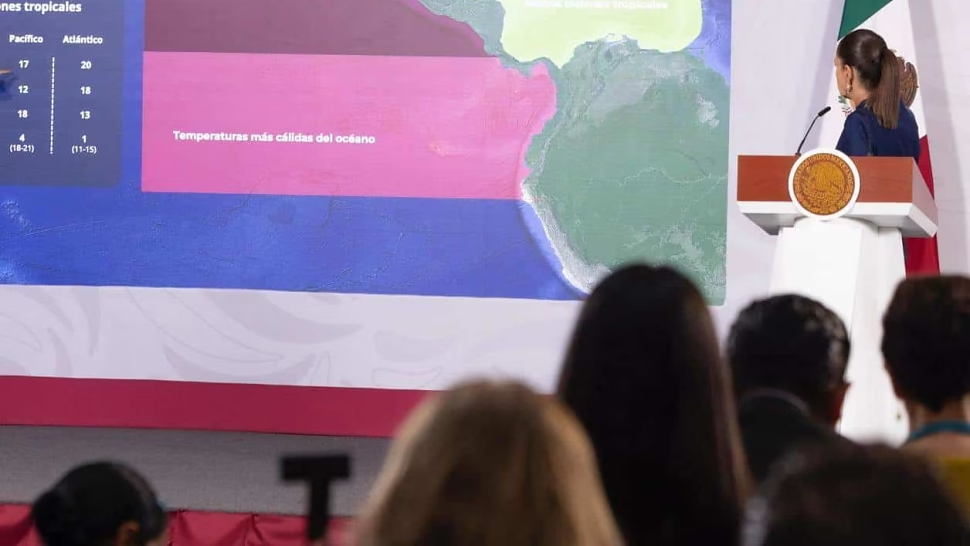

Sheinbaum announces telephone alert for El Niño rains

Federal government activates telephone alert due to intense rains due to El Niño. Coordination with 32 states.

President Claudia Sheinbaum reported that in approximately two months a telephone alert system will be ready to notify the population about meteorological phenomena. The measure is part of the preventive actions against the intense rains that the El Niño phenomenon will bring.

“The objective is that in two months or so we will have the telephone alert ready so that all people, all Mexicans, can be informed,” he stated during the morning conference.

The system is developed in coordination with the Digital Transformation and Telecommunications Agency, the National Civil Protection Coordination and the National Meteorological Service.

Risks of the climate phenomenon

Fabián Vázquez Romaña, coordinator of the SMN, explained that El Niño—an interaction between atmospheric and oceanic temperatures that repeats every two to seven years—has a 63% probability of being very intense. The highest peak is expected to occur in December of this year and continue until 2025.

The consequences include heavier rain in the north of the country towards the end of the year, a greater probability of intense cyclones and possible drought in the center during the next year. “Whether the cyclones are going to reach the coast or not, we cannot know until a few days before,” he warned.

Actions in territory

Laura Velázquez, head of Civil Protection, explained that Command Posts are installed in the 17 coastal states. So far there are 11 formed; the rest will be completed next week. In addition, river and dam desilting, channel opening and barrier placement are carried out.

The agency maintains updated maps, monitors shelters and deploys teams throughout the country to serve the population. Coordination includes the 32 states, legal and expanded cabinets, and the National Water Commission.

Continue reading

Court analyzes whether decree on Frida Kahlo violates private property

The SCJN will review whether the 1984 decree that protects Kahlo's works is constitutional.

The SCJN reviews the decree that protects Frida Kahlo

The Supreme Court of Justice of the Nation (SCJN) will analyze the legality of the 1984 presidential decree that prevents the definitive export of works by Frida Kahlo. The plenary session admitted an injunction from the Ve por Más bank, owner of the oil painting Self-portrait with medallion, painted in 1948. The dispute pits the protection of cultural heritage against the right of private property.

Magistrate Giovanni Azael Figueroa promoted the case to establish whether the restrictions exceed the powers of the Executive. The Court will determine if the decree is constitutional.

Background: the Gelman collection

The review occurs in the midst of the debate over the Gelman collection, which includes 11 works by Kahlo loaned to Banco Santander. The Court’s resolution will set limits for future disputes over cultural property.

The ruling will be key to defining to what extent the State can intervene in the ownership of works considered national heritage.

Continue reading

IMSS and Fonacot update agreement to improve services for workers

IMSS and Fonacot renew their alliance until 2030 to streamline procedures and protect labor rights.

Strategic alliance for labor rights

The Mexican Social Security Institute (IMSS) and the National Fund for Workers’ Consumption (Fonacot) signed a collaboration agreement that updates their exchange of information and services. The objective: respond to the current operational, technological and regulatory needs of both agencies.

The agreement was signed by Wendolyne Retana Alarcón, general director of Fonacot, and Luisa Obrador Garrido Cuesta, director of Incorporation and Collection of the IMSS. It will be valid until September 30, 2030, with the possibility of extending it for two more years.

The relationship between both institutions dates back to 2007. Since then they have maintained a constant flow of data to facilitate procedures and guarantee better credit and social security conditions for working people.

With this update, the aim is to streamline processes, reduce response times and strengthen the protection of the rights of the country’s formal workers.

Continue reading