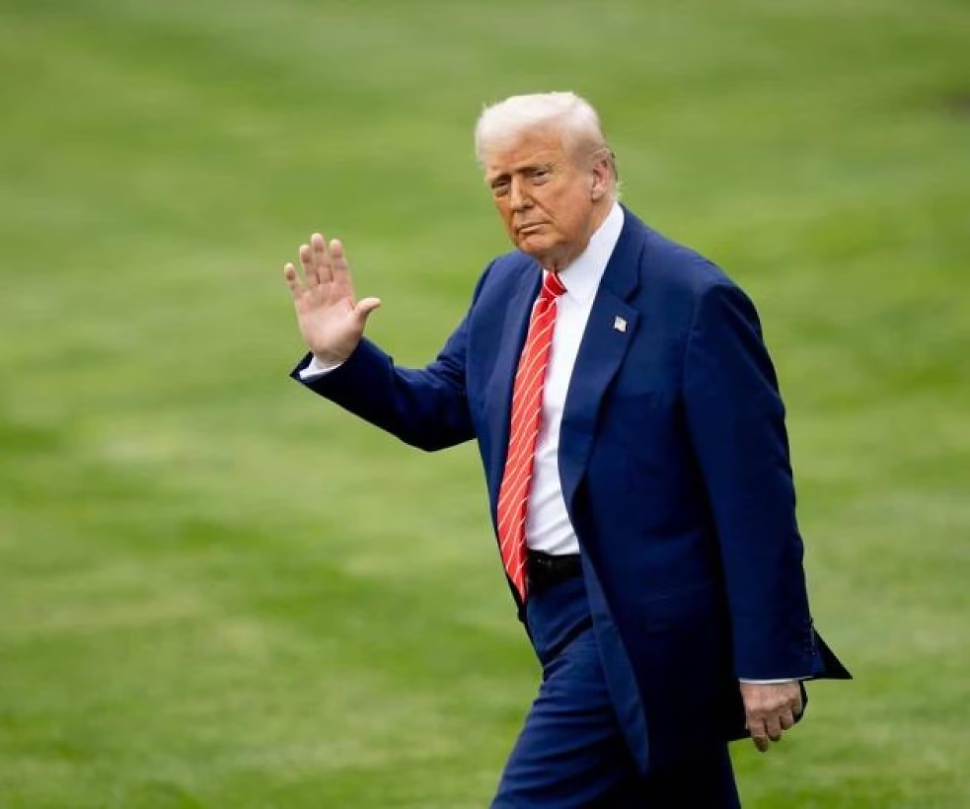
Trump raises tariffs to 50% on imported steel and aluminum

The measure will directly affect Mexican exports and reactivate trade tensions.

Impact of the new US tariff policy

US President Donald Trump has signed an executive proclamation increasing tariffs on steel and aluminum imports from 25% to 50%, a measure that will take effect on June 4. This decision specifically excludes the United Kingdom, whose shipments will maintain the current rate. The stated goal is to protect the local metals industry from what the administration calls “unfair competition” from foreign producers who, according to Trump, saturate the market with low-cost products.

Context and economic justification

The measure is part of the protectionist policy that Trump has promoted since his first term, centered on the motto “America First”. According to data from the Department of Commerce, steel and aluminum imports represent approximately 15% of total consumption in the US, with China, Mexico and Canada as the main suppliers. The key argument is that global overproduction—especially in China—has depressed prices, hurting the profitability of U.S. steel mills. However, independent analysts question the effectiveness of the tariffs: a report from the Peterson Institute for International Economics indicates that, since 2018, these measures have saved just 3,200 jobs in the sector, at an estimated cost of $900,000 per position.

RelatedTrump threatens 100% tariffs on China for rare earths

Consequences for Mexico

Mexico exports around $3.5 billion in steel and aluminum to the US annually, which is equivalent to 2.1% of its total sales to the country. Although the percentage seems modest, the Mexican industry will face an immediate challenge: according to projections from the Bank of Mexico, the volume of exports could contract by up to 4% in 2025. Companies such as Ternium and DeAcero, which concentrate 60% of shipments, are already evaluating strategies to diversify markets. The Mexican Ministry of Economy has avoided making an official statement, but internal sources reveal that selective retaliation is being analyzed within the framework of the T-MEC.

Reactions and future scenarios

The International Chamber of Commerce has described the increase as “a step backwards in economic integration”, while the European Union is considering challenging the measure before the WTO. For Mexico, the most likely scenario includes bilateral negotiations, although experts warn that any retaliation could escalate tensions in key sectors such as the automotive industry. A revealing fact: 78% of Mexican companies linked to these metals do not have contingency plans for tariff fluctuations, according to a CANACERO survey.

Are you interested in understanding how this affects the global economy? Share this analysis on your social networks and discover more articles on international trade in our specialized section.

Explosion at gas plant in Qatar leaves 13 dead

Explosion at gas terminal in Qatar leaves 13 dead and dozens injured.

Explosion in Ras Laffan: 13 dead and dozens injured

An explosion rocked the gas export terminal in Ras Laffan, one of Qatar’s most important energy facilities. The preliminary balance is 13 people dead and dozens injured.

The incident occurred while workers were trying to resume operations in the area. Work had stopped after previous clashes related to the conflict between Qatar and Iran.

Details of the accident

State-owned Qatar Energy confirmed that the explosion originated at the Barzan gas supply facility. The full extent of the damage caused by the fire is still unknown.

Ras Laffan is home to one of the world’s leading gas liquefaction plants. Disrupting its operations could lead to tensions in global energy markets, given that Qatar is a key exporter of natural gas.

Local authorities are investigating the causes of the explosion. It is not ruled out that technical problems or human failures may have contributed to the incident.

The accident adds to a context of instability in the region. The war with Iran had already affected the Qatari energy infrastructure, and this new fact complicates the recovery of the sector.

Continue reading

Ebola in Congo: 1,003 cases and 254 deaths from rare virus

Ebola outbreak reaches 1,003 confirmed cases in Congo. Difficulties in containing the virus.

Ebola outbreak in eastern Congo

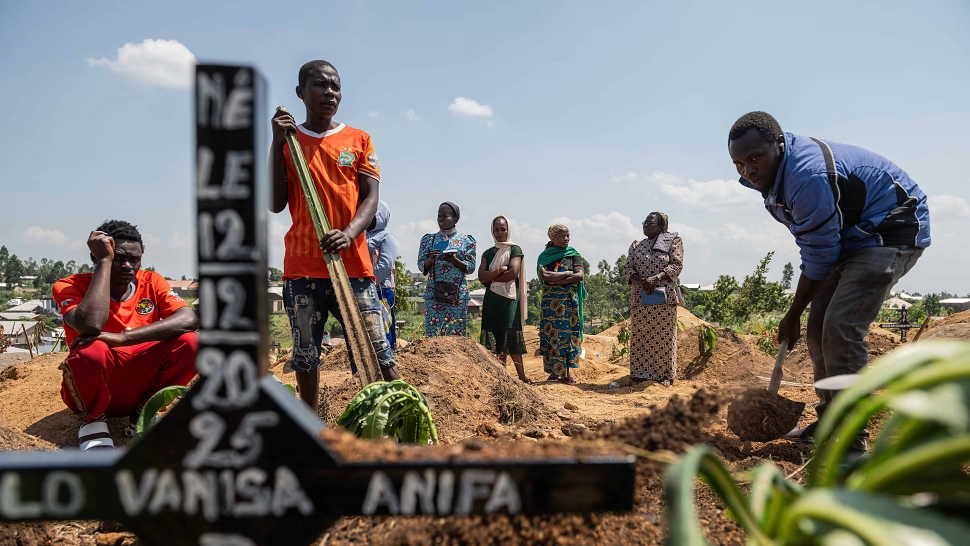
The Ebola outbreak in eastern Democratic Republic of the Congo now has 1,003 confirmed cases. This is reported by the health authorities. Of that total, 254 people have died.

The Congo Ministry of Health indicated that since the outbreak was declared on May 15 in Ituri province, 100 people have recovered. However, 365 patients remain hospitalized or in isolation due to the seriousness of the situation.

A virus without specific treatment

Authorities warn that this outbreak is caused by the Bundibugyo virus, a rare strain. There is no vaccine or specific treatment for this variety. Therefore, they fear that the outbreak will be more extensive than what has been recorded so far. They recognize that the peak of infections has not yet arrived.

Tracing contacts of infected patients remains a challenge. This complicates the containment of the virus and the protection of the population.

Continue reading

China sanctions 10 US companies in the military sector

Beijing replicates Washington's restrictions on Chinese technology firms.

The Chinese government announced sanctions against 10 United States companies linked to the military sector. The measure responds to the restrictions imposed by Washington on Chinese technology companies accused of maintaining ties with the armed forces of the Asian country.

Companies affected and scope of sanctions

According to China’s Ministry of Commerce, American companies will be prohibited from receiving exports of dual-use products. That is, goods with both civil and military applications. The decision seeks to protect national security.

Among the sanctioned firms are manufacturers of military drones, defense technology companies and companies dedicated to the extraction of rare earths. These materials are considered strategic for the technological and military industries.

The Chinese action comes after the United States included companies such as Alibaba and Baidu on a list of companies with alleged ties to the Chinese military. That list prevents them from accessing US defense contracts.

Analysts pointed out that Chinese sanctions have a mainly political and symbolic character. They reflect the growing commercial and technological tension between both powers. However, they warn that they could intensify restrictions in strategic sectors.

Continue reading