Guadalupe Chavira competes for the presidency of the Senate with a conciliatory approach

Morenoista Guadalupe Chavira seeks to lead the Senate with a strategy of unity and dialogue between political forces.

Analysis of Guadalupe Chavira’s candidacy to preside over the Senate

Senator Guadalupe Chavira de la Rosa, a member of the Morena parliamentary group, has formally announced her aspiration to assume the Presidency of the Board of Directors of the Senate of the Republic as of September 1, replacing Gerardo Fernández Noroña. His position focuses on the construction of a unity candidacy, supported by colleagues on the bench, although he does not rule out an internal election if agreements are not reached.

Political context and consensus strategy

In an interview with EL UNIVERSAL, Chavira highlighted his previous experience leading legislative bodies, underlining his ability to mediate between political forces and promote priority reforms. “The Senate should be recognized for its results, not for conflicts,” he said, alluding to past tensions. His speech emphasizes three pillars:

RelatedLaura Itzel Castillo assumes the presidency of the Mexican Senate
  • Plurality: Dialogue with all parties represented in the Upper House.
  • Internal cohesion: Strengthening Morena through consensus, avoiding fractures.
  • Effective legislation: Expedite pending initiatives “for the democratic transformation of Mexico.”

The legislator recognized the parallel aspirations of senators Laura Itzel Castillo and Verónica Camino, with whom she maintains a relationship of mutual respect. “Any decision method—whether by agreement or vote—is valid,” he said, reflecting a pragmatic stance.

Career and profile of the candidate

Chavira has a political career spanning three decades: founder of Morena, former governor of Milpa Alta, and legislator on five occasions (four by popular election). Her technical profile—with a degree in Political Science from UNAM—is complemented by executive roles in public administration, including the CDMX Finance Secretariat. Recently, she coordinated the gender strategy for Claudia Sheinbaum’s presidential campaign, reinforcing her influence within the party.

Implications for legislative dynamics

Analysts consulted agree that his election could mark a change in tone in the Senate, prioritizing negotiations over confrontation. However, challenges remain:

  • Balance of power: Morena requires alliances to approve constitutional reforms.
  • Dissident management: Internal fractures in the parliamentary group could slow down agreements.
  • Pending agenda: Issues such as social security and energy demand immediate attention.

Chavira insists that his approach will be “firm but conciliatory”, citing his previous experience leading the ALDF Board of Directors, where he achieved regulatory advances through transversal dialogue.

Call to action

This process reflects the evolution of power dynamics in the Mexican legislature. Will unity be a viable strategy? Share this analysis on your social networks and explore more content about the political transformation of Mexico.

Sheinbaum asks to preserve native corn for national sovereignty

Sheinbaum highlights that native corn is key to food sovereignty and national identity.

President Claudia Sheinbaum Pardo reaffirmed that the governments of the Fourth Transformation defend national sovereignty in all areas. During a meeting with farmers in Pijijiapan, Chiapas, he highlighted the importance of native corn as a pillar of Mexican identity and self-sufficiency.

Defense of sovereignty through native corn

Sheinbaum presented the “Corn is the Root” program, whose objective is to improve the conditions of producers and reduce dependence on seeds controlled by large corporations.

“Conserving native corn also means defending sovereignty,” he stated.

The president warned about the risks of hybrid seeds:

“If we continue with pure hybrid corn, people will depend on buying seeds and those who sell the seeds will be a few companies.”

He stressed that preserving native varieties is essential to avoid this economic dependence.

“If we did not have native corn, we would lose a good part of food sovereignty, of what we are as Mexicans,” he said.

In addition, it extended the defense of sovereignty to the energy, cultural and food fields. She assured that the Fourth Transformation drives her “in every possible way.”

The program seeks to strengthen small farmers and conserve the genetic diversity of corn, a central element in the country’s diet and culture.

Continue reading

Mexico sends rescue team to Venezuela after earthquakes

25 specialists and 5 canine pairs travel to support search efforts in Venezuela.

Solidarity in action

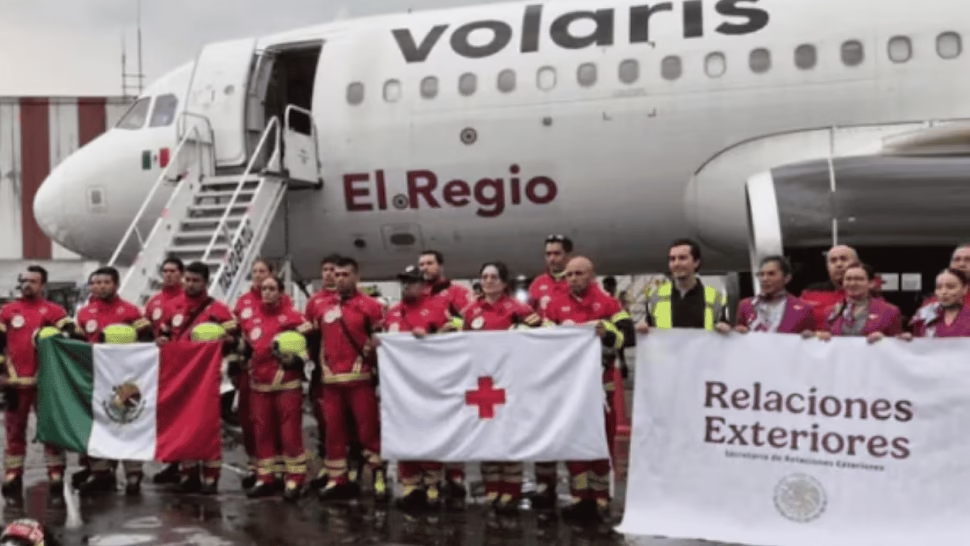
After the earthquakes of magnitude 7.2 and 7.5 registered in Venezuela on June 24, which left 1,430 dead and 3,328 injured, Mexico reinforced its humanitarian support. The Ministry of Foreign Affairs (SRE) coordinated the sending of a rescue mission with the Mexican Red Cross and the Volaris airline.

“This afternoon a support team made up of 25 specialists from the Urban Search and Rescue Unit (USAR) of the Red Cross and the Cancun International Rescue Brigade (USAR BRIC) left for Venezuela, as well as a brigade element from the Azteca Topos,” the agency indicated.

Equipment and logistics

The mission includes five canine pairs and 3.5 tons of specialized equipment for search and rescue tasks in the rubble. The shipment was transported on a Volaris flight.

“With this, Mexico reaffirms its solidarity and commitment to the Venezuelan people in these difficult times,” the SRE said in a statement. Foreign Minister Roberto Velasco heads the coordination of this aid.

Continue reading

Sterile fly plant reopened in Chiapas to combat plague

Mexico and the US reactivate a plant in Chiapas to produce sterile flies and stop a plague that affects livestock.

Binational cooperation against screwworm

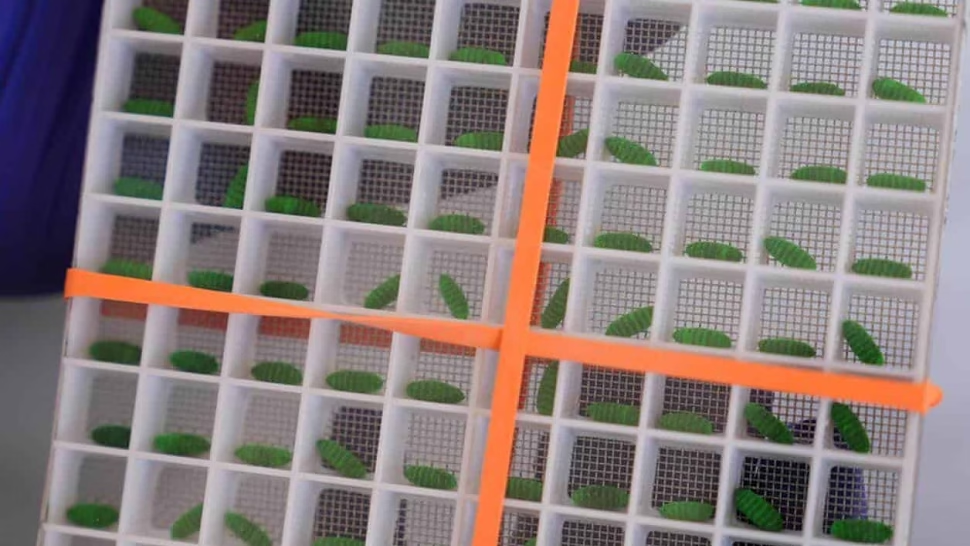
The governments of Mexico and the United States launched a plant on Saturday in Chiapas to produce sterile flies, with the aim of stopping the advance of the screwworm. The plague has affected binational trade and raised alarms in both countries.

The complex is activated after the first case of the parasite was detected in the United States more than three weeks ago. So far, 20 infections have been confirmed in the United States, which motivated Donald Trump’s government to approve an additional $83.8 million to combat it.

The center is in Metapa de Domínguez, Chiapas. It represents the most recent effort in a collaboration that began last year. Mexico accumulates 1,907 active cases of screwworm.

The plant replaces one that closed in 2013, when Mexico was declared free of the pest and a binational agreement in force since 1972 ended. It now produces sterile flies as a biological control: it interrupts the reproductive cycle of Cochliomyia hominivorax, whose larvae invade tissues of warm-blooded animals, including humans.

During the reopening, President Claudia Sheinbaum stated:

“It is the conviction that development cooperation produces results. Animal diseases, pests and food security challenges know no borders. The best response is to add capabilities, share experience and build solutions.”

Also present were the Secretary of Agriculture of the United States, Brooke Rollins, and Ambassador Ronald Johnson, who announced the additional $83.8 million to reproduce more sterile flies in Mexico and reinforce prevention.

The joint investment to convert the old plant was 61 million dollars. It will produce 100 million sterile flies weekly, according to Senasica. Currently, Mexico is supplied from Panama, and another plant is being built in Texas that will begin operating next year.

Livestock farmers consider that the reopening is late. The first outbreaks emerged almost two years ago and the estimated production could be insufficient. Omar Ornelas, a rancher from Tuxtla Chico—a neighboring municipality—has an infested animal:

“I hope that now with the inauguration of the plant there will be support for the livestock area, because we have closed the United States border for the export of livestock and it affects the price of beef.”

To treat his cattle he has used homemade recipes, from veterinary products to diesel and lime.

The commercial impact is severe. On June 9, after infections in Texas, Mexico suspended the import of cattle, horses, sheep, goats and other species from the United States. In the last 18 months, the US closed the passage to Mexican cattle on three occasions. The most recent closure occurred on July 9, after locating an infected cattle in Ixhuatlán de Madero, Veracruz.

Continue reading