The tricolor falls apart: goodbye to 96 years of power in the Senate
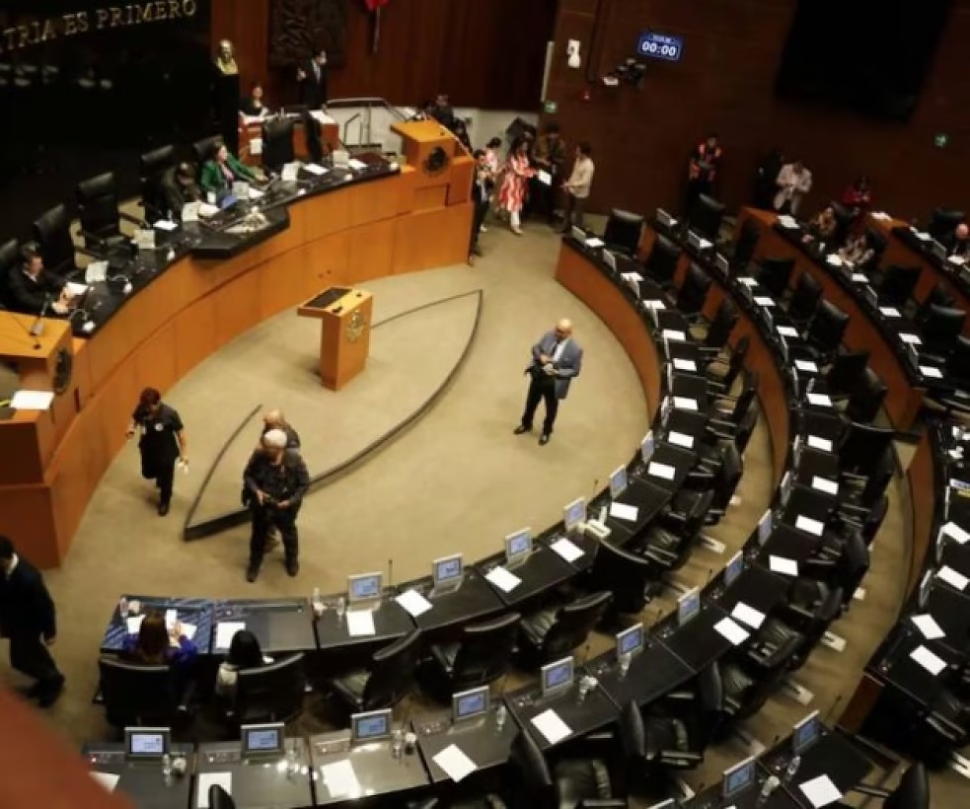
Well, welcome to another chapter of “Hunger Games: Upper House Edition”. It turns out that the PRI, that party that your grandparents still remember with nostalgia (or with terror, depending on the family), has just suffered a blow so hard that it even gave us collective grief. After the resignation of Senator Néstor Camarillo –yes, the same one who decided that he prefers to go have a coffee rather than continue on the sinking ship–, the PRI was left with only 13 senators. And what does that mean? Basically, the party that for almost a century had more power than an influencer with 10 million followers, now cannot even occupy a position on the Senate Board of Directors. Doesn’t it seem like the end of a historical soap opera?
So that you understand the magnitude of the drama: the PRI now has fewer seats than the Green Party. Yes, the same one that we all associate with little turtles and ecological propaganda of dubious credibility. The PVEM now has 14 senators, one more than the once omnipotent tricolor. It’s as if in a dance competition, the team that always won overwhelmingly now doesn’t even make it to the finals. The world is upside down, friends.
And now what? The harsh political reality
But let’s be serious (a little, at least). Camarillo’s departure was not anything. The senator not only resigned: he did so with a speech that seemed straight out of a Netflix movie. He declared himself “democrat”, “statesman” and announced that he was going to dedicate himself to a “true citizen agenda”. In other words, he basically said: “I’m leaving because nothing useful is done here anymore.” And who can blame him, right?
The most ironic thing about all this is that, according to article 62 of the Organic Law of Congress, the Board of Directors is integrated with the largest benches. In other words, the PRI, for the first time in 96 years – since the times of the National Revolutionary Party (PNR) – is left out of the distribution of the cake. They didn’t even get crumbs. Not a symbolic position. Nothing. Zero. Zip.
To put it in millennial terms: it is as if Meta were no longer among the five most important tech companies. Or as if Bad Bunny stopped having relevance in music. It just doesn’t add up. The PRI was synonymous with legislative power, with under-the-table agreements, with “fingers” and with structures that seemed eternal. Now, it is a shadow of what it once was.
What the fuck is the Senate doing and why should you care?
Okay, okay. I know that sometimes politics sounds like that stuff your uncles talk about at family gatherings while you just want to eat your pozole in peace. But this does matter. The Senate is not just a club of well-suited gentlemen and ladies: it is where laws are approved, international treaties are ratified and things as important as who is going to be ambassador or how the country’s resources will be managed are decided. The Board of Directors is basically the team that runs the sessions: the president and his vice presidents are the ones who bring order to the chaos (or at least try to).
The PRI losing its place there is not just a symbolic issue: it is a real change in the power dynamic. It means that negotiations, agreements and even the legislative agenda will have to be built without one of the actors who for decades pulled the strings. It’s as if suddenly, in your group of friends, the one who always chose which club to go to is left out of the group WhatsApp. Nothing will ever be the same.
Not to mention that the vice presidency that the PRI had – headed by Senator Karla Guadalupe Toledo Zamora– is now up in the air. Who will occupy it? The PVEM? Brunette? The PAN? It’s like a season of House of Cards but with more drama and less acting.
And in case anyone doubts it, this is not pure gossip. The numbers don’t lie: before Camarillo’s resignation, the PRI and the PVEM each had 15.38% representation on the Board of Directors. Now, those percentages will be redistributed, and the tricolor is left out of the game. It’s pure mathematics, friends. And mathematics has no political agenda.
So you know: the next time someone says that your vote doesn’t matter or that politics is boring, tell them this story. Because what happened here is not just another gossip: it is the end of an era and the beginning of something new. And who knows, maybe it will even be for the better.
Are you surprised by this turnaround in the legislative power? Share this note and let’s make the debate become a trend. And if you want more analysis with a touch of acid humor (and a lot of truth), be sure to explore our content.