Laura Itzel Castillo assumes the presidency of the Mexican Senate

The architect takes office with majority but not unanimous support, marking the beginning of a new legislative stage.

A New Directorate in the Senate of the Republic

The plenary session of the Senate of the Republic carried out this Friday the election of its Board of Directors, resulting in the appointment of Laura Itzel Castillo as the new president of this legislative body. The electoral process took place with the notable absence of 22 parliamentarians, among whom the national leader of Morena, Adán Augusto López Hernández, stood out, a fact interpreted by political analysts as a significant snub within the majority bloc itself.

The support for Castillo, although majority, did not reach unanimity. Of a total of 106 senators present, 101 cast their vote in favor of his candidacy, which reflects a broad consensus but also reveals political fissures within the chamber. The new president, daughter of the renowned engineer and politician Heberto Castillo, immediately took protest, visibly moved and surrounded by slogans of support from her coreligionists.

RelatedLaura Itzel Castillo assumes the presidency of the Mexican Senate

Inaugural Speech and Assumed Commitments

From his first message on the platform, Castillo made his affiliation and ideological commitment clear. “My commitment to the left and to this movement (Fourth Transformation) is absolute,” he proclaimed emphatically. In his speech, he praised the figures of former president Andrés Manuel López Obrador and the current president, Claudia Sheinbaum, framing their management within the nation project that, according to what he stated, the Mexican people have strongly supported at the polls.

As an architect graduated from the National Autonomous University of Mexico (UNAM), Castillo called to raise the quality of parliamentary debate. “I call for this Senate to be a space for real and high-level debate where ideas flow freely without hatred, without racism, without classism and without machismo,” he stated, thus establishing a tone of plurality and respect as a hallmark of his presidency. He expressly thanked the support of the parliamentary coordinators of the different benches that make up the Upper House.

Context and Relevance of the Transition

This Friday’s session also marked the conclusion of the period at the head of the Board of Directors of Gerardo Fernández Noroña, who served in the position amid constant public scrutiny and questions about matters related to his personal assets. His departure occurred in a political environment full of expectations about the direction the new legislature will take.

The election of Laura Itzel Castillo is not an isolated event; It represents the consolidation of a new generation of leadership within the movement in power. His figure evokes the legacy of his father, Heberto Castillo, symbol of the Mexican left, at the same time that he projects himself as his own force within the structure of the 4T. His ability to generate consensus and conduct the work of the Senate in an environment of political polarization will be fundamental for the governability of the country and the approval of the key reforms proposed by the federal executive.

The immediate challenges for the new Board of Directors include the organization of the commissions, the definition of the priority legislative agenda and the establishment of fluid dialogue channels with the Chamber of Deputies and the Presidency of the Republic. Performance in these areas will be crucial to evaluate the effectiveness of this new stage in the conduct of the legislative branch.

Does this change in the leadership of the Senate seem relevant to you? Share this analysis on your social networks and tag those who should be informed. Explore more content on current national politics in our specialized section.
Controversy over an interview with Monsiváis reaches the Senate and the Palace

The republication of a 1999 interview unleashes accusations between the Executive and legislators.

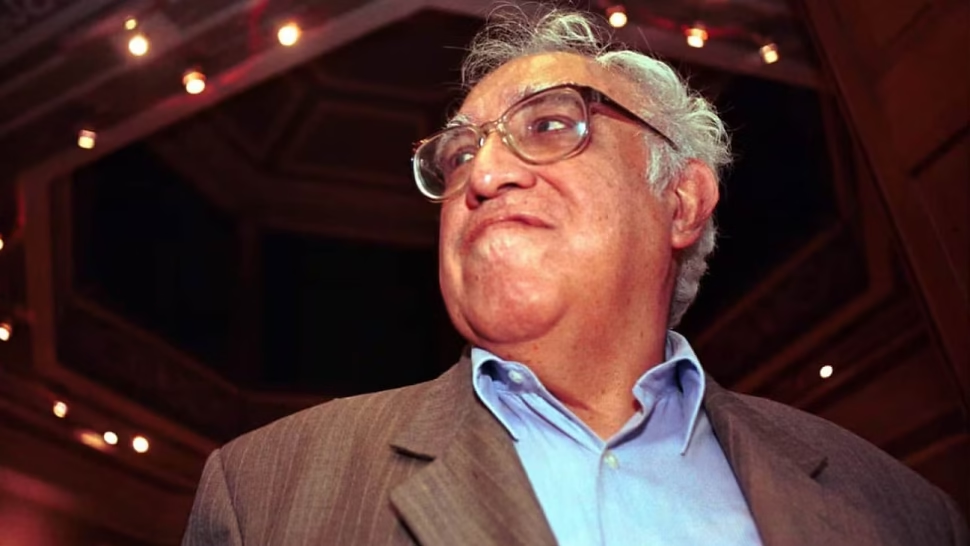
The republication of an old interview attributed to Carlos Monsiváis climbed to the center of the Mexican political debate this Wednesday. The issue was discussed both in the Senate and in President Claudia Sheinbaum’s morning conference.

The original text was written by journalist Edmundo Cázares in 1999 and recently republished by El Universal. It contains statements about the then head of Government Andrés Manuel López Obrador. Its veracity and context have been questioned, generating conflicting positions.

Sheinbaum describes the content as “grotesque”

During her conference, the president harshly criticized the publication. He described the content as “grotesque” and accused the medium of generating a controversy that distorts the tribute to the Mexican intellectual.

Reactions in the Senate

The issue also reached Congress. Senator Lilly Téllez read fragments of the text on the platform. In response, Gerardo Fernández Noroña rejected its use and maintained that it was a false publication with the intention of political attack.

The exchange reflects the polarization around the figure of López Obrador and the use of historical documents as partisan weapons.

Continue reading

PRI demands urgent action against violence in Guerrero

They denounce an incursion of armed civilians in Coyuca de Catalán; party calls for state intervention.

The national leadership of the PRI demanded that the Mexican State intervene urgently in response to the complaint by inhabitants of the Guajes de Ayala ejido, in Coyuca de Catalán, Guerrero. The residents reported the incursion of armed civilians into their community in the Sierra.

Call for safety

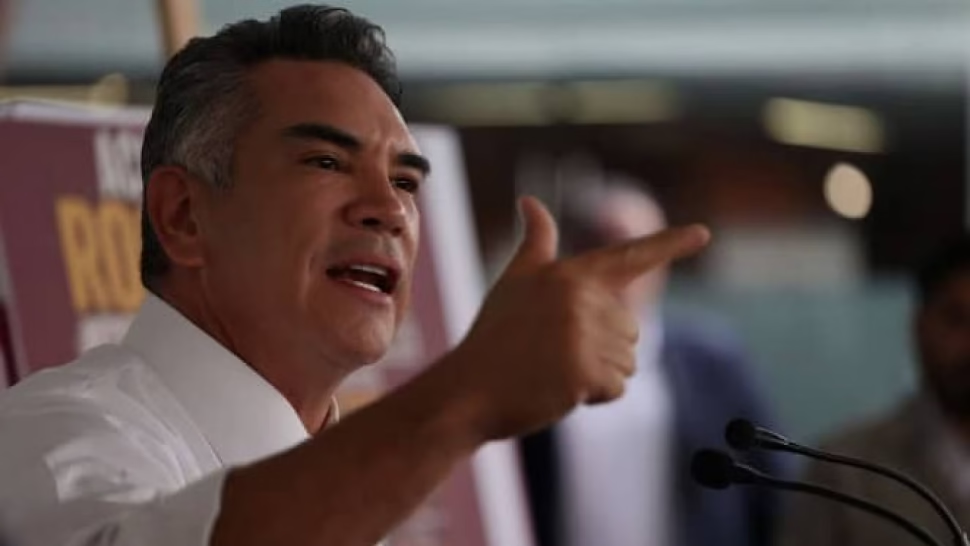
Alejandro Moreno Cárdenas, president of the party, asked the authorities to guarantee the safety of the families. He warned that these events should not be normalized due to the risk they represent for the civilian population.

The leader pointed out that in various communities in Guerrero they live under siege by armed groups. This has caused displacement, confinement of inhabitants and a constant climate of fear and uncertainty. He considered an immediate response from the State necessary.

Moreno Cárdenas also criticized the federal government for minimizing the situation of violence in the country. He affirmed that the population faces conditions of insecurity that require priority attention to restore the rule of law in the region.

Continue reading

Inflation in Mexico slows down and remains at Banxico’s goal

Inflation drops to 3.55% in the first half of June, within Banxico's target range.

Inflation in Mexico continues to decline. According to Inegi, it stood at 3.55% annually during the first half of June. This represents a drop of 0.11 percentage points compared to the second half of May.

With three consecutive months of deceleration, the indicator remains within Banxico’s target range (3% plus/minus one point). This level is key for purchasing power.

Pressures on core inflation

However, pressures remain. Core inflation—which reflects medium and long-term trends—was at 4.12%, with a biweekly increase of 0.19 points. Within this category, merchandise rose 3.65% annually and services, 4.57%.

Non-core inflation and seasonality

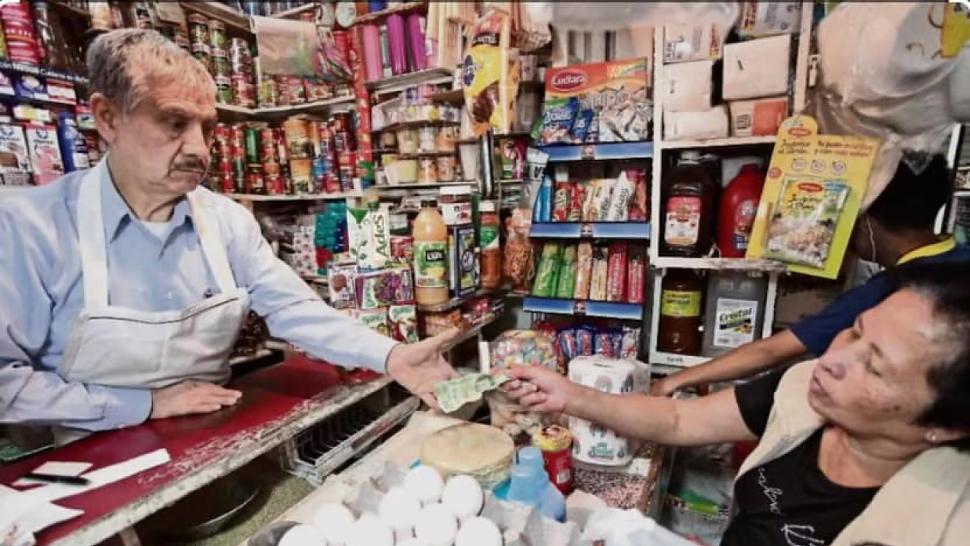
In contrast, non-core inflation slowed to 1.61% annually, driven by the drop in agricultural prices. Products such as tomatoes, eggs and poblano peppers recorded significant decreases.

The report also reflected seasonal movements in tourist services, related to the summer and the Soccer World Cup. Air transportation, hotels and tour packages increased. Despite this, analysts foresee a favorable trend towards the end of the year.

Continue reading