Legislative Initiative to Combat Sexual Violence
The Senate of the Republic has positioned itself at the forefront of the institutional response to classify sexual abuse as a serious crime, placing this issue at the center of the priority legislative agenda. Senator Guadalupe Chavira de la Rosa, in her statement, classified as alarming the official figures provided by the federal government, which detail the existence of at least 25 thousand active investigation files for this crime in the nation, an indicator that reflects the magnitude of the challenge.
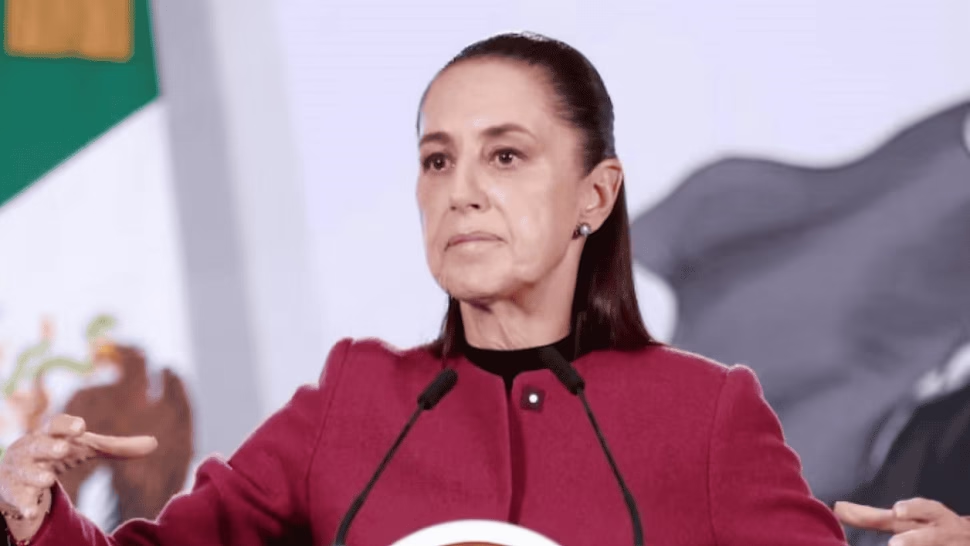
The definitive impetus for this initiative arose after the incident of harassment suffered by the President of the Republic, Claudia Sheinbaum, on the public road of the Historic Center. The Morena legislator stressed that the protection and guarantee of women’s rights constitutes a fundamental pillar of her party’s agenda. However, he stressed the prevailing need to establish robust federal legislation that allows moving from administrative sanctions to effective criminalization of harassment, thus creating a type of criminal offense approved throughout the national territory.
Components of the Comprehensive Plan and Criminal Aggravating Conditions
In the context of an interview, the also leader of the organization “Mujeres Tejiendo Historias” expressed her absolute support for the Comprehensive Plan against Sexual Abuse called by the president. He highlighted that the strategy is not limited exclusively to legislative modification to aggravate crimination, but also incorporates a structural strengthening of access to justice in specialized prosecutor’s offices and the mandatory implementation of the gender perspective in the courts. Added to this is the operation of the National Women’s Line at number 079, a crucial channel for care and assistance.
Senator Chavira de la Rosa was emphatic when pointing out: “It is time for women and to eradicate misogyny and the commission of these crimes. What happened to our president Claudia Sheinbaum, which we regret and condemn, must constitute a watershed to take decisive actions and raise awareness among the male population about the unrestricted respect that must be professed towards women. women.”
The legislator emphasized that the media themselves have documented an exponential increase not only in abuse, but also in sexual harassment in the country during the last decade, with figures that reach 905%, a situation that she described as unacceptable and that demands a forceful response from the Legislative Branch.
Technically, the reform proposal proposes the incorporation of two specific aggravating factors for the crimes of sexual abuse provided for in article 206 of the Federal Penal Code. The first would apply when physical violence is committed in the commission of the crime, and the second, when the aggression is perpetrated against a person in a vulnerable situation or a minor. The proposed sanctions range from six to 10 years in prison, complemented by up to 200 days of fine, thus seeking punitive proportionality that deters the commission of these crimes.
Institutional Commitment and Call to Action
“The president will hold working meetings with the gender equity commissions of the Congress of the Union. From the Legislative Studies Commission, we will provide all the necessary elements to enrich this debate, which must be an absolute priority given the escalation of cases in the country. It is about the integrity of our co-worker, our daughters, the housewives, the teacher who uses public transportation to go to her workplace, the university student who moves in the subway or the merchant who is attacked on public roads. The historic moment has arrived to declare Enough with the abuse!”, strongly emphasized Senator Guadalupe Chavira.
This technical-legislative analysis shows a coordinated effort to attack a social problem with deep structural roots. The combination of a more severe legal framework, with comprehensive public policies that strengthen institutions for the procurement and administration of justice, represents significant progress in building a safe environment for all women. The homologation of criminal types seeks to eliminate legal gaps and guarantee that, regardless of the federal entity, victims find the same standard of protection and justice. The success of this initiative will depend on the allocation of sufficient resources for the training of legal operators, the modernization of reporting systems and the execution of permanent social awareness campaigns that modify the cultural patterns that perpetuate gender violence.
Do you support this crucial initiative? Share this information on your social networks to help make the fight against sexual violence visible and stay informed about more legislative developments on our portal.