Europe and global powers urge dialogue in the face of nuclear escalation in the Middle East

While global powers call for calm, the geopolitical board looks like a game of Risk with real missiles.

When diplomacy tries to put out a fire with a glass of water

Imagine the European Union, China and Russia trying to mediate the conflict between Iran and the United States like that friend who arrives late to the party and finds the couch on fire. “Guys, let’s use nice words instead of bombs!” says Brussels while António Costa, president of the European Council, tweets his “deep alarm” as if it were an Instagram drama. Spoiler: no one likes it.

The US bombing of three Iranian nuclear facilities this Saturday turned the already tense game of geopolitical chess into a game of Jenga with dynamite. “Too many civilians will pay the price,” Costa warned, in an attempt to sound more convincing than an influencer promoting detox. Meanwhile, Kaja Kallas, the head of European diplomacy, repeats like a mantra: “Let’s negotiate, because war does not combine with our values (nor with our GDP).”

RelatedUS launches secret operation against Iran with 13-ton bombs

The E3 and its plan B: “Just in case, we have cookies for the negotiation”

Germany, France and the United Kingdom—the trio that has been playing Guess Who? with Tehran since 2003—urged Iran not to “do any more crazy things.” Friedrich Merz, German chancellor, gathered his security cabinet as if it were a WhatsApp group of panicked parents: “Someone call Washington!” Meanwhile, Jean-Noël Barrot, the French minister, clarified on X (formerly Twitter): “We have nothing to do with this bombing, eh.” #NotMyWar.

In London, Keir Starmer uttered the phrase of the year: “Iran cannot have nuclear weapons.” Thank you, Captain Obvious. The curious thing is that no one mentions that the Non-Proliferation Treaty now seems like a rental contract broken by all the tenants.

Russia and China: the “friends” who always bring gasoline to the fire

Moscow, in its role as devil’s advocate with the UN seal, called the attack a “violation of international law.” Ironic, coming from someone who invaded Ukraine. China, for its part, condemned the United States with the same energy with which it manufactures iPhones: quickly and without blinking. “Blame Israel!” Türkiye chanted between sips of tea, because Erdogan knows that in this chaos, he who does not cry does not suck.

The moral of this geopolitical reality show: everyone asks for diplomacy, but no one lets go of the red button. And meanwhile, civilians in the Middle East look at the sky wondering if the next drone will carry bombs or a “peace and love” tweet.

Are you outraged by this war circus? Share this article and join the global conversation. Because as a millennial would say: “If it’s not on networks, it doesn’t exist.”
Leo XIV asks the US to renew commitment to freedom

The pope urged to maintain the legacy of openness and welcome.

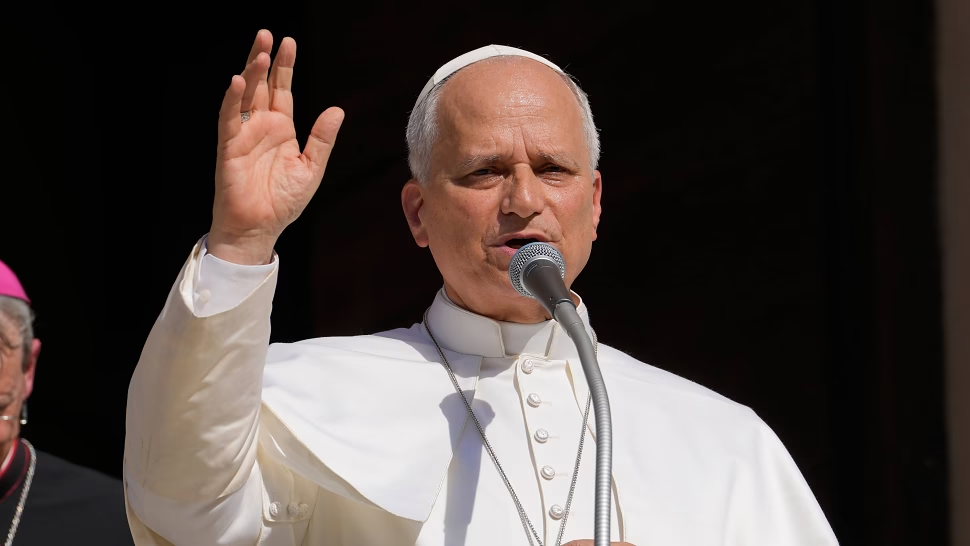
On the eve of the 250th anniversary of the American Declaration of Independence, Pope Leo XIV sent a message from Rome. Through a video broadcast to the National Constitution Center in Philadelphia, he called on the country to renew its commitment to freedom, equality and human dignity.

The pontiff, the first born in the United States, received the 2026 Medal of Freedom. The recognition distinguishes those who promote freedom and human rights in the world. The organizing institution highlighted its track record in favor of freedom of religion, conscience and expression, values ​​of the First Amendment.

Message from the pontiff

In his speech, Leo XIV recalled that the United States was built by generations of immigrants who found opportunities to forge a better future. He pointed out that this tradition of openness turned the country into a benchmark of freedom. He asked to keep that legacy alive through respect and welcoming those who seek a new opportunity away from war, poverty or persecution.

The pope stressed the importance of protecting life and defending the fundamental rights of all people. He urged not to forget that the greatness of a nation is measured by its ability to welcome the most vulnerable. The message, brief but forceful, was received with respect by those attending the constitutional center.

Continue reading

Parrot survives 9 days under rubble in Venezuela

A parrot was rescued alive after spending nine days under the rubble in La Guaira.

The rescue

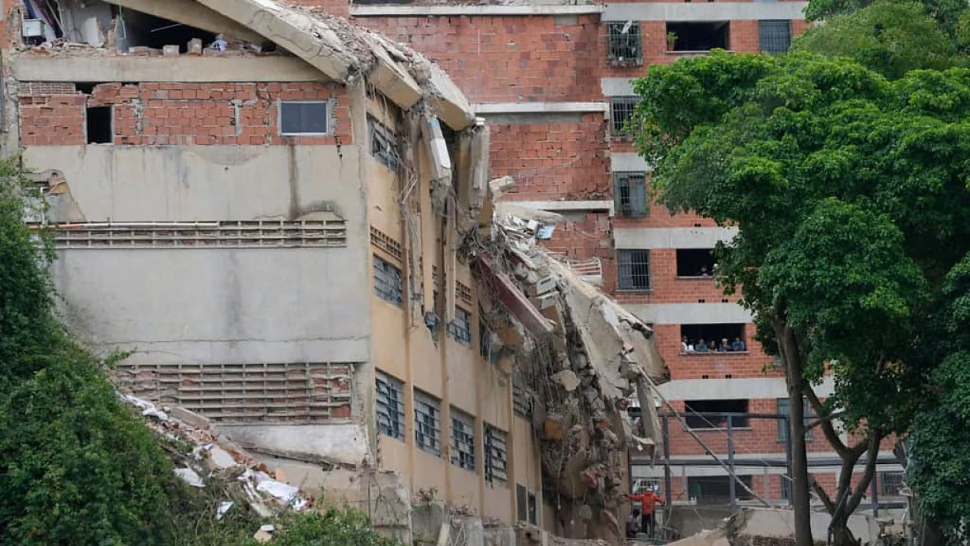
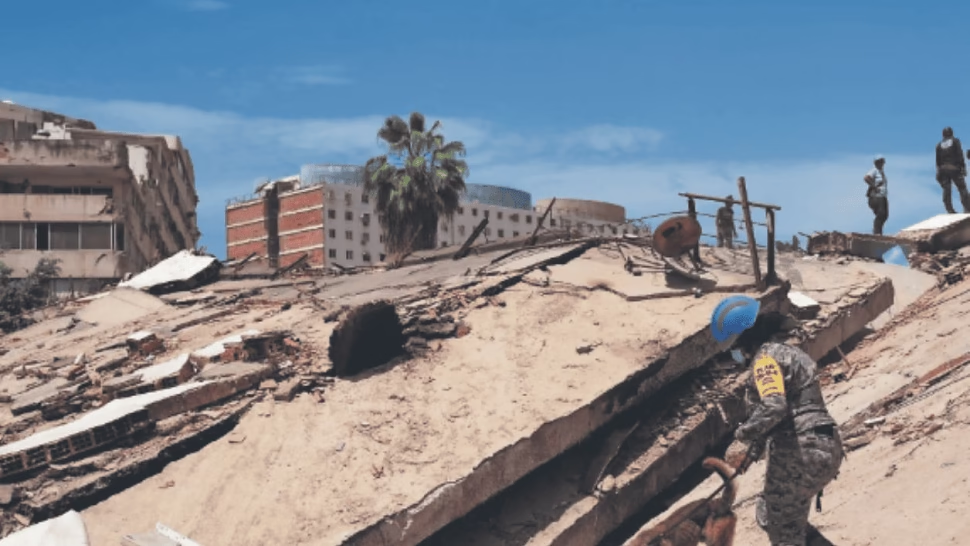
A parrot was found alive nine days after the 7.2 and 7.5 magnitude earthquakes that shook Venezuela on June 24. The bird was located under the rubble of a building in La Guaira, in department number 8, identified as Opp033. The Miranda State Firefighters managed to help him.

The video of the rescue went viral. Upon being removed from the rubble, the parrot received water and the rescuers named him “Panchito.” “My child, you survived,” one of the firefighters can be heard saying while the bird drinks desperately, according to images shared by the team.

Context of the tragedy

Official figures to date report more than 2,200 deaths, 11,000 injured and nearly 50,000 missing, according to the UN. The parrot was the only survivor of that department, which generated commotion on social networks.

The rescue team decided to rename him “Panchito” after welcoming him outside. The case adds to the survival stories that have emerged after earthquakes in the region.

Continue reading

Earthquakes in Venezuela: humanitarian crisis and political struggle

Earthquakes in Venezuela unleash political and humanitarian crisis as Delcy Rodríguez's interim mandate expires.

The consecutive earthquakes that shook Venezuela on June 24 left at least 2,645 dead and more than 12,500 injured, according to official figures. The catastrophe has tested the interim president, Delcy Rodríguez, whose interim term expires this Friday. While she defends her government’s response, exiled opposition leader María Corina Machado – Nobel Peace Prize winner – seeks to return to the country to press for a democratic transition.

Government response and political tensions

In his first press conference after the earthquakes, Rodríguez attributed the criticism to “media prepared in laboratories” and stated that rescue teams were deployed immediately. However, residents reported that during the first 48 hours there was no official support or heavy machinery. The government claims to have sent thousands of rescuers and 11 international field hospitals, and approved a reconstruction fund.

Machado, from Panama, maintained that the government response showed “the total absence of the State” and called for trust in alternative leaderships. His party has created a database with 36,000 missing people and mobilized volunteers to collect donations. Machado was prohibited from running in 2024, when Nicolás Maduro claimed victory, although opposition counts show that Edmundo González, his candidate, won by more than 2 to 1.

The United States has backed Rodríguez since Maduro’s capture in January, praising his oil sector reforms. Two U.S. officials, speaking on condition of anonymity, told The Associated Press that Washington discouraged Machado from returning after the earthquakes, fearing he would lead protests. Rodríguez closed commercial air traffic to Caracas, canceling humanitarian aid flights.

Expiry of mandate and uncertain future

The Venezuelan Constitution establishes that the president’s temporary absences can be covered by the vice presidency for up to 90 days, extendable for another 90. That period expires today, but the authorities have not announced what they will do. The National Assembly, controlled by Rodríguez’s party, can call early elections if it declares the position vacant.

International organizations have pledged hundreds of millions of dollars in aid. Doctors Without Borders warns that the magnitude of the suffering is still emerging. “We know there are still bodies under the collapsed buildings,” said Andreas Spaett, the group’s Venezuela coordinator. “This is one of the great natural disasters in human history.”

Continue reading