Israel and Iran collide in a nuclear fight with drones and retaliation

The war escalation in the Middle East reaches a critical point with high-risk operations and cross-threats.

When geopolitical drama overtakes “House of Cards”

It seems that someone in the Middle East decided that 2024 needed more chaos than usual. Israel, in a move that mixes Mission Impossible with an episode of 24, launched a lightning strike against Iranian nuclear facilities. The pretext? Prevent Tehran from getting close to the atomic bomb. The Iranian reaction? A swarm of drones (yes, like in Black Mirror, but with less satire and more missiles).

Operation: “Did you really think this wasn’t going to explode?”

On Friday, Israel deployed some 200 smuggled planes and drones (because, of course, what’s better than a bit of Bourne-style espionage?). Key targets: nuclear, general and scientific facilities. Among those affected, three senior Iranian commanders, because nothing says “we are watching you” like eliminating the heads of the missile program.

RelatedTrump plays mediator as Israel and Iran accuse each other of violating truce

Iran, which is not far behind in this war reality show, responded with more than 100 drones towards Israel. Result? Intercepted (for now), but the tension has already reached Twitter levels on election day. Meanwhile, Ayatollah Khamenei promised “severe punishment”, which sounds more like a movie villain than a diplomatic speech.

USA: the friend who tries to put out the fire with gasoline

Washington, in its role as “concerned parent”, evacuated diplomats from Iraq and moved ships to the area. Trump, from his corner at Truth Social, blurted out a “guys, please negotiate,” as if this were a schoolyard fight and not a conflict with nuclear weapons involved.

The UN, as always, asked for calm (does anyone listen to them?). Meanwhile, the IAEA confirmed damage to Natanz, Iran’s nuclear jewel, and monitors radiation. Just in case, the American embassy in Jerusalem ordered shelter, because nothing is more relaxing than a security alert on a Friday night.

And now what? Spoiler: nobody knows

Netanyahu justified the attack as “necessary for Israel’s survival”, although some suspect it is also a distraction from its internal problems. The Israeli opposition, for once, supported the move, but if Iran responds forcefully, public opinion could change faster than a trending topic.

The only thing that is clear is that this does not end here. Iran has already announced more centrifuges (because why stop?), and the region is on the brink of all-out war. Meanwhile, the world watches with popcorn in hand, waiting for the next chapter of “Who will launch the next missile?”

Are you left wanting more geopolitical chaos? Share this article and continue exploring our coverage of international conflicts. Because, let’s be honest, this is more addictive than a Netflix series.

Israel lanza ataque fulminante contra instalaciones nucleares de Irán; Teherán responde con drones

Canada cancels ceremony with the US due to Trump’s tariff threats

Ottawa cancels joint event with Washington due to tariff tensions. The bridge opens on July 27.

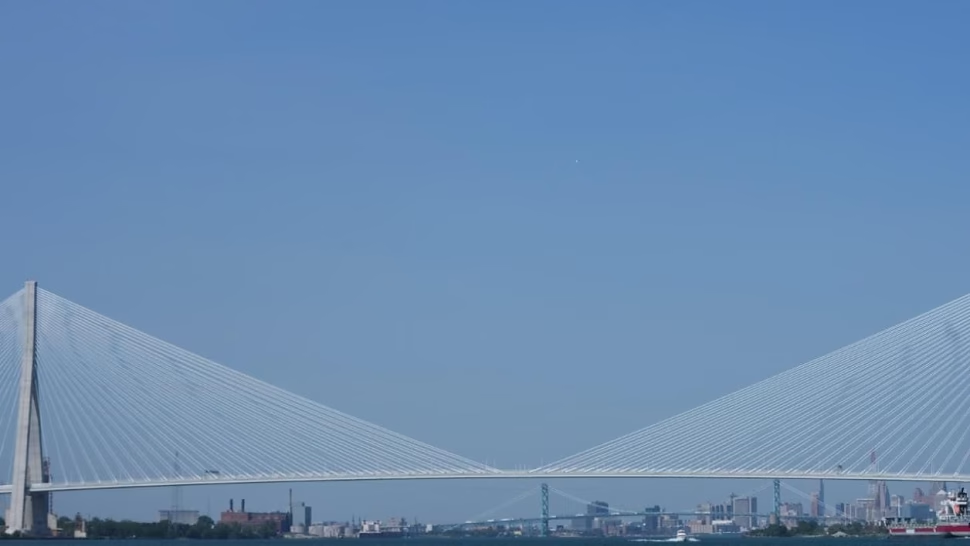
The Government of Canada decided to cancel the joint ceremony with the United States for the inauguration of the new Gordie Howe International Bridge, which connects Windsor with Detroit. The measure responds to recent tariff threats from President Donald Trump.

“In light of the trade actions threatened by the United States this week, it would be inappropriate to move forward with a celebratory event between the two countries,” said Jenna Ghassabeh, spokesperson for Canadian Infrastructure Minister Gregor Robertson.

The binational event was scheduled for July 24 with authorities from both countries. However, Ottawa will maintain the opening date to traffic on July 27, with an exclusively Canadian celebration.

Commercial tension and key work

The decision comes after Trump announced 50% tariffs on various Canadian imports, arguing alleged discriminatory treatment of American cars, alcoholic beverages and dairy products.

The Gordie Howe Bridge required an investment of $4.7 billion. It is one of the most relevant infrastructure works in North America and seeks to relieve the flow of the Ambassador Bridge, through which 126 billion dollars in merchandise circulated during 2023.

Despite the suspension of the joint event, the border crossing will begin operating as scheduled.

Continue reading

The official number of deaths from earthquakes in Venezuela rises to 5,346

5,346 dead and 16,740 injured: new official balance after the earthquakes of June 24 in Venezuela.

The Venezuelan authorities updated this Tuesday the official balance of the double earthquake registered on June 24. The death toll rises to 5,346 after adding 68 additional deaths in the last few hours.

Jorge Rodríguez, president of the National Assembly, reported that the injured remain at 16,740. A total of 17,265 people remain homeless, while 23,122 victims remain housed in 107 temporary camps. So far, authorities have provided care to 128,324 affected families.

Material damage and disappearances

The official report registers 856 buildings damaged and 190 collapsed. Civil society organizations estimate 29,460 people missing under the rubble, a figure that the government has not officially confirmed.

This new count is released 27 days after the earthquakes that generated a large-scale humanitarian emergency in the country. Rodríguez disseminated the data through his Telegram channel, where he detailed the progress in the care work for those affected.

The authorities maintain active search, rescue and humanitarian assistance tasks in the impacted areas. Thousands of people continue to depend on state aid and international cooperation to face the consequences of the tragedy.

Continue reading

The skeleton of a Triassic giant is restored in Poland

Volunteers restore a 6-meter-long prehistoric amphibian skeleton in Warsaw.

Volunteers restore the fossil of a prehistoric colossus in Warsaw

At the Copernicus Science Center in Warsaw, a team of more than 2,000 volunteers is working on restoring the skeleton of a Mastodonsaurus, a giant amphibian that lived 240 million years ago. With chisels, brushes and protective glasses, they remove the rock that covers the bones millimeter by millimeter.

Visitors watch through a window as the work progresses. The skeleton measures almost 6 meters and weighs 1,300 kilograms. It will be the largest of its kind displayed in a museum in the world, according to Tomasz Sulej, a paleontologist at the Polish Academy of Sciences.

An experience open to citizens

The volunteers are not scientists, but managers, cleaning staff and tattoo artists, among others. They receive training and protective equipment before supervised two-hour sessions. “I imagine that those bones were underground for 240 million years and I am the first human being to touch them,” commented Tatyana Kozyk, team coordinator.

The specimen was discovered in southern Poland in 2023 by Sulej and Wojciech Pawlak. Unlike other finds in Germany and Russia, which measure 2 to 3 meters, this specimen offers new information about the species. “The structure of the body is different from what we knew,” Sulej said.

A message of natural resilience

Dorota Serafín, a 51-year-old manager, described the experience as “relaxing and philosophical, even mystical.” The Mastodonsaurus lived after the largest mass extinction on the planet, just before the rise of the dinosaurs. For Sulej, his story sends a message of hope in the face of climate change: “Nature and life always find ways to survive.”

The restoration will be completed in October or November. The skeleton will then be displayed to the public at the same center.

Continue reading