A destiny woven between mud and glory
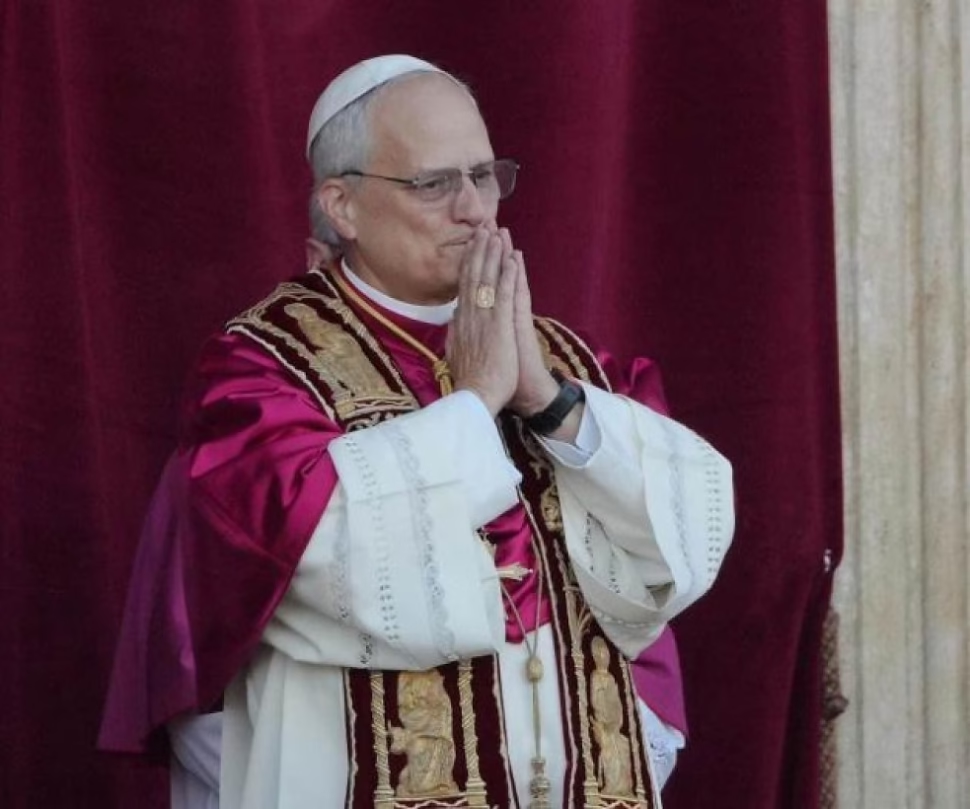
The world held its breath that Thursday, May 8, 2025, when Robert Prevost, the humble missionary who defied storms and pandemics, emerged on the balcony of St. Peter’s Basilica as Leo XIV. He wasn’t just a pope; He was a living symbol that miracles still dwell among us. The first pontiff born in the United States, but forged in the wild valleys of Peru, where torrential rains and human pain carved his soul.
The saint who walked among the forgotten
Janinna Sesa, a witness of his delivery at Caritas Peru, still trembles when remembering it: “He did not rest until he got not one, but two oxygen plants when COVID-19 was drowning our people.” Prevost was not a palace bishop; He was the man who fixed trucks with his own hands and slept on the floor during vigils, like on that night in 2018 when Francisco visited Peru. The poor called him “the Saint of the North”, a title he carried with the simplicity of someone who knows that holiness is measured in actions, not in words.
His promotion was no coincidence. Francis, the first Latin American pope, saw in him a kindred spirit: he sent him to Chiclayo in 2014, naturalized him as a Peruvian in 2015, and in 2023 catapulted him to the Vatican to direct the Pontifical Commission for Latin America. There, among shadows and murmurs, Prevost orchestrated a silent revolution: he incorporated three women in the selection of bishops, a masterstroke against the traditionalists who still resisted change.
The conclave that changed the course of history
The Reverend Alexander Lam, his fellow Augustinian, revealed the best kept secret: “He was the man the Vatican needed, but not the one it deserved.” As the bells of Lima tolled in ecstasy, the cardinals realized that they had chosen more than a leader; They had anointed a bridge between two worlds. A man who spoke Italian on the balcony, but whispered comfort in Spanish to the crowds, deliberately avoiding English to set a new course.
His inaugural speech resounded like thunder: “A church with open arms, which builds bridges and not walls.” A declaration of war against the division that fractured the American Church, where conservatives and progressives fought ideological battles. Natalia Imperatori-Lee, an expert in religious studies, summed it up this way: “It is the dawn of a different American Catholicism, where social justice is no longer optional.”
While Rome celebrated, in Chiclayo, Father Purisaca remembered the cardinal who had breakfast laughing with his priests, “handling global problems with an unbeatable smile”. And in the streets of Lima, teacher Isabel Panez looked at the sky, begging for the Saint of the North to return: “He is our dad as much as theirs.”
Today, Leo XIV does not rule from a throne, but from the legacy of a man who turned mud into foundations and crises into opportunities. The Church will never be the same.
Did this story move you? Share it and join the conversation about the future of faith. Explore more content about the leaders who are transforming the world.