Robert Francis Prevost is elected as the new Pope of the Catholic Church

A historic conclave elects the first American pontiff after an agile and multicultural process.

A milestone in the history of the Vatican

Cardinal Robert Francis Prevost, 69 years old and originally from Chicago, has been designated as the 267th Pope of the Catholic Church, adopting the name Leon XIV. This election marks a historic moment, not only because of his nationality—being the first American pontiff—but also because it reflects the growing diversity within the college of cardinals. The process, carried out in the Sistine Chapel, concluded after four votes, exceeding the required two-thirds (89 votes) with unusual speed by recent standards.

A multicultural and agile conclave

The conclave of 2025 has been classified as the most multicultural in history, with 133 cardinals representing various regions of the world. This plurality influenced the election of Prevost, whose career ranges from missionary work in Peru to key roles in the Roman Curia. Comparatively, the process was more expeditious than previous ones: in 2005, Benedict XVI was elected in 24 hours (four votes), while in 2013, Francis required five rounds.

RelatedCelebrities say goodbye to Pope Francis with emotional messages

The formal announcement was made by Protodeacon Dominique Mamberti from the balcony of St. Peter’s Basilica, using the traditional Latin formula: “Annuntio vobis gaudium magnum: habemus Papam!”. This ritual, loaded with symbolism, underlines the continuity of an institution with two millennia of history.

Profile of the new pontiff

Robert Francis Prevost has developed a notable ecclesiastical career. As prefect of the Dicastery for Bishops, he oversaw key appointments at a global level, a role that gave him deep knowledge of pastoral needs on different continents. His connection with Latin America is particularly relevant: after years as a missionary, he was appointed archbishop of Chiclayo (Peru) in 2014, where he promoted social reforms until his transfer to Rome in 2023.

Analysts highlight his balance between tradition and pragmatism, as well as his ability to mediate between factions within the Church. His election could be interpreted as a bridge between the most conservative and progressive visions, especially on issues such as the decentralization of the Vatican and the focus on marginalized communities.

Context and immediate challenges

The Catholic Church faces complex challenges: from secularization in Europe to the persecution of Christians in Asia and Africa. Prevost must also address Vatican financial reform and demands for transparency. His experience in diocesan management and his knowledge of ecclesial structures give him unique tools for this task.

The appointment also reflects the legacy of Francisco, who closely followed his career. However, Leo XIV is expected to put his own stamp, possibly prioritizing synodality and interreligious dialogue, themes he has defended in previous speeches.

What’s next? After the investiture ceremony, the new Pope will begin his Petrine ministry in a polarized world. Its ability to unite the faithful—especially the new generations—will be key to the future of the institution.

Explore more about this historical milestone and share your reflections on social networks with #NuevoPapa. Discover detailed analyzes in our Internacional section.
1,430 dead and 3,238 injured left by earthquakes in Venezuela

Official balance reports 1,430 deaths and more than 3,000 injured after two earthquakes in Venezuela.

Official figures after the earthquakes in Venezuela

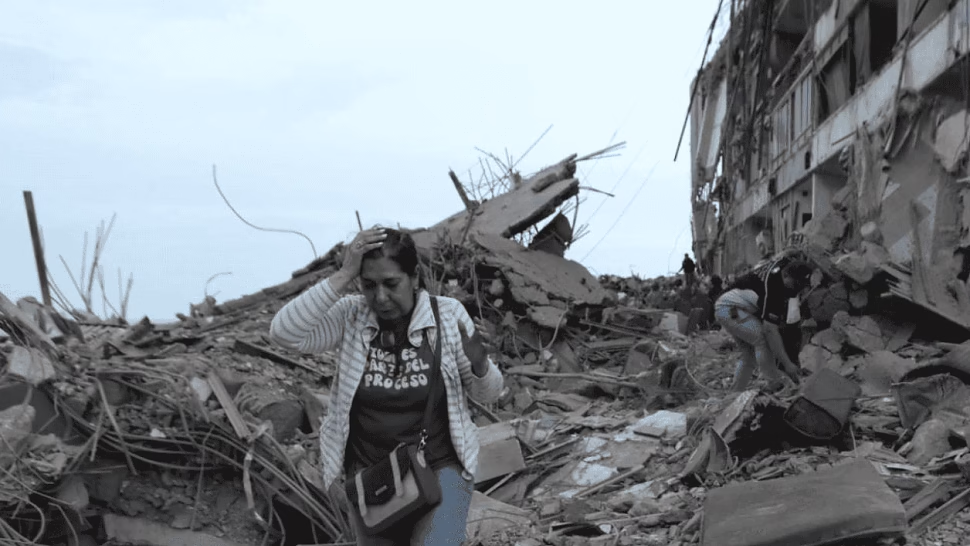
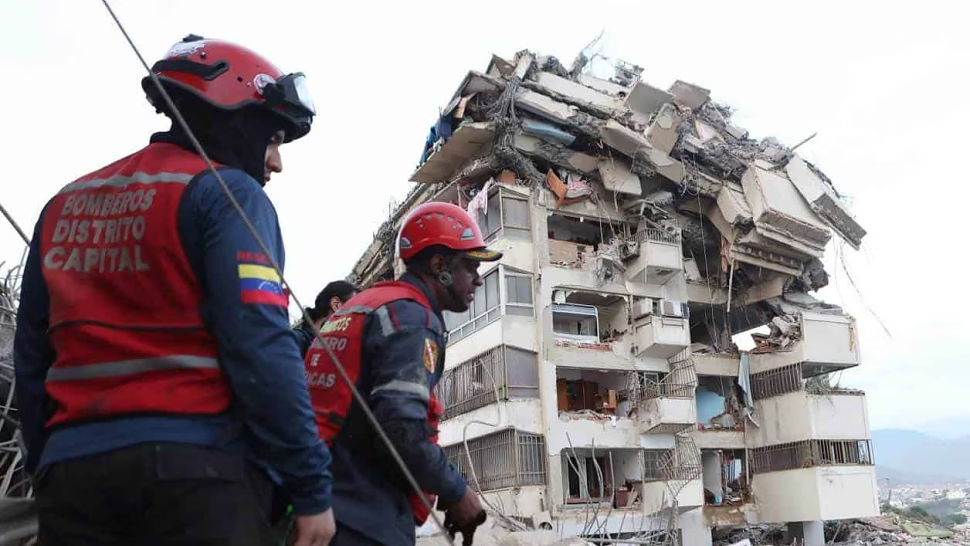
The president of the National Assembly, Jorge Rodríguez, updated the balance of the two earthquakes that shook the country. So far there are 1,430 deaths and 3,238 injuries. Search and rescue efforts continue in the most affected areas.

Rodríguez specified that 3,142 families were affected and are being cared for in shelters distributed in the seven affected states. In addition, 430 aftershocks of the earthquakes have been recorded.

According to the open online platform, the missing number 50,947. The official, brother of interim president Delcy Rodríguez, reiterated the call to citizens not to enter La Guaira and deposit their aid in authorized collection centers.

Continue reading

La Guaira: smell of decomposition and slowness in rescues after earthquakes

After 72 hours of the earthquakes, activists report unrecovered bodies and little official response.

La Guaira: 72 hours after the earthquakes

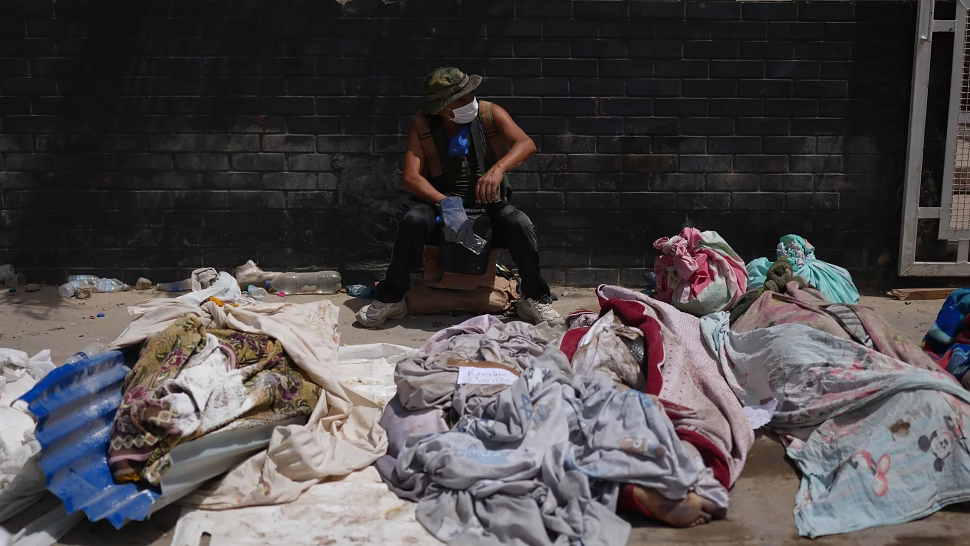
In Caraballeda, a residential area of La Guaira, the smell of decomposition was clearly perceived on Friday night. The first 72 hours after the earthquakes had passed, a key period for life rescues.

Activists from Provea, the oldest human rights NGO in Venezuela, confirmed to ANSA that during a tour of that area “we smelled decomposition (a sign of unrecovered bodies under rubble).” In addition, they pointed out that “there are few body recovery units.”

72 hours after the two earthquakes that devastated the region, activists observed “bodies that have not yet been transferred with dignity.” They recalled that “the State has the obligation to guarantee dignified recovery operations for each victim and their families.”

The earthquakes, magnitude 7.2 and 7.5, occurred consecutively this Wednesday, according to the United States Geological Survey (USGS). The epicenter was located in Yaracuy, about 300 km west of Caracas, but La Guaira, just 30 km from the capital, suffered the greatest structural impact.

The head of Humanitarian Affairs of the UN, Tom Fletcher, estimated that more than 50,000 people were missing. Journalists and observers indicated that the majority is concentrated in La Guaira, where images on networks show numerous lifeless bodies.

Journalist León Hernández, who was in La Guaira on Friday, told ANSA: “I was there… there are really thousands. This Friday night the key 72 hours for rescues were completed.” He added that “in many collapsed buildings, only civil servants and volunteers have been in charge of continuing to rescue people.” He explained that “the damage is of enormous proportions, thousands of victims. I saw complete buildings from which only one person was taken alive.”

This Saturday, interim president Delcy Rodríguez said that seven states were affected, but that the catastrophe hit La Guaira. The government reported the sending of machinery and military personnel, and the closure of access to La Guaira since Friday night, justifying it for reasons of order and security. However, local activists and journalists question the prioritization and insufficient response in the first 72 hours.

Thousands of victims remain in makeshift shelters or on the streets for fear of aftershocks. The combination of debris, heat (up to 40°C) and unrecovered bodies creates an increasing health risk. The families demand transparency in the figures, dignified access to the bodies and a state response in line with the scale of the catastrophe.

Continue reading

La Guaira: 72 hours of uncertainty after the earthquakes

The smell of decomposition and few rescue teams mark the area most devastated by the earthquakes.

Rescues in La Guaira: 72 hours of uncertainty

72 hours after the two earthquakes that shook northern Venezuela, the La Guaira area faces a humanitarian crisis. Activists from Provea, the country’s oldest human rights organization, report the smell of decomposition and few body recovery units.

“We smelled decomposition—a sign of unrecovered bodies under rubble—and there are also few body recovery units,” they told ANSA after a tour of the area.

The earthquakes, magnitude 7.2 and 7.5 according to the USGS, occurred consecutively. The epicenter was located in Yaracuy, 300 km from Caracas, but La Guaira, just 30 km from the capital, suffered the greatest structural impact. The UN, through Tom Fletcher, estimated that more than 50,000 people were missing.

Journalist León Hernández, present on Friday, described the magnitude of the tragedy:

“I was there… there are really thousands. This Friday night the key 72 hours for rescues were completed. In many collapsed buildings, it has been only civil servants and in many cases volunteers in charge of continuing to rescue people.”

He added that thousands of victims were left in makeshift shelters or on the streets for fear of aftershocks. Temperatures reach 40 degrees Celsius, combining debris and unrecovered bodies, creating a growing health risk.

Interim President Delcy Rodríguez reported damage in seven states, but the tragedy is concentrated in La Guaira. The government announced the sending of machinery and closing access from Friday for order and security. However, activists question the insufficient response in the first critical hours.

The families demand transparency in the figures, dignified access to the bodies and a state response in line with the catastrophe. The search efforts continue, but the slowness and scarce official presence mark the panorama in this coastal region.

Continue reading