Drill 2026: seismic alert arrived with a message that was not expected

Alert sounded with legends different from what was promised. What happened?

The alert that they promised to change… and it did not change

At 11 a.m. this Wednesday, May 6, the country shook—but not because of a real earthquake, but because of the First National Drill 2026. Cell phones vibrated with messages like “Presidential Alert” and “Maximum Alert”, although President Claudia Sheinbaum had announced that she was considering reducing the volume and changing the text to something simpler, like “Earthquake” or “Alert.”

“It’s more the volume. We’re not sure if the message can still change for the drill, it requires preparation time,” Sheinbaum said from his morning conference in February, when they announced the exercise.

In other words, the promise was on the table, but the technical changes did not arrive on time. The Digital Transformation Agency already has the request, but the clock did not give them a chance.

RelatedMexico carries out national drill with massive seismic alert

The detail that no one expected

The curious thing is that this time the alert did sound on cell phones. Why is it news? Because just on Monday, May 4, during a real earthquake, the platform was under maintenance and was not activated. The ATDT explained that it was due to technical work, but the irony is not lost on us: in the simulation it worked, but not in the real earthquake.

The population, as always, reacted with a mixture of relief and confusion. The legends different from what was expected raised doubts: was it a political message or a real warning? On social networks, some joked that “Presidential Alert” sounded more like a spot notification than imminent danger.

The bottom line

Behind this little technical chaos is a bigger lesson: crisis communication is not improvised. Sheinbaum promised changes, but digital bureaucracy is slow. Meanwhile, the country continues to depend on a system that, when needed most, sometimes fails.

My wife, who teaches, told me: “Hopefully for the next drill we won’t have to explain to the kids why the alert says strange things.” You are right. Technology should be invisible, not a mystery.

—Carlos, a journalist who does not believe official stories without evidence
Hurricane Genevieve reaches category 5; rain alert

Genevieve escalates to category 5; It will not make landfall but will cause rain and high waves.

Record intensification in the Pacific

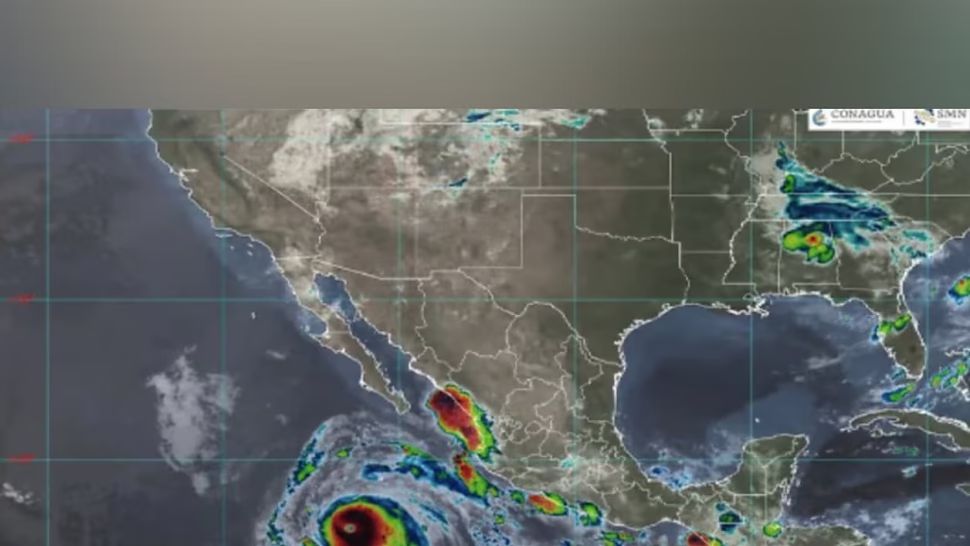
Hurricane Genevieve reached category 5 on the Saffir-Simpson scale this Monday morning, the highest level. The National Meteorological Service (SMN) confirmed it as the first major hurricane of the season.

At 08:00 hours, the center of the cyclone was located 855 kilometers south-southwest of the southern tip of Baja California Sur. With maximum sustained winds of 260 km/h and a minimum pressure of 925 millibars, it is moving towards the northwest.

The SMN indicated that “Genevieve” will maintain its intensity during the next few hours; However, a gradual weakening is expected to begin on Tuesday as it moves over the open waters of the Pacific Ocean.

Risks for coastal and inland areas

Although there is no risk of direct impact on land, the system will generate storm surges and high waves with dangerous conditions on the southwest coast of the country and on the Baja California peninsula.

The humidity associated with the hurricane will favor storms and intense rains in entities of the west, northwest, center and south of Mexico.

The authorities urge the population to remain attentive to official notices and follow the recommendations of Civil Protection.

Continue reading

84% of gas stations comply with the diesel cap, reports Profeco

Eight out of ten gas stations comply with the diesel cap. The average price is close to the goal of 27 pesos.

Compliance with diesel prices

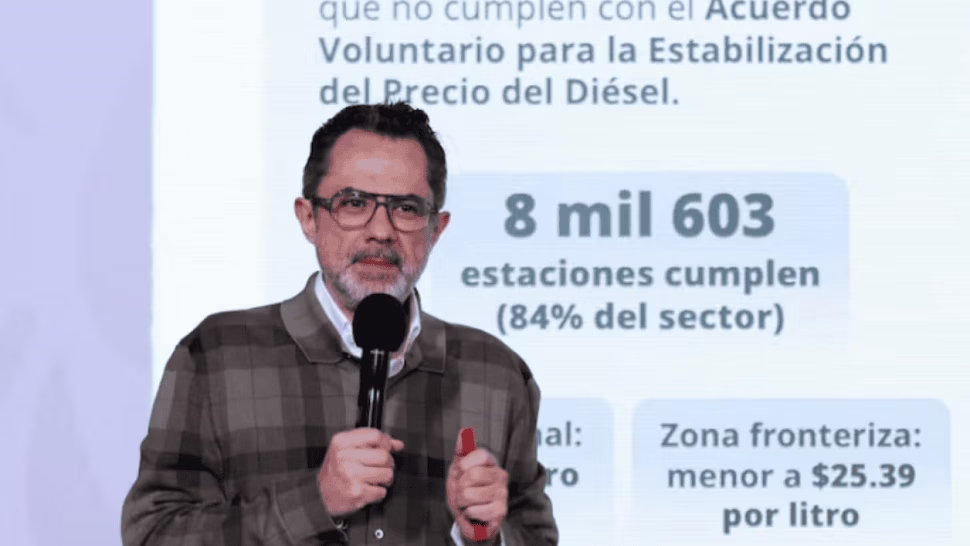
The head of the Federal Consumer Prosecutor’s Office (Profeco), Iván Escalante, reported that 84% of the gasoline sector abides by the voluntary agreement to keep diesel below 27 pesos per liter. In the morning conference of President Claudia Sheinbaum, Escalante detailed that about 8,600 stations already meet the goal.

“We have the goal of being less than 27, right now we have the average price at 27 pesos and five cents,” he reported. Profeco has a map to locate the stations and their prices in real time.

Prices of the basic basket

Regarding the basic basket of 24 products, the attorney pointed out that the goal is 910 pesos for families: “we are doing very well, we have very good results.” Regarding specific products, he indicated that whole chicken is sold on average at 39.66 pesos per kilo.

The official highlighted that continuous monitoring makes it possible to adjust actions and maintain pressure on prices. The agreement, of a voluntary nature, seeks to stabilize the cost of fuel without coercive measures.

Continue reading

Employment in Mexico grows by 412 thousand people in six months

Employed population increases in Mexico during the first half of the year.

Occupancy figures on the rise

The Ministry of Labor and Social Welfare (STPS) reported that, according to the National Occupation and Employment Survey (ENOE), the employed population in Mexico grew by 412 thousand people between January and June of this year.

At the end of the sixth month, the Economically Active Population (EAP) reached 61.9 million people. The unemployment rate was 2.9 percent.

The Mexican Social Security Institute (IMSS) registered 22 million 779 thousand 704 jobs, the highest figure for the month of June.

Youth employment also rebounds

The agency highlighted that the young employed population—from 18 to 29 years old—increased by 204 thousand people in annual comparison. This data reflects an improvement in the labor insertion of young people.

The figures, based on the ENOE and IMSS records, show a positive trend in the Mexican labor market during the first half of the year.

Continue reading