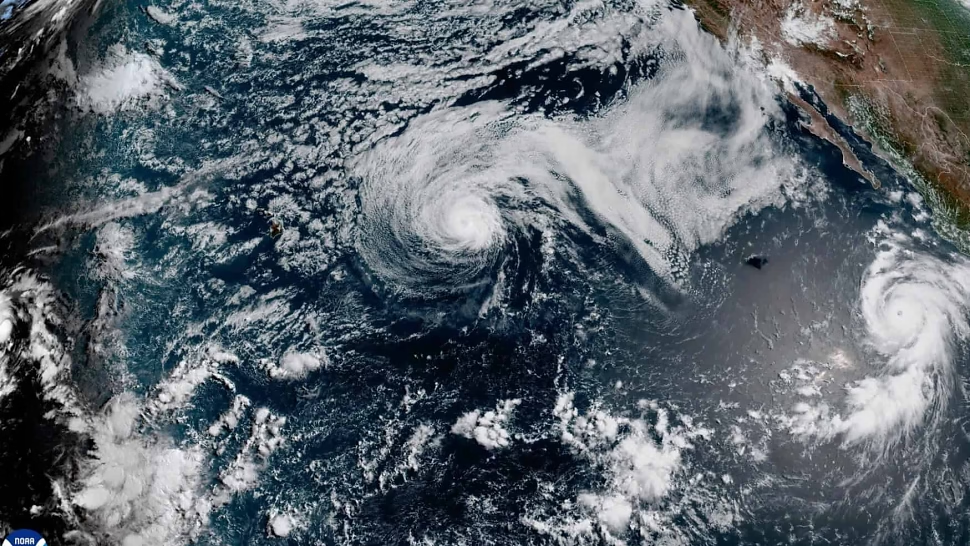
The Fujiwhara Effect: When hurricanes decide to dance a waltz
It seems that the hurricane season in the Atlantic decided to raise the bar for drama and offer us a choreographic spectacle. In the most cinematic corner of the ocean, hurricanes Imelda and Humberto are not content with being simple atmospheric disturbances; No, they aspire to something more. Their plan, according to gossip from the always well-informed meteorology platform Ventusky, is to star in the phenomenon known as the Fujiwhara Effect. Or what is the same: they are going to dance a tango so passionate that they could end up merging into a single, gigantic cyclonic entity. Because what is a hurricane without a dance partner to keep up with it?
The idea is as crazy as it is fascinating. Imagine these two titans of wind and rain, instead of competing over who causes the most damage to the coast, deciding that it is much more fun to spin around each other in an intense meteorological dance. It’s the oceanic equivalent of those reality shows where two people who barely know each other must learn to coordinate or be eliminated, only here elimination involves being absorbed by the other. The good news, we are told with a sigh of relief, is that this tempestuous romance appears to be a private affair on the high seas. Thanks to this merger, the continental United States will be saved from being the unwanted guest at this party. Come on, the hurricanes have decided to be considered and are going to vent among themselves, far from the coasts, gradually weakening over the vast waters of the Atlantic. How kind.
And what exactly does this cyclonic ballroom dance consist of?
The Fujiwhara Effect, which sounds like a spell from a Japanese anime but is pure atmospheric physics, occurs when two tropical cyclones get close enough to each other to abandon their independence and begin to orbit around a common center. It is not a random collision, but a precise and lethal choreography. And as in any soap opera worth its salt, there are three possible endings to this mess.
The first possible script is that of meteorological cannibalism. In this scenario, the smaller hurricane and, let’s assume, with less self-esteem, gets too close to the big guy’s vortex and the big guy, unceremoniously, absorbs it. He disappears without further ado, swallowed by the voracity of his co-star. A sad but effective ending.
The second option is the fusion of talents. Here, both systems decide that there is strength in numbers (literally) and merge into a single colossal storm, increasing its power significantly. It’s the climatic version of those robots in the movies that combine to form a megazord. The result? An even more formidable monster, but one that, luckily in this case, seems to prefer to fade into the distance of the ocean.
And then there is the third possibility, the most dramatic and typical of a comedy of affairs: the dance and farewell. The two hurricanes engage in a mutual spin, look into each other’s eyes (or whatever looks like eyes), spin around a few times, and then, as if nothing had happened, each continues on its path along completely different paths. It is the “ours cannot be” of the meteorological world. They have fun for a while, change their original trajectories completely, and ale hop, start looking for new horizons to disturb.
It’s ironic to think that, on a planet where human activity often exacerbates extreme weather events, nature sometimes regulates itself in the most colorful ways. This Fujiwhara effect is a reminder of the unpredictable and chaotic beauty of Earth systems. Two potential threats neutralize each other, or at least entertain each other, far from civilization. One can almost imagine the meteorologists watching the screens, eating popcorn, and betting on which of the three endings will be chosen. Absorption, fusion or a simple “you stay there”? The Atlantic Ocean is the great stage and we are simple spectators of a ballet of titanic forces that, for once, seems to end in peace.
So, the next time you hear about hurricanes, remember that it’s not all destruction and panic. Sometimes, it’s pure theater. A theater with winds of more than 100 kilometers per hour, but theater nonetheless.
Were you surprised by this hurricane dance? Share this incredible natural choreography on your social networks and make your contacts also marvel at the whims of the weather. Explore more in our section to discover other weather phenomena that defy the imagination.