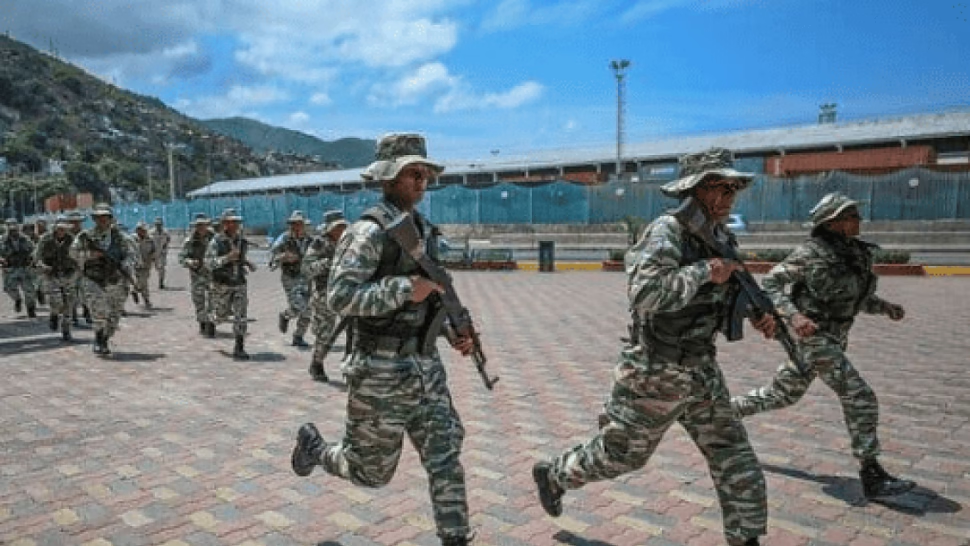
China warns its citizens about risks when traveling to the United States

China issues travel alert to the US due to trade tensions and educational restrictions, urging citizens to assess risks.

China issues travel alert to the United States due to trade tensions

The Chinese government has issued an official warning to its citizens, recommending them to extreme caution if they plan to travel to the United States. This measure comes amid the deterioration of bilateral relations and the escalation of the trade war between both powers.

China’s ministries of Education, Tourism and Foreign Affairs jointly published a risk alert, noting that the security situation in the United States, coupled with economic tensions, could present challenges for Chinese travelers. Authorities urge you to carefully assess the risks before traveling and to act with caution if you are already in the country.

RelatedTrump threatens 100% tariffs on China for rare earths

Educational restrictions and specific warnings

The Chinese Ministry of Education emphasized its concern for students considering academic exchanges in the United States. This warning comes after the passage of the Higher Education Act in Ohio, which limits cooperation between Chinese and American educational institutions. Authorities recommend reviewing the specific policies of each state, especially those that have implemented restrictions.

“The current situation requires a thorough evaluation of the risks associated with academic mobility,” the ministry highlighted in an official statement.

Context of the trade war and tariff measures

The alert coincides with the recent increase in US tariffs on Chinese products, which reached 125%, a measure announced by former President Donald Trump on his social networks. Beijing responded by raising its tariffs on US goods by up to 84%, in a clear reflection of the escalation of tensions.

Trump called these actions a response to what he considers unfair trade practices by China, stating: “The days of ripping off the United States are no longer acceptable.”

This scenario highlights the complexity of the relations between both nations and its direct impact on areas such as trade, education and citizen security.

Are you interested in learning more about geopolitics and international economics? Share this analysis on your social networks and explore other related articles on our platform.
New 4.6 earthquake in Venezuela; international community reinforces aid

New 4.6 aftershock shakes Venezuela while rescue teams continue work.

New aftershock shakes the Venezuelan coast

An earthquake of magnitude 4.6 was recorded this Monday 30 km from La Guaira, in northern Venezuela, according to the United States Geological Survey (USGS). The earthquake, which occurred at 7:01 local time, is the most recent of the aftershocks that follow the devastating earthquakes of June 24. So far, no damage or victims have been reported.

“Here we are on the street again, I don’t know when we are going to have a moment of true tranquility,” declared Concepción Hernández, a 51-year-old housewife, who evacuated a building in Caracas with her husband. “We are blessed, our building held up again,” he added.

International aid underway

Mexico will send water treatment plants, electrical equipment and non-perishable food by air and sea. President Claudia Sheinbaum affirmed that her country will also support the reconstruction phase with construction standards and seismic alert systems.

The United States increased its financial commitment to more than $300 million for humanitarian organizations, bilateral financing and UN common funds.

China pledged 100 million yuan ($14.7 million) in humanitarian aid. Chinese media reported that eight Chinese citizens died from the earthquakes.

Geological impact in Trinidad and Tobago

Geologists confirmed that the two earthquakes raised the southwest coast of Trinidad by up to six meters and moved it about 30 meters to the south. Lifeless fish, crabs and rays were found on Galfa Point beach. Specialist Xavier Moonan explained that the transfer of energy is reflected in the fault along the southern coast of Trinidad.

Slowness in Caracas

In the Venezuelan capital, shops open later than usual and public transportation operates with few passengers. “I’m going to work late, but despite the scare we can’t stay home,” said Johny González, a 22-year-old employee.

Continue reading

Earthquakes in Venezuela: rescues and criticism of the government

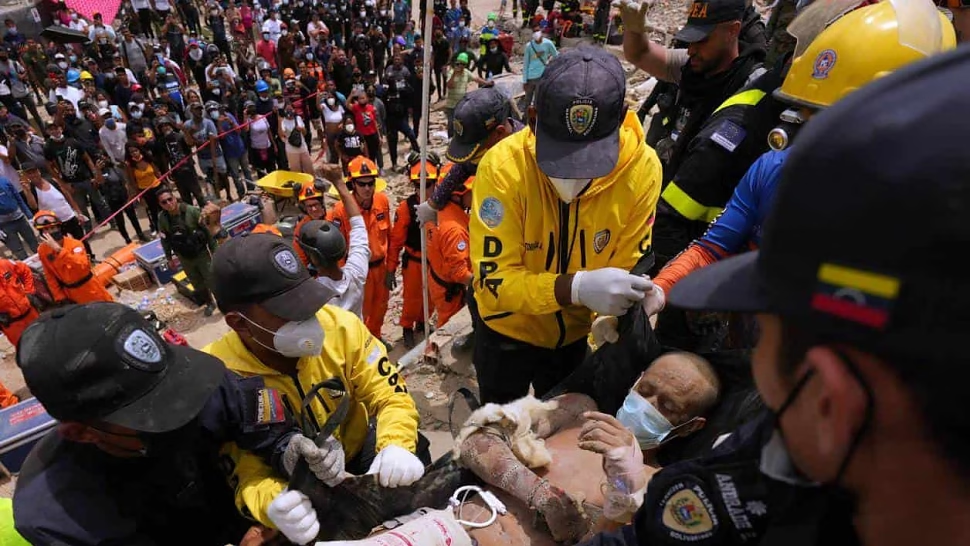
Rescuers manage to save a father and son under the rubble in La Guaira.

Four days after the earthquakes

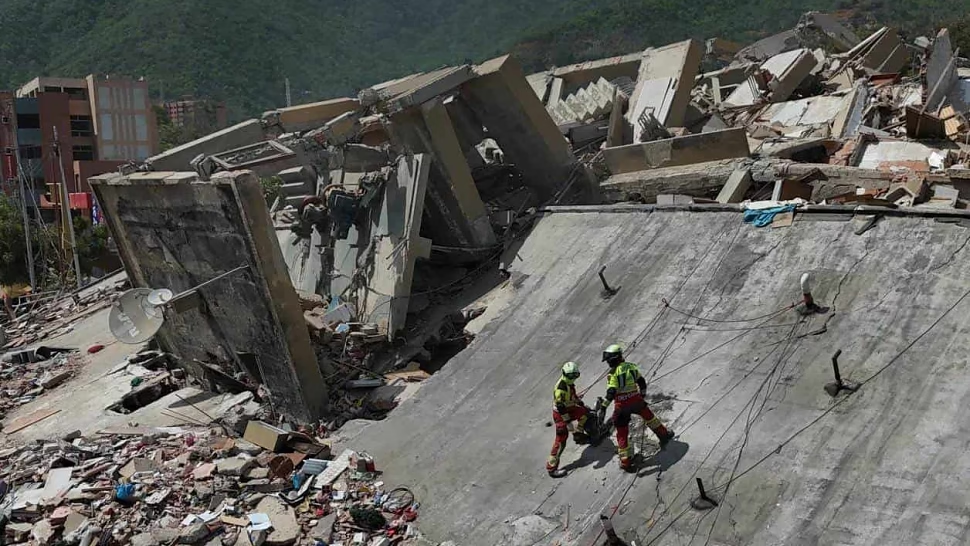
Rescue teams continue to search for survivors in the rubble in La Guaira state, Venezuela. Until now, the official death toll exceeds 1,450 people. Thousands of people remain missing.

Although the chances of finding people alive are reduced as the hours go by, this Sunday rescuers from the United States and France managed to extract a man and his son trapped under a collapsed building. The discovery renewed hope for dozens of families who are still waiting for news of their loved ones.

Criticism of the official response

Residents of the affected areas assure that the first rescue tasks were carried out by volunteers and civilians. The government’s slowness in addressing the emergency has generated strong questions. Authorities report that more than 770 buildings were destroyed or severely damaged.

The United Nations confirmed the participation of more than 2,200 rescuers from various countries in the operations. The International Organization for Migration warned that up to six million people could be affected, including about two million residents of Caracas.

As the aftershocks continue, the risk of new landslides persists. Emergency teams continue searching through the collapsed buildings. The Simón Bolívar International Airport is still in the process of reestablishing operations to facilitate the arrival of international aid.

Continue reading

US Marines reinforce rescue in Venezuela

New contingent of marines arrives in Venezuela for humanitarian aid after earthquakes.

Second military deployment in the midst of the emergency

A new contingent of United States Marines arrived in Venezuela this Sunday to join the search and rescue efforts after the two earthquakes recorded last Wednesday. According to the US embassy in Caracas, members of the Litoral Combat Force-24, along with sailors from the USS Fort Lauderdale, disembarked in the port of La Guaira with heavy vehicles and supplies.

Simultaneously, another group of Marines arrived by air in Bell UH-1Y Venom helicopters to work in the most affected areas. It is the second deployment since the emergency began; the first, two days ago, included military engineers and rescue specialists.

Cooperation with the new Venezuelan government

The arrival occurs almost six months after Nicolás Maduro was captured in Caracas by US forces and transferred out of the country. After that event, the then vice president Delcy Rodríguez assumed power and changed relations with Washington.

Rodríguez has publicly thanked the assistance of the United States and confirmed conversations with the Secretary of State, Marco Rubio, to coordinate aid in the face of the humanitarian crisis. Cooperation is managed by the State Department with support from the Southern Command.

On the ground, operations are under the supervision of Marine Major General Kevin J. Jarrard, in charge of facilitating the rescue and distribution of assistance to the affected population.

Continue reading