China sanctions 20 US defense companies

Beijing responds forcefully to the latest US military assistance package, hardening its stance on the Taiwanese issue.

Strong response to arms sales to Taiwan

The government of the People’s Republic of China has implemented this Friday a package of coercive measures directed against twenty American corporations in the defense sector and ten of their senior executives. This decision constitutes a direct reply to Washington‘s recent announcement of a proposed arms sale to Taiwan valued at more than ten billion dollars, an action that Beijing interprets as serious interference in its internal affairs.

According to the official statement from the Chinese Ministry of Foreign Affairs, the sanctions include the immediate immobilization of any assets that the companies own within the Chinese mainland and in the special administrative regions. Likewise, any entity or individual under Chinese jurisdiction is strictly prohibited from establishing or maintaining commercial and business relationships with the aforementioned firms. For the executives included on the list, a ban on entry to the country is imposed, banning any visa.

RelatedChina’s Fujian aircraft carrier crosses Taiwan Strait

The list of affected companies and executives

Among the main defense contractors sanctioned are industry giants such as Northrop Grumman Systems Corporation, L3Harris Maritime Services and the conglomerate Boeing Defense, Space & Security. In the area of ​​executives, the inclusion of Palmer Luckey, founder of the innovative technology company Anduril Industries, stands out. Beijing authorities have been categorical in stating that these people and corporations “will pay the price” for their involvement in war material transactions with the island, underlining the consequences of challenging their principled position.

Geopolitical context and escalation of tensions

This announcement comes at a time of maximum diplomatic sensitivity, just a week after the US administration notified Congress of what could be, after its approval, the largest shipment of weapons to the self-governing island. Beijing, which claims historical and legal sovereignty over Taiwan, considers the island’s status an “insurmountable red line” in its bilateral relations with the United States. The One China Doctrine is the central pillar of this position, rejecting any action that could be interpreted as supporting Taiwanese independence.

In its statement, China also urged the United States to cease what it called the “dangerous and destabilizing practices” of militarization of Taiwan. This episode is framed in a scenario of growing strategic rivalry between the two superpowers, where the disputes extend beyond the territorial, encompassing trade conflicts, technological competition and disagreements on human rights. While the Chinese People’s Liberation Army has intensified its patrols and military exercises in the straits surrounding the island, the United States maintains, under the Taiwan Relations Act, its commitment to provide defense items necessary for Taiwan’s deterrence capability.

Analytically, these sanctions represent a state policy tool aimed at increasing the economic and reputational cost for companies that participate in operations that China considers hostile. Although the direct financial impact on these large corporations may be limited due to previous restrictions, the message is clear: it seeks to deter future sales and deepen regulatory uncertainty for the US military-industrial complex in the global market. This move reinforces the narrative that Beijing will not hesitate to use its considerable coercive economic power to defend what it defines as its fundamental national interests, setting a new chapter in the systemic competition between both nations.

Are you interested in understanding how these geopolitical tensions affect the global economy and technology? Share this analysis on your social networks and explore more specialized content on international relations and security.
China imposes restrictions on 14 European entities

Beijing applies measures against EU firms due to sanctions on Chinese companies linked to Russia.

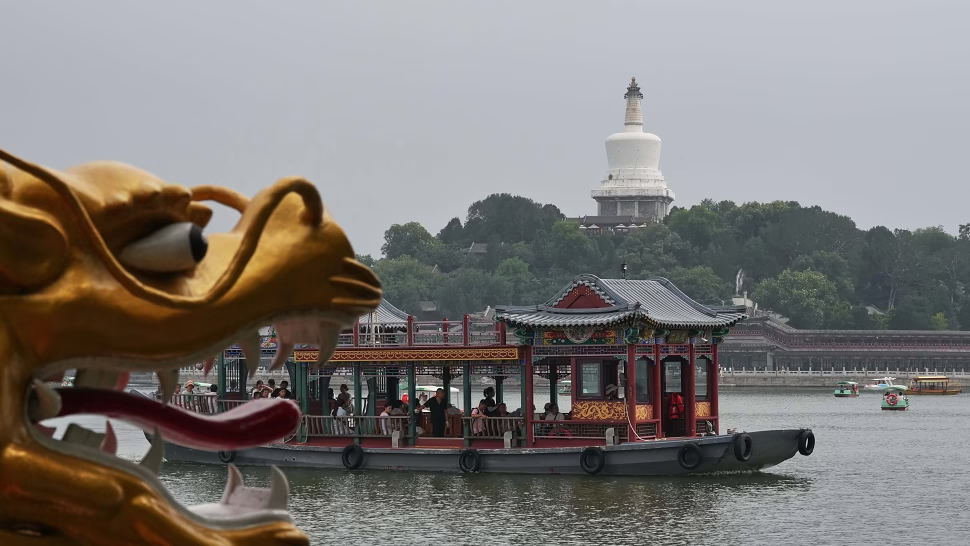
China has announced new trade restrictions against 14 European entities. The measure responds to the sanctions that the European Union imposed on Chinese companies for their alleged indirect support for Russia in the Ukraine conflict. Tension between Beijing and Brussels intensifies over the control of goods with possible civil and military applications.

The Chinese Ministry of Commerce reported that European firms included on the list will no longer be able to receive exports of dual-use items manufactured in China. In addition, foreign companies are prohibited from supplying products of Chinese origin that can be used in both civil and military activities to these organizations.

Among the affected companies are firms from the Czech Republic, Italy, Germany and France. They are dedicated to sectors such as vehicle manufacturing, electric motors and drones. Beijing assured that the restrictions seek to protect its security and national interests, as well as comply with international commitments related to non-proliferation.

Continue reading

US partners reject Trump’s new wave of tariffs

US partners reject new taxes. What effect will they have on global trade?

Global rejection of the new US tariffs

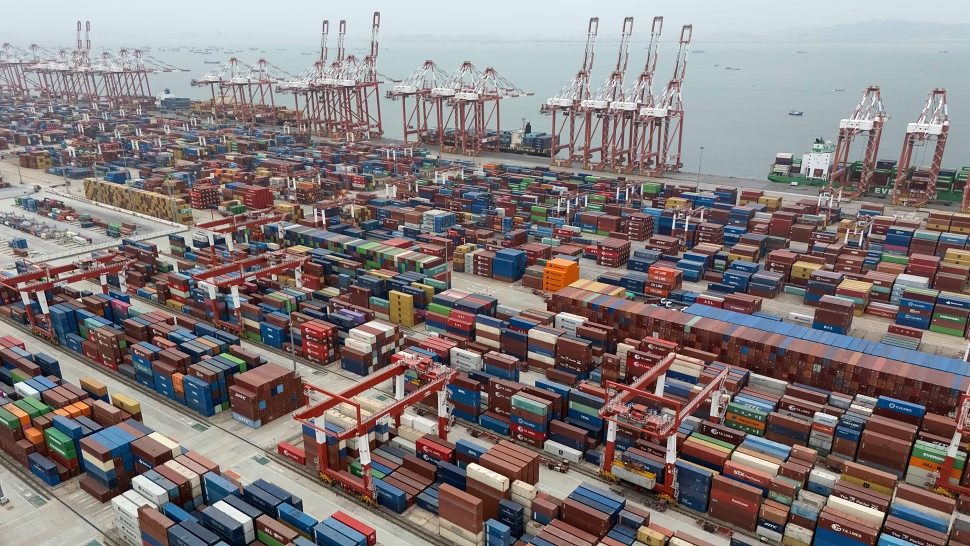
This Friday, the White House activated a new round of taxes ranging from 10% to 12.5% on products from 60 economies. The measure, justified by alleged failures in the adoption of standards against forced labor, provoked an almost unanimous reaction from trading partners.

Australia and New Zealand were the first to speak out. Both countries rejected Washington’s accusations and assured compliance with international labor standards. They requested the immediate elimination of tariffs.

Japan also protested. He recalled that there was a previous agreement with the United States to maintain a rate of 10% and affirmed that its trade rules adjust to global criteria.

China reiterated its rejection of “all forms of unilateral tariffs” and maintained that trade wars do not benefit either party.

Chinese exporters acknowledged that the new tariffs are lower than those of 2025, but pointed out that uncertainty has led them to diversify markets, increasing their sales to Europe.

South Korea and Thailand opted for the path of dialogue. They announced that they will hold talks with Washington while evaluating the impact on their exports.

Long-lasting tariffs?

Specialists consider that these liens have a better chance of remaining in force as they are supported by an investigation under Section 301 of the United States Trade Act. This gives them a more solid legal basis than previous measures.

The European Union and Singapore, for their part, described the decision as unjustified and warned that it will affect the stability of international trade.

Continue reading

UNESCO declares World Heritage sites in the West Bank and Lebanon

UNESCO inscribes archaeological sites in the West Bank and Lebanon despite Israeli objections.

UNESCO includes archaeological sites in the West Bank and Lebanon despite Israeli objections

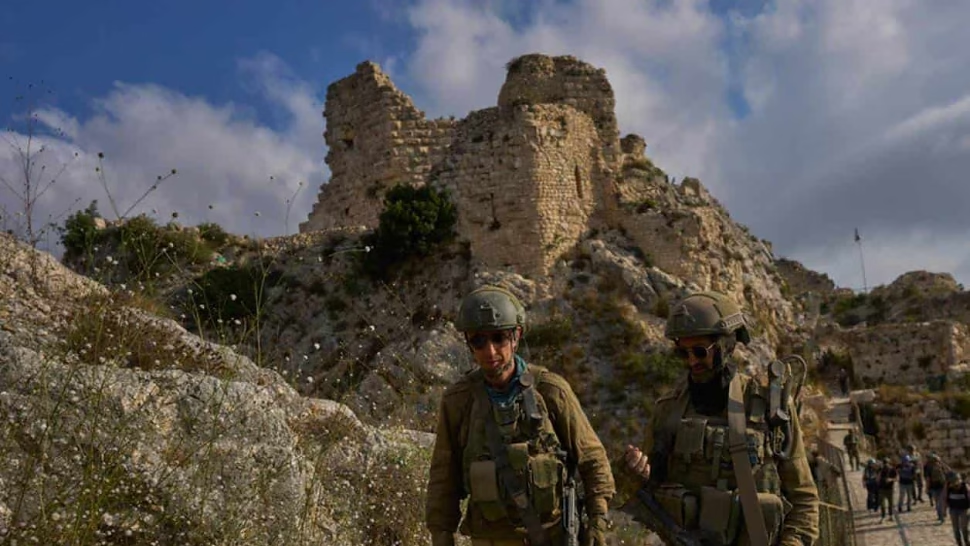
A United Nations committee inscribed an archaeological site in the West Bank and a group of castles in southern Lebanon on the World Heritage List. The decision was made at a UNESCO meeting in South Korea, days after Israel urged the rejection of the nominations, calling them an attempt to “instrumentalize cultural heritage.”

Sebastia, a hill town 10 km northwest of Nablus (occupied West Bank), is identified as ancient Samaria, capital of the biblical Kingdom of Israel. Its remains range from the Iron Age to the Islamic period. The Palestinian bid, submitted in 2012, argued that World Heritage status would help preserve the site, which remains undeveloped under Israeli control.

The five castles of Mount Amel, also included, combine influences from Crusaders, Ayyubids and Mamluks. Among them is Beaufort Castle (Al-Shaqif), taken by Israeli forces in May during their deepest incursion into Lebanon in more than 25 years.

Adel Naim Daoud Atieh of the Palestinian delegation said: “who have protected this extraordinary site for generations, despite occupation, restrictions and repeated attempts to separate it from their own heritage.” An Israeli delegate called the decision a “disgrace” and accused it of politicization. Israel withdrew from UNESCO in 2019.

The Israeli Foreign Ministry accused the Palestinian delegation of a “hostile and unilateral campaign” and claimed that Hezbollah has turned Beaufort Castle into a military stronghold. UNESCO responded that all nominations are evaluated under the same criteria and that it does not take a position on political disputes. A Lebanese delegate noted that the castles have been used “only for cultural and tourist purposes” since the Israeli withdrawal in 2000.

Additionally, the committee included Tyre, an ancient Phoenician city in southern Lebanon, on the List of World Heritage in Danger, following intense Israeli airstrikes during the war against Hezbollah before the June ceasefire.

Continue reading