Caro Quintero to trial in 2027 after tense hearing

The Mexican kingpin's trial was set for 2027, but his defense denounces extreme conditions of isolation.

The long wait for justice for a historical boss

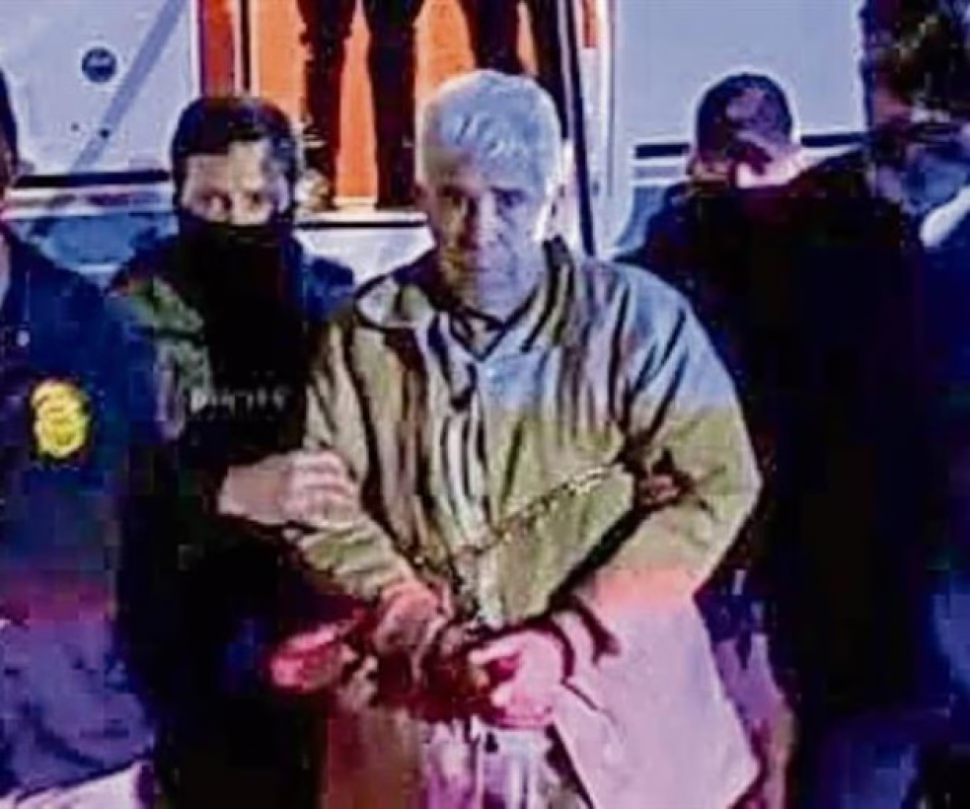
Judge Frederic Block set a date on the calendar: March 8, 2027. That day, the trial against Rafael Caro Quintero, co-founder of the extinct Guadalajara Cartel, will begin in a New York court. A court date that comes almost four decades after the crimes with which he is accused.

But that date could change. It all depends on whether the accused first reaches an agreement with the US authorities. A path that many take to avoid a long process with an uncertain ending.

RelatedRafael Caro Quintero faces key hearing in Brooklyn court

A defense against the ropes

In the previous hearing this Thursday, the tension was not in the charges – which are serious – but in the conditions of the detainee. His lawyer, Mark DeMarco, launched a direct and forceful complaint.

“My client is being held in a 3.3 square meter cell. We can’t even meet with him to properly prepare the case,” DeMarco alleged.

Caro Quintero is under the so-called Special Administrative Measures: 23 hours a day of total isolation. His defense maintains that these conditions are seriously damaging his health. So far, their requests to soften them have been denied.

The boss pleaded not guilty to all charges. The most serious revolve around the kidnapping, torture and homicide of the DEA special agent, Enrique “Kiki” Camarena, in 1985. A case that marked the relationship between Mexico and the United States.

The prosecution has already taken a step back on one thing: it will not seek the death penalty. But life imprisonment remains on the table as a very real possibility.

Now it’s time to wait. The next appointment is a follow-up hearing on June 17. The road until March 2027 will be long, full of procedures and possibly more resources due to the conditions of the accused.

Meanwhile, Caro Quintero remains behind four walls, waiting for a trial that promises to reopen one of the darkest chapters of the conflict against drug trafficking.
US reestablishes blockade in Strait of Hormuz

Washington reestablishes the blockade of Iranian ports; Tehran threatens to stop energy exports.

City at the center of tension

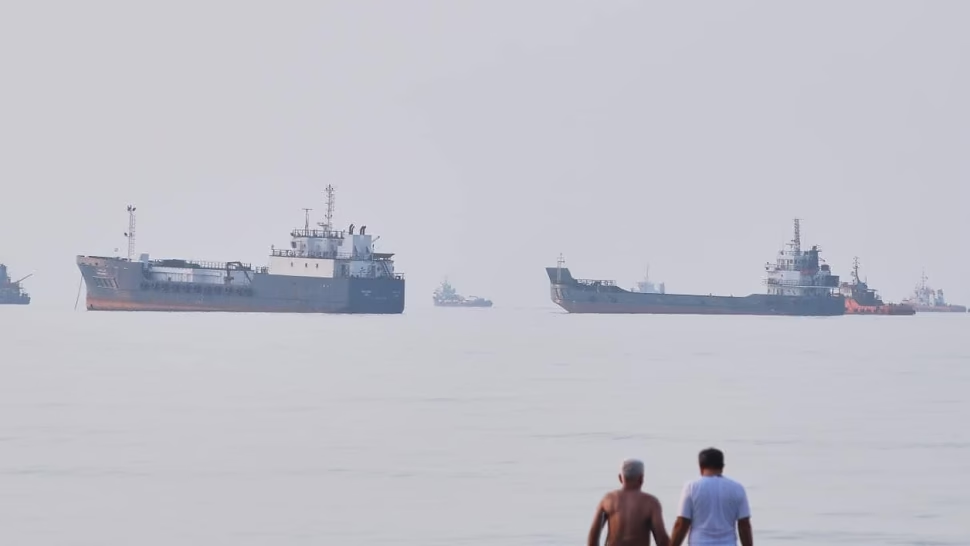
The US military confirmed this Wednesday the reestablishment of the blockade of Iranian ports in the Strait of Hormuz. The measure responds to Tehran’s attacks against vessels trying to cross the sea route through which a fifth of the planet’s crude oil and natural gas passes.

The escalation puts at risk the provisional ceasefire signed weeks ago. Now, retaliatory attacks threaten to tip the region back into open conflict.

What did the US do?

The blockade was originally imposed in April, but was lifted in June following a 60-day deal to negotiate Iran’s nuclear program. But talks stalled and fighting in the strait intensified.

President Donald Trump announced the return of the fence on Monday and also proposed a 20% tariff on ships crossing the strait. Hours later, he abandoned that rate, saying Gulf allies requested it.

“The export of oil and gas from the region will be for everyone or it will be for no one,” warned Iran’s Revolutionary Guard.

Iran’s reactions

The Iranian ambassador to the UN, Amir Saeid Iravani, called the United States “the aggressor, not the victim,” according to the state agency IRNA.

The United States carried out a new wave of attacks while reestablishing the blockade, according to Central Command. Missile alerts were activated in Bahrain and Kuwait. Admiral Brad Cooper noted that Iran launched dozens of missiles and drones against Gulf Arab countries.

“US forces are holding Iran accountable for unjustified aggression,” Cooper declared.

Military and economic scenario

There are at least 19 American warships in the Arabian Sea, including two aircraft carriers and an amphibious ship with more than a thousand Marines. Central Command reports “hundreds of military aircraft operating throughout the Middle East.”

Iran closed the crossing in February when the United States and Israel attacked it. That skyrocketed the price of oil, fertilizers and other goods. Now, Tehran has attacked ships near Oman, outside its control.

Trump said that kings and emirs of the Gulf proposed to him to invest billions in the US instead of paying tolls. “I don’t think anyone should charge a fee for the strait,” he said. Experts doubt Washington can forcibly reopen the passage without a much larger navy or tens of thousands of troops on the ground.

Continue reading

NASA and Roscosmos launch joint mission to the ISS from Kazakhstan

NASA astronaut and two Russian cosmonauts take off together despite geopolitical tensions.

Successful launch despite the geopolitical context

A NASA astronaut and two Russian cosmonauts took off this Tuesday towards the International Space Station (ISS). The mission departed from the Baikonur Cosmodrome in Kazakhstan aboard the Soyuz MS-29 spacecraft.

The crew includes American Anil Menon and Russians Pyotr Dubrov and Anna Kikina. They will remain on the orbital station for approximately eight months. Docking was scheduled for hours after launch.

Cooperation that persists

NASA Administrator Jared Isaacman attended the launch and met with Roscosmos Director Dmitry Bakanov. Isaacman recognized the teams’ collaborative work and professionalism.

For Menon it will be his first trip to space. Dubrov and Kikina carry out their second orbital mission. On the ISS, they will be integrated into scientific research and maintenance tasks.

Although cooperation on the ISS continues, joint projects have been reduced. Russia is no longer participating in the Artemis lunar program and has strengthened its collaboration with China for future missions to the Moon.

Continue reading

Venezuela: ruling party and opposition agree on dialogue agenda

The ruling party and the opposition begin a joint agenda after earthquakes that left thousands of victims.

Agreement in Venezuela: joint agenda for democracy

The National Assembly of Venezuela, controlled by the ruling party, and a group of former opposition legislators announced an agreement to begin a joint agenda on August 1. The objective is to strengthen democracy. The rapprochement occurs after a meeting between the president of Parliament, Jorge Rodríguez, and former deputy Dinorah Figuera, who returned to the country after almost eight years of exile.

The “joint work sheet” also responds to the call for national unity in the face of the June 24 earthquakes. According to the official balance, the earthquakes left 4,561 dead, 16,740 injured and more than 20,000 affected.

Parliament highlighted that international support for reconstruction shows the need to work in a coordinated manner to overcome the humanitarian crisis and maintain stability. The authorities consider cooperation between sectors key to national recovery.

The United States supported the initiative. The State Department proposed that the agenda serve as a roadmap for a political dialogue that leads to a democratic transition. Among the priorities: strengthen institutions, renew the National Electoral Council, restore guarantees for political participation and protect civic liberties.

The new dialogue process occurs in a political scenario transformed after the capture of former President Nicolás Maduro in January, during a US military operation, and the establishment of a transition plan promoted by Washington. Dinorah Figuera, representative of the former members of the National Assembly elected in 2015, will participate in building consensus for the political future of the country.

Continue reading