Caro Quintero asks to leave extreme confinement in prison

The Mexican kingpin seeks to escape extreme isolation in a US prison, alleging "unconstitutional" conditions.

The boss who wants to change his prison suite

Rafael Caro Quintero, the drug dealer who seems straight out of a strange season of Narcos, is fed up with his “stay” at the Metropolitan Correctional Center in Brooklyn. His defense, with more arguments than a Better Call Saul lawyer, asked the court to transfer him to a “less restrictive” cell. Because, of course, being locked up 23 hours a day in a windowless cubicle isn’t exactly a five-star Airbnb.

Complaints of the most uncomfortable “guest”

According to his legal team, the Special Administrative Measures (SAM) applied to him are so extreme that they even deny him the right to gossip with his family. No calls, no letters, not even a miserable “hello” by sign. The only thing that passes through the slot in your door is your food (cold, because the air conditioning works when it feels like it) and, occasionally, a lawyer with a “this-isn’t-my-thing” look on his face.

RelatedCaro Quintero to trial in 2027 after tense hearing

The worst? He can’t even go to mass. And in prison, entertainment is limited: no Netflix, no TikTok, and the “gym” consists of spinning around in a cell the size of a closet. Of course, the light never goes out, because who needs to sleep, right?

A past that haunts him

For the clueless: Caro Quintero is not just any recluse. He’s the guy the United States lists as one of the “most evil cartel bosses in the world.” Founder of the Guadalajara Cartel (yes, the one that later mutated into the Sinaloa Cartel), he is accused of crimes that include the murder of DEA agent Enrique Camarena in 1985. A resume that, let’s face it, does not help to gain sympathy.

But here’s the ironic twist: the US Department of Justice will not seek the death penalty for him or his colleagues Ismael “El Mayo” Zambada and Vicente Carrillo Fuentes. Perhaps because, in the country of second chances, even the bosses have the right to a trial… and to complain about the prison menu.

Meanwhile, Caro Quintero remains in his cell, dreaming of a transfer to a prison with better amenities. Because if there is something that unites millennials and drug traffickers, it is the hatred of inhumane conditions… and slow Wi-Fi.

Are you surprised by their request? Share this note and discover more stories about the less glamorous side of organized crime. #JusticeWithSarcasm

Sheinbaum presents law against femicide with sentences of up to 70 years

Initiative seeks to standardize femicide investigations throughout the country.

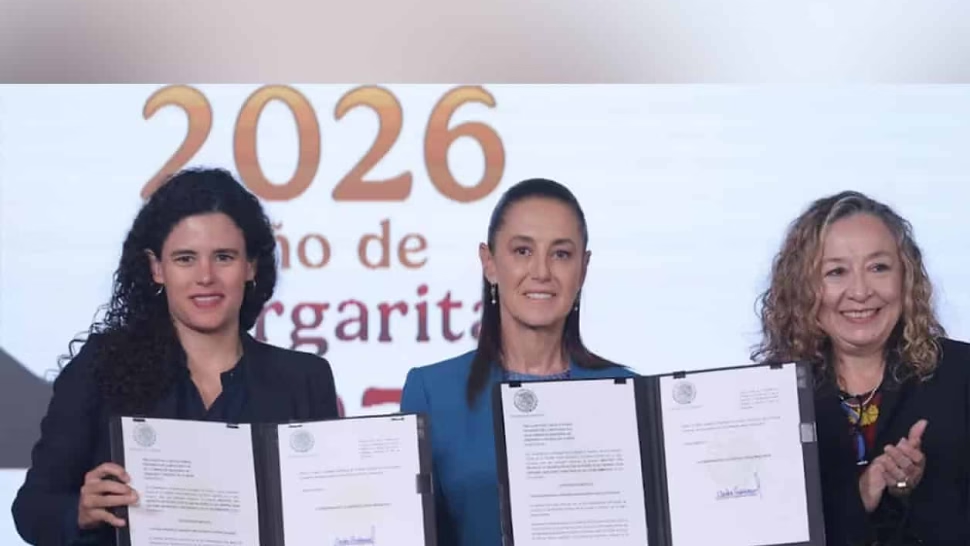
President Claudia Sheinbaum presented the General Law to Prevent, Investigate, Punish and Repair the Harm caused by the Crime of Femicide. The objective: zero impunity and a uniform investigation in all prosecutors’ offices in the country.

Details of the initiative

In her morning conference on July 15 at the National Palace, Sheinbaum stressed that this crime represents the worst form of discrimination and violence against women.

“The worst crime of violence against women… is death, feminicide, which means depriving a woman of her life for the sole reason of being a woman. It is a hate crime.”

He acknowledged that in some prosecutor’s offices it is still classified as suicide when the evidence points to a direct family member. The law seeks to avoid this misclassification and guarantee that all prosecutors’ offices work to the same standard.

Luisa María Alcalde, legal advisor to the Presidency, explained that the criminal type is homologated: “the person who deprives a woman of her life for reasons of gender commits the crime of feminicide.” 10 gender reasons are established, including signs of sexual violence, antecedents of violence and contexts of power asymmetry.

The penalty will be 50 to 70 years in prison throughout the country, with 19 aggravating circumstances that include when the victim is a child, adolescent, elderly, pregnant, disabled, journalist or human rights defender. The loss of inheritance rights, guardianship and parental authority is also contemplated, as well as dismissal and disqualification for public servants.

Sanctions and protocols

Maribel Bojorges Beltrán, head of the Special Prosecutor’s Office for Crimes of Violence against Women, indicated that the initiative establishes approved protocols with a gender perspective, reinforced due diligence and preservation of evidence. The specialized prosecutor’s offices must intervene in all stages of the criminal process.

Ingrid Gómez Saracibar, undersecretary of the Right to a Life Free of Violence, highlighted that the law guarantees victims access to truth, justice and emergency medical and psychological care. The comprehensive reparation of the damage will be transformative, adequate and rapid, with emphasis on the daughters and sons of the victims.

The initiative will be sent to Congress for discussion and approval.

Continue reading

Sheinbaum defends delivery of alleged El Mayo pilot to the US

The FGR identified the detainee after a voice and fingerprint comparison; He was delivered to the US with 25 others.

Claudia Sheinbaum affirmed that the surrender of the alleged pilot related to Ismael “El Mayo” Zambada was carried out in accordance with the National Security Law. The Attorney General’s Office (FGR) reported that the detainee hid his identity when he was captured.

The facts

The man was arrested on February 8 in Jesús María, Culiacán, Sinaloa, after an armed confrontation between federal forces and members of organized crime. One soldier died in the event and five others were injured.

When presented before the Public Ministry, he identified himself with a false name. Subsequent expert evidence established his true identity. He was linked to proceedings for several crimes and identified as a high-level member of the Sinaloa Cartel.

In August, he was handed over to the United States along with 25 other criminals considered highly dangerous, based on the National Security Law. It was not until June when the current administration of the FGR found in the investigation folders evidence of a coincidence of voice and fingerprints that relate him to the pilot who transferred Zambada on July 25.

Presidential posture

Sheinbaum defended the actions of the National Security Council. He stated:

“The delivery of these criminals to the United States by the National Security Council was carried out in strict compliance with the National Security Law.”

He explained that the Security Cabinet carried out an exhaustive analysis of the profile of each envoy and the risk they represented for the country. “The decision made by the Council is for the protection of Mexico,” he said.

The president indicated that, according to the FGR, at the time of the surrender the authorities were unaware that the detainee was the pilot involved. “It is understood that until that moment it was not known who was the pilot,” he concluded.

Continue reading

Sheinbaum supports suspension of ICE raids

The president trusts that ICE will stop operations after the losses of two compatriots.

President Claudia Sheinbaum celebrated the decision of the Immigration and Customs Enforcement Service (ICE) to suspend traffic controls, after two migrants died during operations by the US agency.

In the morning conference this Wednesday, July 15 at the National Palace, the president expressed her support for the measure. “Everything that is done to promote a policy of promoting human rights is good, that’s how it is,” he stated.

Sheinbaum recalled that his government has already implemented actions to protect Mexicans abroad in the face of the anti-immigration policies of Donald Trump’s administration. “It would be very good if ICE stopped doing these raids,” he added. When asked by journalists, he responded: “Well, yes.”

The victims were identified as Sebastian Guerrero, of Colombian nationality, and the Mexican Lorenzo Salgado Araujo. Their deaths generated protests in several cities in the United States.

The Mexican government had previously requested the US authorities to guarantee the safety of its compatriots during immigration operations. The temporary suspension of traffic controls represents a first step, although human rights organizations demand a comprehensive review of ICE protocols.

Continue reading