Cancún reduces intentional homicides by 70.6% according to official data

The entity managed to reduce the average murder to less than one per day, marking a historic low in almost a decade.

Detailed analysis of the reduction in homicides in Quintana Roo

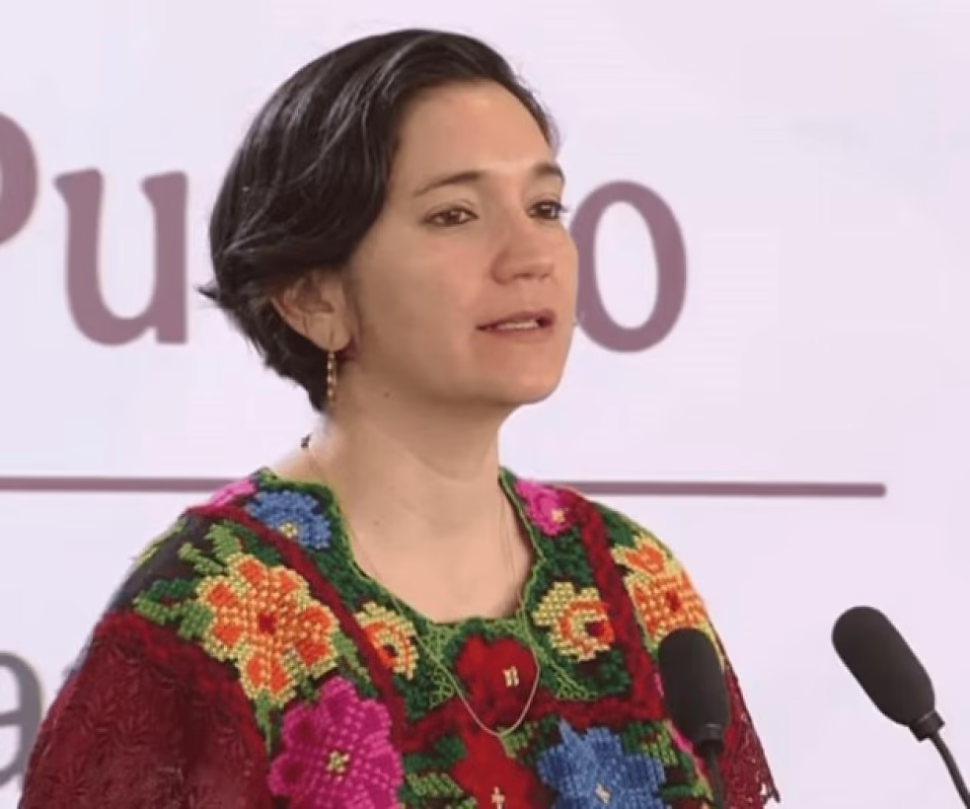
According to data provided by Marcela Figueroa, head of the Executive Secretariat of the National Public Security System (SESNSP), the state of Quintana Roo experienced a decrease of 61.3% in the daily average of intentional homicides between July 2024 and July 2025. This decrease is particularly significant in Cancún, where the reduction reached 70.6%, according to figures presented during a press conference in Chetumal.

Context and historical evolution

Records indicate that in September 2024, Quintana Roo reported an average of 2 victims per day due to intentional homicide. However, by July 2025, this figure was reduced to 0.77 cases per day, which represents the lowest level since 2017. Figueroa emphasized that this July 2025 is the “lowest July in eight years”, according to comparative data presented in official graphs.

RelatedGuerrero reduces intentional homicides by 24% with new security strategy

In the municipality of Benito Juárez (which includes Cancún), the improvement was even more notable: from 1.1 daily victims in July 2024 to only 0.32 homicides on average during the same month of 2025. This reduction of 70.6% suggests a tangible impact of the policies implemented in the last year.

Factors behind the decline

Although the official speech links this improvement to the actions undertaken during the administration of President Claudia Sheinbaum and Governor Mara Lezama, public security experts point out that multiple variables can influence these statistics. Among them:

  • Operational reinforcement: Greater presence of federal forces and inter-institutional coordination.
  • Focused strategies: Interventions in areas of high crime incidence.
  • Socioeconomic factors: Possible reduction in conflicts linked to illegal activities.

However, a longitudinal analysis is required to determine whether this trend will continue in the medium term. Data from SESNSP show that, between 2017 and 2024, Quintana Roo fluctuated between 1.5 and 2.5 homicides daily, which highlights the relevance of current figures.

Implications and pending challenges

Despite progress, security challenges persist. The reduction in homicides does not necessarily reflect a drop in other crimes, such as robbery or extortion. Additionally, the registration methodology—which prioritizes “intentional” cases (with criminal intent)—may omit variations in other categories.

Civil organizations have called for these statistics to be complemented with indicators of security perception and institutional effectiveness, since cold numbers do not always capture citizen reality.

Conclusion

The data presented by the SESNSP show notable progress in Quintana Roo, especially in Cancún. However, the sustainability of these results will depend on comprehensive policies that address both prevention and criminal prosecution. Transparency in the dissemination of information will be key to evaluating the real impact of government strategies.

Are you interested in learning more about security policies in Mexico? Share this analysis on your social networks and explore other specialized reports on our platform.
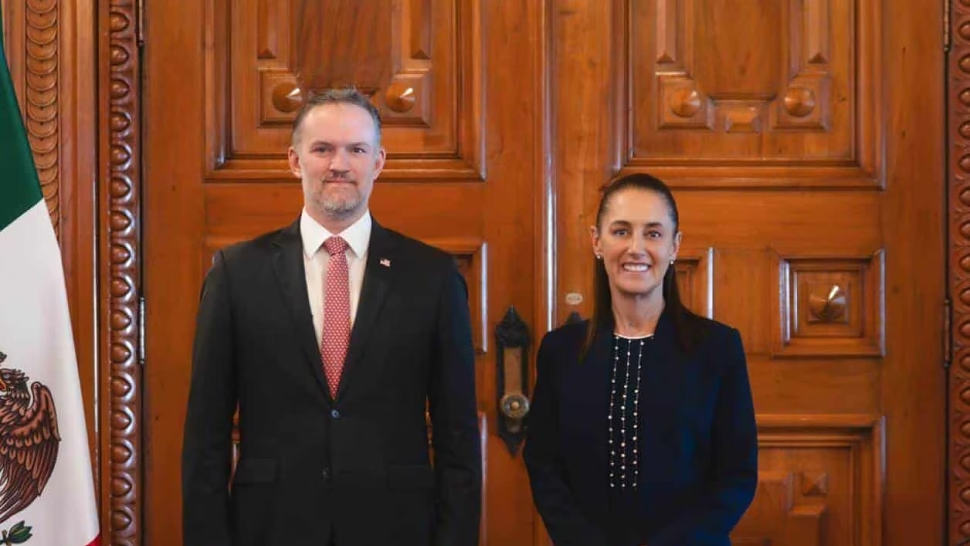
Sheinbaum and Greer review progress of the T-MEC in the National Palace

Sheinbaum and Greer discussed the review of the trilateral trade agreement.

Key meeting for the T-MEC

The United States trade representative, Jamieson Greer, left the National Palace at 11:31 a.m. after an hour and a half meeting with President Claudia Sheinbaum. An extensive security operation protected his departure, accompanied by Ambassador Ronald Johnson.

The meeting was attended by Marcelo Ebrard, Secretary of Economy; Julio Berdegué, former head of Agriculture; and Altagracia Gómez Sierra, coordinator of the Regional Economic Development Advisory Council. No official offered statements at the exit.

Sheinbaum published on social networks: “At the National Palace, we met with the United States trade representative, Jamieson Greer; we made progress in the review of the T-MEC and bilateral agreements for the benefit of both peoples.”

In her morning conference, the president affirmed that her government has done “everything humanly possible” so that Mexico faces the trade review in the best conditions. Sheinbaum assured that they will continue to defend national interests against unilateral decisions from Washington.

“We don’t know exactly what the United States is going to do; what we do is our best work to find the best conditions for our country,” he said.

The president rejected statements by US legislators about an alleged failure to deliver water. “We are complying perfectly and there is total agreement with the United States. This year we expect more rain and it will still be fulfilled; there is no problem at this moment with the issue of water,” he said.

He indicated that the meeting focused on trade issues, while security and other bilateral issues will be addressed at the coordination tables. Sheinbaum added that he will not respond to every statement made by US officials or legislators, as many correspond to other spaces for dialogue.

Continue reading

Automation reduces jobs in maquiladoras; 100 thousand fewer places

Layoffs in maquiladoras due to robots, high wages and tariffs.

The impact of automation

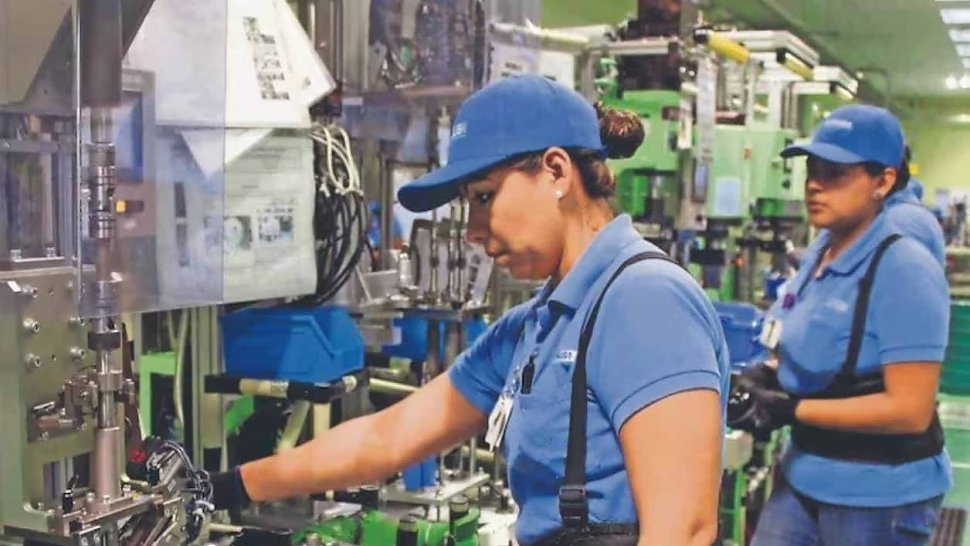
The wave of layoffs in the maquiladoras does not stop. The growing use of robots in production, especially at the border, has accelerated job losses. Added to this are higher minimum wages, increased vacation days, trade uncertainty and US tariffs.

According to data from Inegi, establishments with the Immex program had 3.19 million workers in May, 3% less than two years ago. That is equivalent to 100 thousand fewer places. Companies began laying off staff from the end of 2023.

Analysts consulted by EL UNIVERSAL point out that the combination of factors—automation, insecurity and tariffs—is behind this trend.

Humberto Martínez Cantú, president of the National Council of the Maquiladora and Export Manufacturing Industry (Index), explained that maquiladoras are being automated in the country. The process was accelerated by the increase in labor costs and external commercial pressure.

The northern border, a traditional bastion of the maquiladora industry, is the most affected area. There, robotization advances faster than in the rest of the country.

Official data reflect a sustained contraction. The sector is losing dynamism and with it, sources of formal employment for thousands of Mexicans.

Although the government has promoted incentives for investment, the reality is that technology replaces repetitive tasks. The least skilled workers are the most vulnerable.

Trade uncertainty with the United States and threats of additional tariffs complicate the outlook. Maquiladoras, which depend on global supply chains, adjust their workforces to remain competitive.

The immediate challenge is how to retrain the workforce. Without training and retraining policies, the loss of positions could worsen.

Continue reading

El Bogueto joins México Canta 2026 with Sheinbaum

The Mexican reggaeton player participates honorably in the binational contest.

Reggaeton singer Armando Toledo, known as El Bogueto, accompanied President Claudia Sheinbaum in her morning conference this Thursday at the National Palace, within the framework of the México Canta contest.

Sheinbaum explained that the artist collaborates on an honorary basis in this binational initiative aimed at musicians from Mexico and the United States who seek to create new narratives away from violence and addictions.

“Voluntarily, honorably, you are helping this great program to promote music, with love lyrics, to keep away from hatred, to keep away from violence,” said the president.

Contest progress

The Secretary of Culture, Claudia Curiel, presented the results of the second edition of México Canta 2026. In total 16,289 young people participated: 10,528 from Mexico and 5,761 from the United States.

“This speaks of an extraordinary response and a generation that has a lot to say,” said Curiel.

The seven young people selected from the neighboring country were presented in the Treasury Room. Among them stood out Grecia Marín, 25 years old and originally from Perris, California.

Testimony of hope

Marín took the floor to thank the opportunity and pointed out that the contest represents much more than a musical competition for young Mexicans living in the United States.

She said that since she was little she discovered that music was “the language of her heart” and that she has worked to make her way in different scenarios. He shared that his birth was complicated and that the doctors predicted multiple difficulties, but thanks to the love and courage of his mother he managed to move forward.

“I am a miracle and every day I thank God for this second chance,” he expressed.

He assured that this experience marked his way of seeing life and his music. Although many of his compositions talk about love and heartbreak, his message always seeks to convey hope and demonstrate that music can heal and unite.

Finally, he thanked President Claudia Sheinbaum, the Secretary of Culture, Claudia Curiel, and the Mexican Music Council for promoting México Canta 2026 and opening spaces for new talents from both countries. He highlighted the support for the children of Mexicans who fight to keep their roots, dreams and identity alive.

“I promise to give you my best. Long live Mexico, long live good music, long live the band and long live the Mexican regional!”, he concluded.

Continue reading