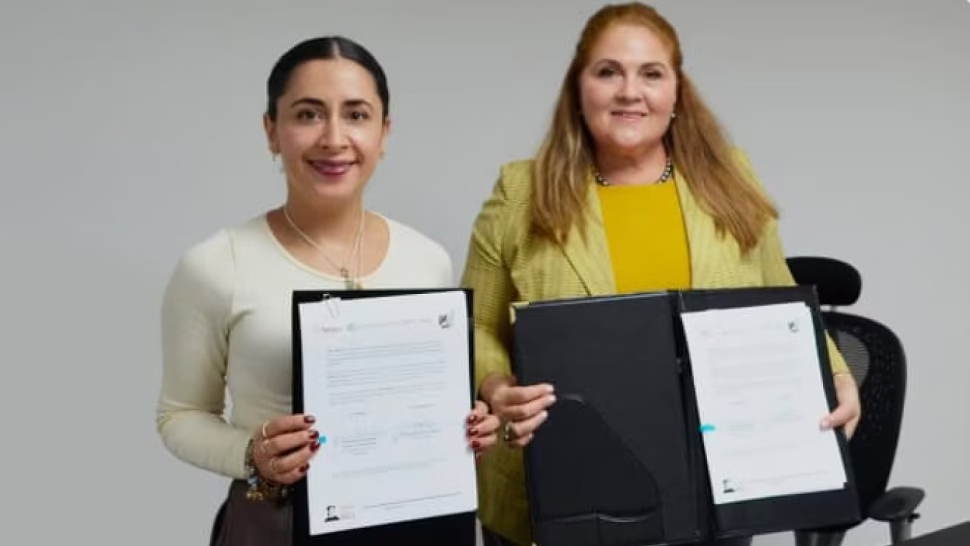
Mexican banks train 100,000 employees against human trafficking

Banks train 100,000 employees in the face of a 47% increase in trafficking victims in 2025.

Months before the 2026 Soccer World Cup, the Mexican banking system activated a national strategy to detect possible cases of human trafficking and financial operations linked to this crime. The objective is to respond to the risks that tend to increase in large-scale international events.

Massive training in branches

The Association of Banks of Mexico (ABM), the Citizen Council for Security and Justice of Mexico City and the United Nations Office on Drugs and Crime (UNODC) reported that nearly 100,000 employees of financial institutions are being trained to identify warning signs and channel reports on possible cases of exploitation.

RelatedMexico faces a trafficking crisis with 20 thousand minor victims annually

The initiative covers more than 11 thousand bank branches of the 54 institutions affiliated with the ABM. These participate in awareness and prevention actions at the national level.

The purpose is to strengthen the capacities of the financial system to detect operations that could be linked to trafficking networks and contribute to the protection of people in vulnerable situations.

According to data from the Executive Secretariat of the National Public Security System, during 2025 the number of trafficking victims in Mexico grew 47%.

Faced with this panorama, the organizations pointed out the importance of strengthening coordination between authorities, international organizations and the private sector to prevent crime and care for affected people.

The strategy coincides with alerts issued by the National Banking and Securities Commission (CNBV), the Financial Intelligence Unit (UIF) and the United States Financial Crimes Enforcement Network (FinCEN) about the risks associated with trafficking and money laundering.

As part of the program, UNODC and the Citizen Council developed training materials focused on identifying unusual financial movements, atypical transaction patterns and other risk indicators related to possible cases of sexual and labor exploitation.

Branches will also disseminate informational materials to help recognize early signs of trafficking and promote the Citizen Council’s National Anti-Human Trafficking Hotline and Chat. This service provides legal and psychological guidance, emotional support and accompaniment to victims 24 hours a day, free of charge, anonymous and confidential.

The initiative seeks to close spaces for resources from this crime to enter or circulate within the formal banking system.

Sheinbaum announces telephone alert for El Niño rains

Federal government activates telephone alert due to intense rains due to El Niño. Coordination with 32 states.

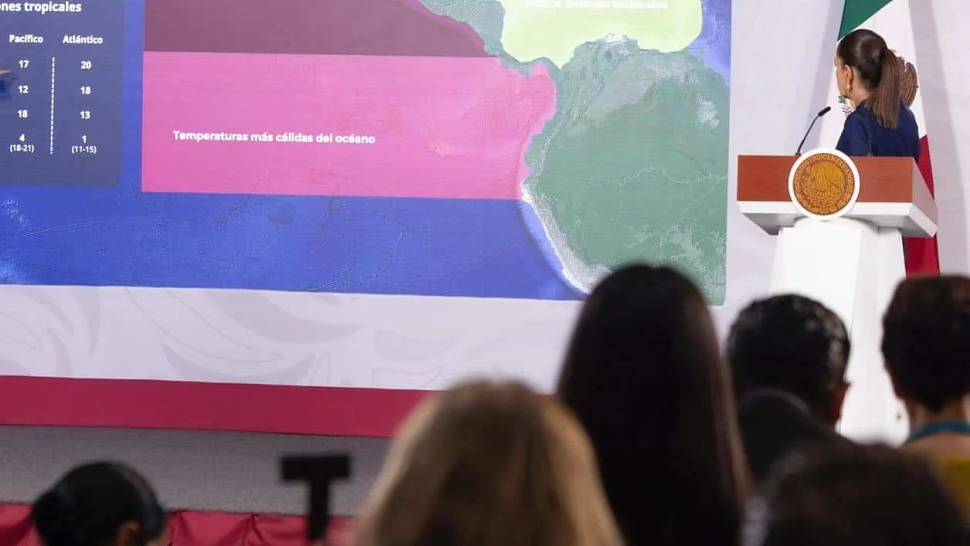
President Claudia Sheinbaum reported that in approximately two months a telephone alert system will be ready to notify the population about meteorological phenomena. The measure is part of the preventive actions against the intense rains that the El Niño phenomenon will bring.

“The objective is that in two months or so we will have the telephone alert ready so that all people, all Mexicans, can be informed,” he stated during the morning conference.

The system is developed in coordination with the Digital Transformation and Telecommunications Agency, the National Civil Protection Coordination and the National Meteorological Service.

Risks of the climate phenomenon

Fabián Vázquez Romaña, coordinator of the SMN, explained that El Niño—an interaction between atmospheric and oceanic temperatures that repeats every two to seven years—has a 63% probability of being very intense. The highest peak is expected to occur in December of this year and continue until 2025.

The consequences include heavier rain in the north of the country towards the end of the year, a greater probability of intense cyclones and possible drought in the center during the next year. “Whether the cyclones are going to reach the coast or not, we cannot know until a few days before,” he warned.

Actions in territory

Laura Velázquez, head of Civil Protection, explained that Command Posts are installed in the 17 coastal states. So far there are 11 formed; the rest will be completed next week. In addition, river and dam desilting, channel opening and barrier placement are carried out.

The agency maintains updated maps, monitors shelters and deploys teams throughout the country to serve the population. Coordination includes the 32 states, legal and expanded cabinets, and the National Water Commission.

Continue reading

Court analyzes whether decree on Frida Kahlo violates private property

The SCJN will review whether the 1984 decree that protects Kahlo's works is constitutional.

The SCJN reviews the decree that protects Frida Kahlo

The Supreme Court of Justice of the Nation (SCJN) will analyze the legality of the 1984 presidential decree that prevents the definitive export of works by Frida Kahlo. The plenary session admitted an injunction from the Ve por Más bank, owner of the oil painting Self-portrait with medallion, painted in 1948. The dispute pits the protection of cultural heritage against the right of private property.

Magistrate Giovanni Azael Figueroa promoted the case to establish whether the restrictions exceed the powers of the Executive. The Court will determine if the decree is constitutional.

Background: the Gelman collection

The review occurs in the midst of the debate over the Gelman collection, which includes 11 works by Kahlo loaned to Banco Santander. The Court’s resolution will set limits for future disputes over cultural property.

The ruling will be key to defining to what extent the State can intervene in the ownership of works considered national heritage.

Continue reading

IMSS and Fonacot update agreement to improve services for workers

IMSS and Fonacot renew their alliance until 2030 to streamline procedures and protect labor rights.

Strategic alliance for labor rights

The Mexican Social Security Institute (IMSS) and the National Fund for Workers’ Consumption (Fonacot) signed a collaboration agreement that updates their exchange of information and services. The objective: respond to the current operational, technological and regulatory needs of both agencies.

The agreement was signed by Wendolyne Retana Alarcón, general director of Fonacot, and Luisa Obrador Garrido Cuesta, director of Incorporation and Collection of the IMSS. It will be valid until September 30, 2030, with the possibility of extending it for two more years.

The relationship between both institutions dates back to 2007. Since then they have maintained a constant flow of data to facilitate procedures and guarantee better credit and social security conditions for working people.

With this update, the aim is to streamline processes, reduce response times and strengthen the protection of the rights of the country’s formal workers.

Continue reading