Artemis II astronauts reveal the human side of their lunar journey

The four crew members share their reflections after the perfect landing of the Orion capsule, highlighting the human side of the journey.

“We are a mirror that reflects you”

After a perfect splashdown in the Pacific Ocean, the four crew members of the Artemis II mission spoke for the first time. It was not a technical conference on rockets. It was something much more personal.

Commander Reid Wiseman summed it up this way:

“It is a special privilege to be human and it is a special privilege to be on planet Earth.”

He confessed that being more than 320 thousand kilometers from home was not easy. “Before launch, it feels like the biggest dream in the world. And when you’re out there, you just want to get back to your family and your friends.”

RelatedThe physical price of going to the Moon: the human body under siege in Artemis II

A connection that transcends technology

Victor Glover, the pilot, was grateful for “what we saw, what we did and being with those I was with.” He said the experience was “too big to fit into one body.”

Christina Koch shared two key moments. The beginning: When the mission manager knocked on her door and whispered, “Christina, we’re ready for launch. Get up.” And the ending: when a nurse on the ship asked her, “Ma’am, can I give you a hug?”

His reflection was profound:

“What struck me wasn’t necessarily just the Earth. It was all the blackness around it. The Earth was just this lifeboat suspended and undisturbed in the universe.”

Jeremy Hansen, the Canadian astronaut, was blunt: “You haven’t heard us talk much about science… because it is the human experience that is extraordinary to us.”

He spoke of the team’s commitment to returning to the “Train of Joy” after difficult times. And he left a powerful idea for everyone at home:

“When they look at us up here, they are not looking at us. We are a mirror that reflects you.”

Four people. A historic journey. And a clear message: beyond engines and computers, this was always about what it means to be human.

AI becomes a dating coach, but divides opinions

Users turn to chatbots to start romantic conversations, but doubts persist about authenticity.

The role of AI in modern romance

Marie Lansley recently arrived in San Francisco and, while looking for a partner, decided to try artificial intelligence. “I’ve tried everything,” says the 36-year-old engineer, who consults chatbots like ChatGPT and Claude to help her start conversations on dating apps. “I’m open to AI finding the love of my life, but I’m not totally convinced,” she says. “Chemistry is always going to be analog.”

More and more people are using chatbots to compose messages or interpret responses. Dating coach Carey Gaynes compares him to Cyrano de Bergerac: “You’re using a voice that’s not your own.” He worries about overdependence, although he recognizes that it can be useful.

Mason Naung, a 25-year-old student in Los Angeles, only turns to AI to break the initial ice. “If the messages go further, it would be a small warning sign,” he says. San Diego businesswoman Dani Cohen prefers an AI-written farewell message to being ghosted. “Anything that gets people to communicate in a friendly way is great,” he says.

Other voices are more critical. Clara Sullivan, a 22-year-old student, would not respond to a profile that uses AI. “It’s scary how dependent people are. It’s taken away the ability to think creatively,” he says. A Pew Research Center survey reveals that 53% of US adults believe AI will worsen creativity, and half think it will affect meaningful relationships.

Dating apps already integrate AI. Tinder has Chemistry, Hinge uses AI launchers, and Bumble plans to eliminate swipe to prioritize automated matching. Its CEO, Whitney Wolfe Herd, says that technology “should make love feel more human, not less.”

Mohammed Nizami, 23, does not use AI for dating. “We all crave authentic connection. If there’s a filter, it’s not a good way to start,” he says. Jake Clay, a content creator in New York, calls the situation a “vicious cycle” that bypasses sacred processes of life. “It’s sad to delegate something so fundamental to an AI that doesn’t understand emotions,” he laments.

Despite reservations, the merger between AI and dating seems inevitable. Efficiency gains ground, but authenticity remains the challenge.

Continue reading

NASA takes the 2026 World Cup ball into space and plays it on the ISS

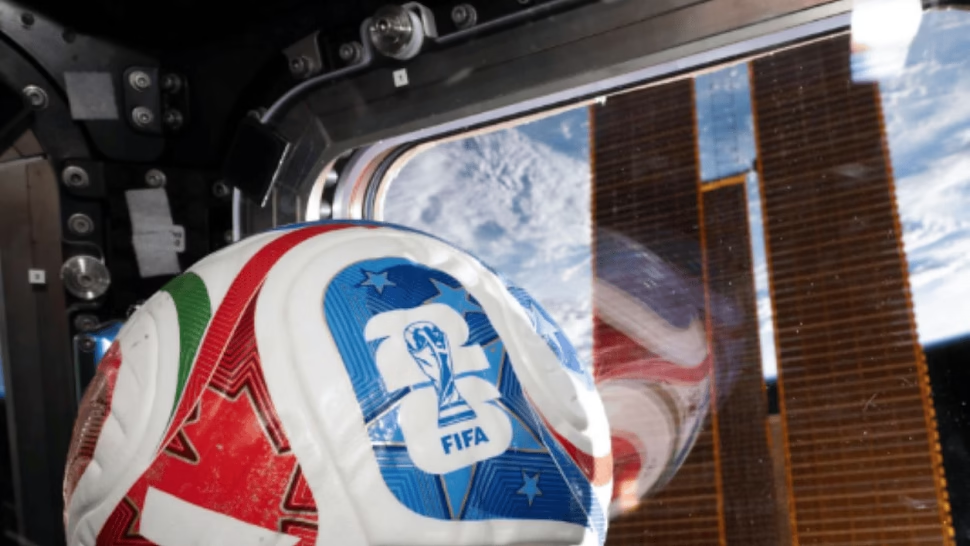
NASA sent an official 2026 World Cup ball into space and opened an exhibition in Houston.

World Cup ball arrives at the International Space Station

The fever of the 2026 World Cup permeated the atmosphere. NASA sent an official World Cup ball to the International Space Station (ISS). In a video shared on social networks, four astronauts are seen playing with the ball in microgravity. The message: “We work to inspire the next generation by showing how space exploration drives innovation in sports science.”

The agency seeks to disseminate how research on the ISS generates advances in science, technology and human health. Benefits that even reach the soccer field.

Exhibition at the FIFA Fan Fest in Houston

NASA set up an exhibit at the FIFA Fan Fest in Houston, Texas. It opened on June 11 at the start of the World Cup and will be available until July 19. Visitors can discover how space research improves life on Earth and learn about the Artemis program missions.

The exhibition explains how more than 25 years of studies on the ISS have helped understand the aerodynamics of the ball. According to a statement from the Johnson Space Center, previous research analyzed how internal mass, sensors and seam texture affect stability and rotation under real-play conditions.

Science applied to sports

As part of the project, NASA and Adidas present the “STEMonstration” demo. They compare how balls spin with different balance in microgravity. The objective: to show that space discoveries benefit athletes and fans of the most popular sport in the world.

Continue reading

Users report massive drop in X this Monday

Users report problems accessing social network X this Monday, June 22.

Cuts in X during Monday

Users of the social network X, formerly Twitter, reported this Monday, June 22, difficulties accessing and browsing the platform. According to data from DownDetector, a site that monitors digital failures, 1,131 people have reported problems with the application, loading the main feed and connecting to servers.

The most common issues include the inability to refresh the home page, errors when displaying posts, and crashes when using basic functions. When trying to log in, some see messages like “Something went wrong. Try loading again,” without the platform recovering.

So far, X has not issued an official statement on the origin of the failures or the estimated time to restore service.

Continue reading