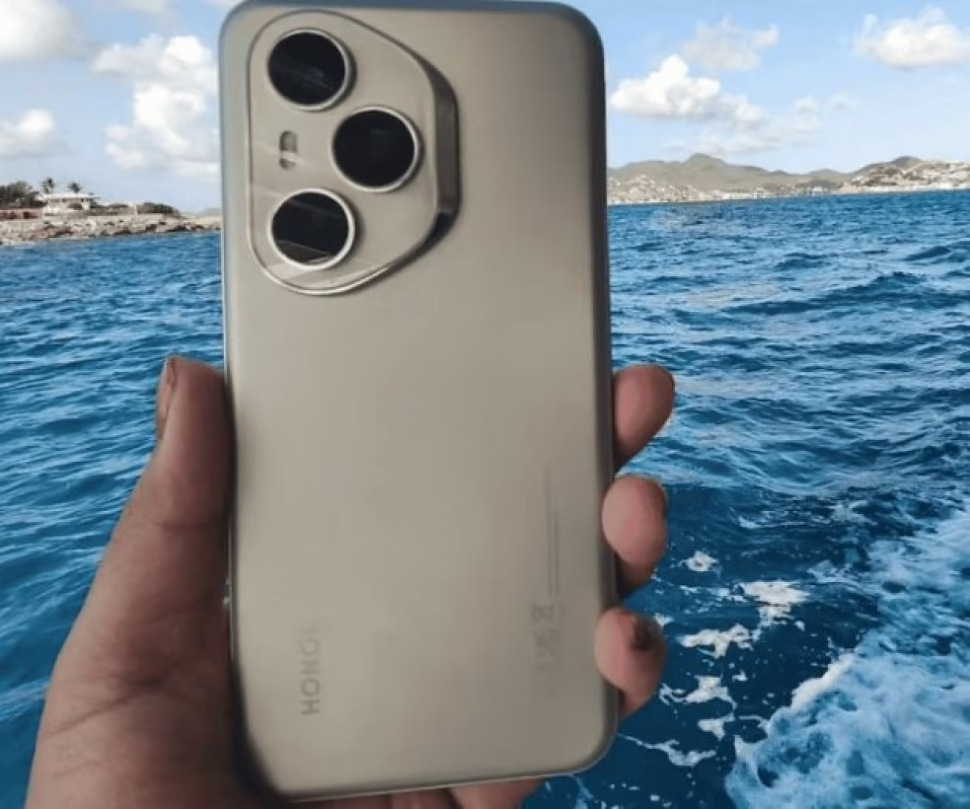
Technical Evaluation of the Honor 400 Pro: A Powerful Smartphone with Integrated Artificial Intelligence
After a fourteen-day evaluation period, we have thoroughly tested the Honor 400 Pro, a mobile terminal that the company categorizes as a “genuinely smart device.” This name, endorsed by David Moheno, Director of Communication and Public Relations of Honor Latin America, is not an empty slogan, but the reflection of a hardware-software architecture designed to integrate artificial intelligence in a native and transversal way.
The fundamental value proposition of this team lies in its ability to use AI algorithms to enhance critical functionalities, from the photo capture system to productivity and accessibility tools. Although a longer analysis would be ideal to evaluate its long-term durability, the testing time has been sufficient to identify its most notable virtues in a real use environment.
Artificial Intelligence Architecture and Computational Performance
The heart of the Honor 400 Pro experience is its artificial intelligence co-processor, which works in conjunction with Qualcomm’s Snapdragon 8 Gen 3 platform. This synergy is not limited to adding isolated functions; It constitutes the core of a computational strategy aimed at executing machine learning models directly on the device (on-device AI). This approach has crucial implications: real-time processing, lower latency and, as will be detailed, enhanced privacy by avoiding dependency on external servers.
Overall system performance is exceptionally smooth. During intensive testing, which included extended sessions of AI photography, video editing, and demanding multitasking, the device exhibited no thermal throttling or noticeable lag. This stability is a testament to the optimization between the high-performance chipset, internal heatsink and software, allowing demanding AI workloads to be sustained without degrading the user experience.
The autonomy is supported by a 6000 mAh battery with an adaptive energy management system. Most notably, this management intelligently prioritizes resources, maintaining efficient consumption even with the active and constant use of AI-powered functionalities, something that many competitors in the premium segment still fail to balance.
AI-Driven Features: An In-Depth Analysis
The implementation of artificial intelligence is materialized in five fundamental pillars that demonstrate its practical usefulness:
1. Camera System with Neural Processing:Beyond the impressive 200 MP main sensor, the differential value lies in the software. The Image to Video feature uses generative adversarial networks (GANs) to analyze a static photograph, understand its spatial context, and generate interpolated frames that create a short, dynamic video sequence. The algorithm is remarkably precise, avoiding deformations in subjects and objects, making it ideal for both everyday scenes and reliving memories in old photographs.
2. Productivity Tools with Local Processing:The automatic audio transcription function is one of the most effective. It uses a large language model (LLM) optimized to run locally. This ensures that conversations and voice notes are converted to text with high accuracy (if the audio source is clear) without data leaving the device. As David Moheno stated for Tech Bit: “The user remains fully the owner of their information. All co-processing is immediately deleted and nothing is used to train models.” This is a crucial technical stance on data privacy.
3. Simultaneous Translation with AI:The translation tool operates as a personal interpreter in real time. By employing neural translation models, it can process input speech and output oral and textual translation almost instantly. In tests of language pairs such as English-Spanish, the semantic and contextual accuracy was notable, positioning it as a viable tool for breaking linguistic barriers in international travel or communications.
4. Anti-Motion Sickness Function:This is a technically ingenious innovation. The system uses the phone’s IMU (Inertial Measurement Unit) sensors to detect the erratic movement typical of a moving vehicle. By identifying this pattern, the AI algorithm adjusts the visual representation on the screen (possibly through gentle stabilization and refresh rate adjustments) to compensate for the vestibular conflict that causes dizziness, allowing for prolonged reading without discomfort.
5. Intelligent System Optimization: Behind the scenes, AI manages resources, allocates memory and prioritizes processes to anticipate user needs, ensuring that the most used applications load quickly and that the battery is distributed as efficiently as possible.
In conclusion, the Honor 400 Pro represents a significant advance in the integration of artificial intelligence as a utilitarian and everyday element, not as a mere marketing feature. Its architecture guarantees performance, privacy and tangible utility. The overall impression is of a device that not only incorporates advanced technology, but applies it to solve real problems efficiently and safely.
Did you like this deep technical analysis?Share this article on your social networks so that more technology enthusiasts discover the future of mobile AI. Explore more content related to technological innovations in our specialized section.