Expansion of the Macuspana-Escárcega highway will boost the southeast

An investment of 21 billion pesos will transform the connectivity of the southeast, benefiting hundreds of thousands of people and generating thousands of jobs.

Strategic Announcement for the Connectivity of the Mexican Southeast

In an act of significant relevance for the infrastructural development of Mexico, President Claudia Sheinbaum Pardo made a formal announcement in the state of Tabasco. The central work of the statement is the expansion of the Macuspana-Escárcega highway, a large-scale project whose execution period is estimated at three years. This is not an isolated project, but a vital component within a broader national strategy aimed at strengthening the road network and economic integration of the southern regions of the country.

The president emphasized the primary function of this communication route, pointing out that it links the states of Tabasco, a portion of Chiapas and Campeche, also serving as a crucial corridor to the Yucatan Peninsula. This interconnection is fundamental not only for local traffic, but for the commercial and tourist dynamics of the entire southeast region, facilitating a more agile flow of goods, services and people.

RelatedSheinbaum reports progress in social programs in the southeast

Investment, Scope and Current Status of the Road Work

According to the technical details provided by the Secretary of Infrastructure, Communications and Transportation (SICT), Jesús Antonio Esteva Medina, the project is part of the modernization of Federal Highway 186, specifically in the section that goes from Villahermosa to Chetumal. The work consists of transforming this road into a four-lane artery, covering a total length of 250 kilometers. The financial investment committed to this great work amounts to the considerable sum of 21 billion pesos, which reflects the government’s priority in the development of transportation infrastructure.

Construction work is already underway. During the year 2025, the intervention of 16 kilometers began, strategically distributed between Tabasco (12 km) and Campeche (4 km). It is noteworthy to mention that the first section of the work already reports a physical progress of 80 percent, indicating substantial execution and an accelerated work pace that predicts compliance with the established deadlines.

Technical Characteristics and Tangible Socioeconomic Benefits

One of the most relevant technical aspects, detailed by the head of the SICT, is the specialized engineering incorporated into the design of the expansion. The new road has been designed to withstand large volumes of water and extreme humidity conditions. This feature is of vital importance in a region prone to flooding, since it will guarantee the operability and safety of the road during adverse weather events, minimizing the effects and ensuring the continuity of traffic.

The social and economic impact of this project is multidimensional. It is estimated that the work will directly benefit a population of 760 thousand people, improving their quality of life and access to services. In the labor field, the generation of a total of 34 thousand jobs is expected, distributed between direct positions in construction and indirect positions in the related production and service chains. This boost to employment represents a catalyst for the regional economy.

The announcement was attended by a high-level delegation, which underlines the inter-institutional coordination required for projects of this magnitude. Among the attendees were the governor of Tabasco, Javier May Rodríguez; the Undersecretary of Infrastructure, Juan Carlos Fuentes Orrala; the general coordinator of Development Programs, Carlos Torres Rosas; and the coordinator of Government Affairs, Leticia Ramírez Amaya. Key representatives of the executive and business sector were also present, such as the general director of the SICT Center in Villahermosa, Daniel Ochoa Leyva, and the representatives of the construction companies involved, Héctor Saúl Ovalle Favela, Ángel Lara Zúñiga, Saturnino Núñez Sánchez and Erick Reyes Hernández.

This infrastructure project stands, therefore, as a transformative axis for the connectivity and development of the Mexican southeast, with quantifiable benefits that will materialize in the coming years.

Do you think this type of investment in infrastructure is essential? Share this news on your social networks so that more people know about the projects that transform connectivity in Mexico and explore our section to discover more analysis on regional development.
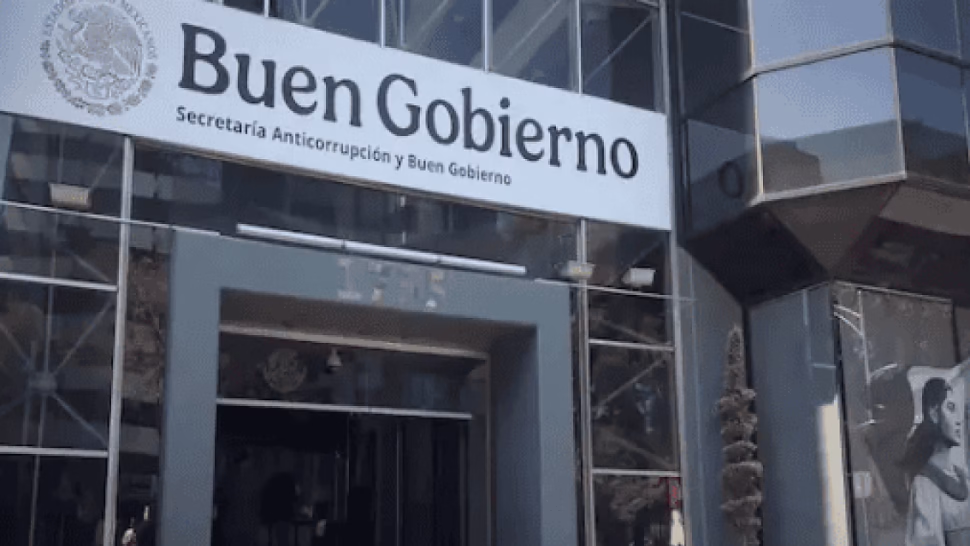

They sanction 13 public servants in nine agencies

13 officials from 9 agencies were sanctioned for non-serious administrative offenses.

The Anti-Corruption and Good Government Secretariat reported that it applied sanctions to 13 public servants from 9 agencies for non-serious offenses. Disqualifications range from 15 days to 3 months.

Details of sanctions

The investigations were carried out through the responsibilities units at Pemex and CFE, as well as the internal control bodies at IMSS, Defense, SNDIF, ANAM, INDEP, ASIPONA Manzanillo and Salud.

  • In Pemex, suspension for 30 days of Marlyn C and María F for not following up on the payment of post-mortem benefits of a worker between 2022 and 2025.
  • In CFE, 15 days of suspension to Josué S for registering requests for electricity supply without powers in 2024.
  • In IMSS, Víctor C was disqualified for 3 months for omitting medical treatment for a patient, which deteriorated his health until his death in 2022.
  • In Defense, private reprimand to Luis C for not integrating a clinical file in accordance with official standards in 2023.
  • In SNDIF, Ornela G is suspended for 15 days for abuse of a minor in 2025.
  • In ANAM, Tomas M, Brenda P and Hernán M are suspended for 15 days for failing to check the luggage of three passengers in 2023.
  • In INDEP, 15 days of suspension to José A and Omar G for signing an agreement that exceeded 20% of the contractual amount in 2023.
  • In ASIPONA Manzanillo, two suspensions of 10 and 12 days to Edmundo C for not managing budget adjustments in 2023.
  • In Health, public reprimand to Ana G for providing documentation with confidential information in 2023.

Reaction of the Secretariat

The agency explained that the sanctions were imposed in accordance with the law, considering proportionality and severity. Sanctioned people can challenge.

“The Anti-Corruption and Good Government Secretariat reaffirms its commitment to eradicate corruption in public life and promote ethics, honesty, integrity and good governance,” he said.

He invited people to report conduct contrary to legality at denuncias.gob.mx.

Continue reading

Sheinbaum in Acapulco: Women’s Pension and goodbye to La Parota

President delivers cards to 70,000 Guerrero residents and cancels dam project.

President Claudia Sheinbaum visited Acapulco, Guerrero, to lead the delivery of cards from the Pensión Mujeres Bienestar program. This scheme grants 3,100 pesos every two months to Mexican women between 60 and 64 years old.

Support for women and new works

During the event, the president stressed that the benefit recognizes the care work that women have historically carried out. Currently, almost 70 thousand people of Guerrero receive support, of which around 18 thousand reside in the port.

“When women walk together, there is nothing that stops us, we are the center of the Transformation, we are the history and future of Mexico,” stated Sheinbaum.

In terms of infrastructure, the president announced the definitive cancellation of the La Parota Dam project due to its effects on communities. Instead, wells and high tanks will be built to guarantee the supply of drinking water. Rehabilitation work will also be carried out after hurricanes Otis and John.

Sheinbaum reiterated his administration’s commitment to women and the sustainable development of Guerrero, prioritizing solutions that do not harm the social or natural environment.

Continue reading

They urge SEP to strengthen actions against bullying

28.5% of adolescents suffered bullying; They urge SEP to reinforce protection protocols.

The Second Commission of the Permanent Congress approved an opinion that urges the Ministry of Public Education (SEP) and the educational authorities of the 32 entities to reinforce strategies for preventing bullying and school violence. The request is part of the “Safe School Environments” program.

According to the National Discrimination Survey (ENADIS) 2022, carried out by Inegi, Conapred and the CNDH, around 28.5% of people between 12 and 17 years old have experienced some form of harassment or mistreatment at their school. The National Educational System serves more than 34 million students in 258 thousand basic, upper secondary and higher education schools.

The “Safe School Environments” strategy promotes co-responsibility between authorities, families and school communities to prevent risks and promote a culture of peace. The opinion highlights that this mechanism articulates guidelines, protocols and actions to guarantee safe, healthy and inclusive spaces, without restricting fundamental rights.

The legislators considered it necessary to maintain permanent prevention and care actions. The exhortation seeks to ensure that educational centers are environments free of harassment, with full respect for human rights and the best interests of children.

Continue reading