Latin America divides positions after the US military intervention in Venezuela

The region responds with divided voices and deep concern in the face of a military action that redefines the rules of the game and shakes the foundations of sovereignty.

A continent at the crossroads: between condemnation and hope

Latin America has shown the world the face of its deep political division! This Saturday, the reaction to the attack carried out by the United States against Venezuela, which resulted in the capture of President Nicolás Maduro, was immediate and came from all corners with diametrically opposite tones. Beyond the positions, a wave of concern about a new US intervention swept through the region, accompanied by urgent calls for dialogue and prudence. This historic moment invites us to reflect on the power of unity, even in the diversity of opinions, and how each nation can find its voice to advocate for peace and self-determination. Remember, in the midst of chaos, there is always room to build bridges and learn lessons that strengthen us as a global community.

The range of reactions: from frontal rejection to explicit support

Polarization was evident in official statements. Countries such as Colombia, Brazil, Mexico, Uruguay and Cuba condemned the military operation, although with different nuances, and demanded that the United Nations Organization act to seek a peaceful solution. On the other hand, governments aligned with Washington, such as those of Argentina, Paraguay, Ecuador and Bolivia, celebrated the departure of who they consider an illegitimate leader, expressing their hope that the result of the 2024 presidential elections will be imposed. the region; Each position represents the fight for what is believed to be right, and it is in that debate where the future is forged. Take advantage of this moment to inform yourself, to understand the different perspectives and form your own criteria, because knowledge is the first step towards conscious action.

RelatedThe United States carries out a military operation and captures Maduro in Venezuela

In the streets, the pulse of the Latin American people also beat strongly. Thousands of Venezuelans in the diaspora, part of the more than seven million who have left their homeland, celebrated the end of an era from Argentina to Florida, passing through Colombia. Meanwhile, in Havana, the Cuban government organized rallies in support of Maduro. Every celebration and every protest is a reminder of the power of human hope and the collective longing for a better tomorrow, whatever path is imagined to achieve it. Your voice and your story also matter in this great tapestry of human experiences.

The weight of history and the search for a path forward

The shadow of past interventions was present. In Panama, President José Raúl Mulino expressed his mixed feelings, remembering the North American invasion of 1989. His statement summarizes the complex duality that many feel: concern about foreign interference and, at the same time, a glimmer of hope for a possible return to democratic normality in Venezuela. History teaches us, shapes us, but does not condemn us to repeat it; We can learn from each chapter to write a new one full of greater wisdom and mutual respect. This is the time to embrace complexity, to understand that not everything is black and white, and to work with determination for solutions that honor the sovereignty and dignity of all peoples.

Leaders from across the region raised their voices with strong messages. The Colombian president, Gustavo Petro, warned about the management of a possible flow of refugees. Luiz Inácio Lula da Silva of Brazil warned about an “extremely dangerous precedent” that puts regional peace at risk. From Mexico, Claudia Sheinbaum highlighted the risk to stability, while her predecessor, Andrés Manuel López Obrador, criticized the action. At the other extreme, the Argentine Javier Milei openly celebrated, and the Ecuadorian Daniel Noboa sent a message of support to the Venezuelan opposition. Each of these voices is a call to reflection and action. They show us that, even in the deepest disagreements, there is an opportunity to passionately defend our principles and to build, from respect, a common horizon.

This crucial moment for Latin America is more than news; It is a call to collective conscience.The region faces a turning point that challenges its principles of sovereignty, non-intervention and peaceful resolution of disputes. The diversity of reactions underlines the absence of a unified vision, but also highlights the vitality of their democracies. The path forward will be paved by the capacity for dialogue, adherence to international law and the will to prioritize the well-being of people over geopolitical disputes. The future is written now, and every lesson learned today will be the basis for a stronger and more united region tomorrow.

Does this analysis resonate with you? The debate is open and your perspective is valuable! Share this article on your social networks to amplify the conversation and explore more content related to Latin American geopolitics and the challenges of democracy in our era. Together we can foster informed and constructive dialogue.
Trump threatens Iran with missiles after Ayatollah’s funeral

Trump warns Iran after Khamenei's funeral. Tension in the Persian Gulf.

Khamenei’s funeral sets off alarms

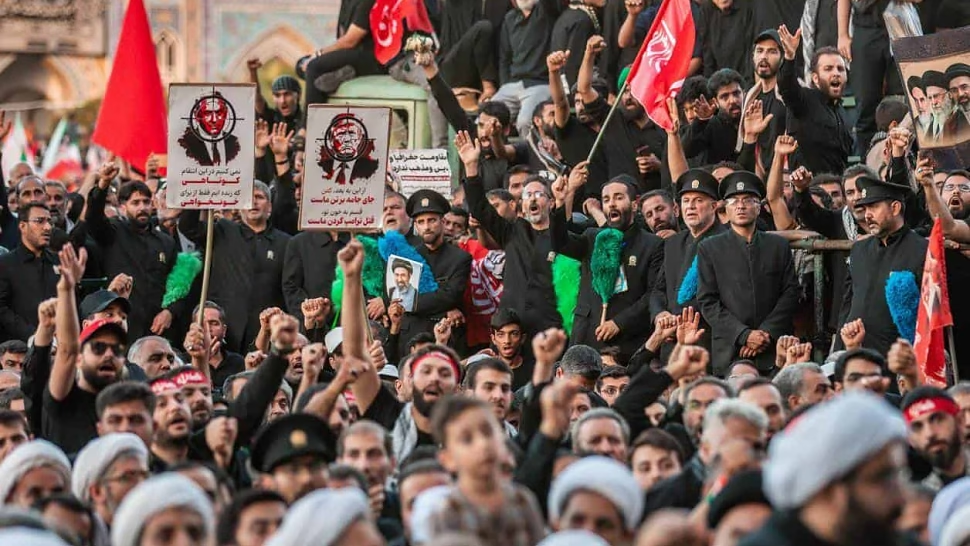
Mourners chanted slogans against President Donald Trump during the funeral of Ayatollah Ali Khamenei, Iran’s late supreme leader. The images traveled around the world and provoked an immediate response from Washington.

“We have 1,000 missiles ready and loaded against Iran. Thousands more will be used if they make an attempt on my life,” Trump wrote in Truth Social.

The warning came at a critical time. The ceasefire in the region remains fragile, and any spark could reignite a conflict that has left hundreds dead in recent months.

Cross demands

The United States also demanded that Tehran guarantee free navigation through the Strait of Hormuz, a key route for oil and gas trade. Iran rejected the claim and instead proposed charging fees to ships that cross its waters, breaking decades-old agreements.

Washington conditions any negotiations on Iran stopping attacks on commercial vessels and handing over its stockpile of highly enriched uranium. Tehran has ruled out both conditions.

Diplomats from Oman and Qatar try to mediate to avoid an escalation. But the clashes continue: in recent days, hostile actions left at least 17 dead and more than a hundred injured in Iranian territory.

The international community watches with concern. Control of the Strait of Hormuz and the Iranian nuclear program continue to be the most critical points between both powers, with the risk of a new crisis that impacts global energy markets.

Continue reading

South Africa requests US tariff exemption for forced labor

Pretoria asks Washington to exclude key products from a 12.5% ​​tariff.

South Africa seeks to avoid 12.5% tariff amid investigation into forced labor

The South African government has asked the United States to exclude it from a tariff proposal linked to a federal investigation into the enforcement of bans on imports of goods made with forced labor.

The South African delegation appeared this week before the Office of the United States Trade Representative in Washington, as part of a Section 301 investigation examining whether at least 60 countries are properly enforcing those bans.

South African representatives argued that the country has strong laws against forced labor and has ratified key International Labor Organization conventions. They also noted that goods produced through prison labor are already prohibited by their legislation.

The mission called for the proposed 12.5% ​​tariff not to be imposed on South African exports. It requested exemptions for key products such as platinum group metals, vehicles, citrus fruits, fish, shellfish, wine and nuts, ensuring that there is no evidence that they are produced with forced labor.

Trade relations between Washington and Pretoria have been strained in recent years due to disagreements over tariffs, South African internal policies and opposing positions in conflicts such as the war in Gaza.

Impact of the AGOA trade agreement

South Africa has long benefited from tariff-free access to the US market through the African Growth and Opportunity Act (AGOA). This program has supported billions of dollars in exports from sub-Saharan Africa. The program is set to expire unless the US Congress renews it.

Commerce Minister Parks Tau stated that the United States remains an important trading partner and that the government will continue to dialogue with Washington about the investigation and other current tariffs, such as those on steel, aluminum and automobiles.

After the hearing, the US Trade Office indicated that additional submissions will be accepted until Thursday before making a decision.

Continue reading

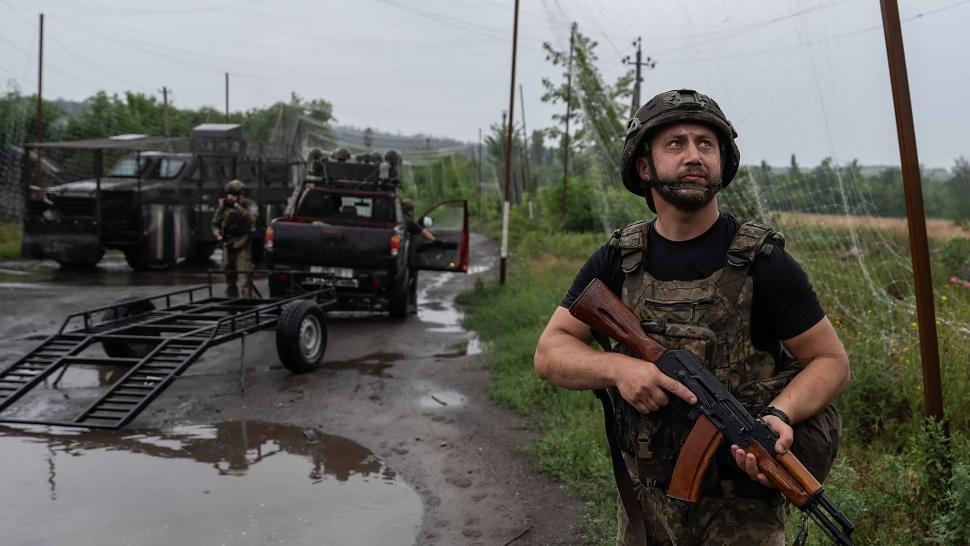
Russia erases the identity of Ukrainian children to turn them into soldiers

OSCE documents Russian system of indoctrination and militarization of deported Ukrainian children.

An independent mission from the Organization for Security and Cooperation in Europe (OSCE) documented a Russian system designed to erase the national identity of Ukrainian children and turn them into soldiers. The report, prepared through the Moscow Mechanism, reveals systematic practices of indoctrination and militarization from an early age.

Documented practices

According to experts, minors are exposed to compulsory pro-war propaganda from the age of six. Between 13 and 18 years old, they receive training in weapons handling, tactical medicine and drone operation.

In addition, the report points out the elimination of teaching in Ukrainian and the persecution against those who express their national identity. Upon reaching the age of majority, adolescents are forced to join the Russian armed forces to fight against their country of origin.

The investigation also indicates that children forcibly deported to Russia have suffered violations of international humanitarian and human rights law.

Possible crimes against humanity

Experts Hervé Ascensio, Elina Šteinerte and Stefan Wolff concluded that these actions could constitute a crime against humanity in the form of persecution, and identified probable war crimes. They recommend that the return of Ukrainian children be a central element of any peace negotiations, without exchanges, and that Russia be held accountable.

Ukraine’s response

Given this situation, the Ukrainian Foreign Ministry invited Mexico to join the International Coalition for the Return of Ukrainian Children, made up of 47 countries and three international organizations.

Continue reading