2026 World Cup Fan Fest takes shape in the capital’s Zócalo

Work is progressing for the FIFA Fan Fest in the Zócalo with a giant screen in front of the Cathedral.

The plate of the Zócalo in Mexico City already shows the first traces of what will be the FIFA Fan Fest of the 2026 World Cup. A large metal structure rises in front of the Metropolitan Cathedral to support a screen where the matches will be broadcast.

The work began approximately 15 days ago. In the place, right in front of the capital’s Government buildings, beams and stairs can be seen at one end. Installation progresses steadily as crews place the supports that will hold the large screen.

RelatedJ Balvin closes the Flow Fest with a tribute to his eras

Activities and planned capacity

The FIFA Fan Fest will be open to the public from June 11 to July 19, 2026. According to information from the Government of Mexico City, it is expected to receive up to 55 thousand people per day in the Plaza de la Constitución.

In addition to the broadcast of the World Cup matches, the festival will have food and drink sales, as well as cultural and recreational activities for attendees. Admission will be free and the event seeks to bring together football fans in the heart of the capital.
Mexico sends humanitarian support to Venezuela after earthquakes

Mexico sends rescue team to Venezuela after earthquakes that left dozens dead.

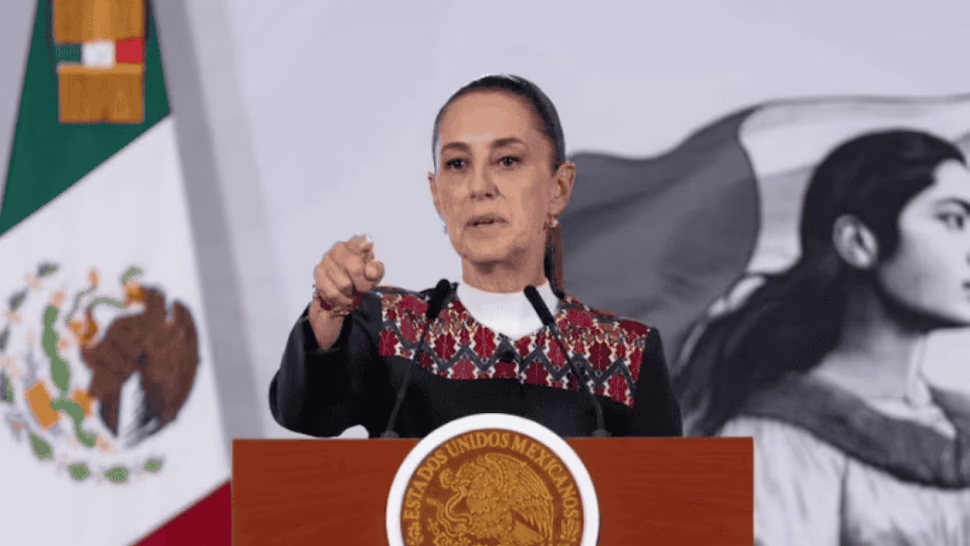
President Claudia Sheinbaum expressed the solidarity of the Government of Mexico with Venezuela after the earthquakes registered this Wednesday, which left dozens of people dead and injured.

During his conference, Sheinbaum reported that this same day a team from the Secretariat of National Defense (Defense), composed of rescuers and health personnel, will leave to collaborate in the emergency.

“Before continuing, our solidarity with the people of Venezuela. Today a team from the Secretariat of National Defense of rescuers and health personnel leaves to reach Venezuela,” he said.

Coordination with Venezuelan authorities

Sheinbaum explained that, once installed in the affected area and after coordinating with local authorities, the need for more support will be evaluated.

“And once we are installed there and having spoken with the authorities, tomorrow we will determine additional personnel that are required to always be able to help the towns that need it,” he added.

The president reiterated Mexico’s commitment to providing humanitarian aid in the face of natural disasters.

No Mexicans affected

Sheinbaum reported that, so far, the Mexican Embassy in Venezuela does not report injured or deceased compatriots.

“At the moment we do not have any communication from the Mexican Embassy in Venezuela, no injured Mexican has been reported, unfortunately deceased, but we are under permanent review,” he indicated.

He explained that the sending of aid was decided after contact between Foreign Minister Roberto Velasco and Venezuelan authorities, who requested trained personnel, not food or supplies.

The federal government will send 250 soldiers, five dogs, four aircraft, a drone, search and rescue tools, as well as equipment and healing materials.

Continue reading

CRT gives new deadline for registration of prepaid lines

Prepaid cell phone registration is extended: know the dates by digit

The Telecommunications Regulatory Commission (CRT) extended the deadline for prepaid cell phone users to link their line to the CURP. The new deadline is December 31 of this year, but not everyone has the same time: the calendar depends on the last digit of the phone number.

Calendar by digit

According to an official statement, the CRT assigned a specific period between August and December for each line. The objective is to organize the registration and improve the low participation registered until now. The telephone company will be in charge of making the connection once the user presents their documentation.

The process seeks to ensure that all prepaid lines are associated with the name and CURP of the owner. This, according to the CRT, will facilitate the identification of users and strengthen security in the use of telecommunications services. So far, the response has been insufficient, which led to the extension of the deadline.

Users should consult their telephone number to know the exact date on which they must complete the procedure. The CRT recommends not waiting until the last few days and going to your operator in advance.

Continue reading

Sheinbaum highlights record in clean energy and economic rebound

Sheinbaum reports historic growth in renewables and low inflation at 3.55%.

Economy and energy: the president’s announcements

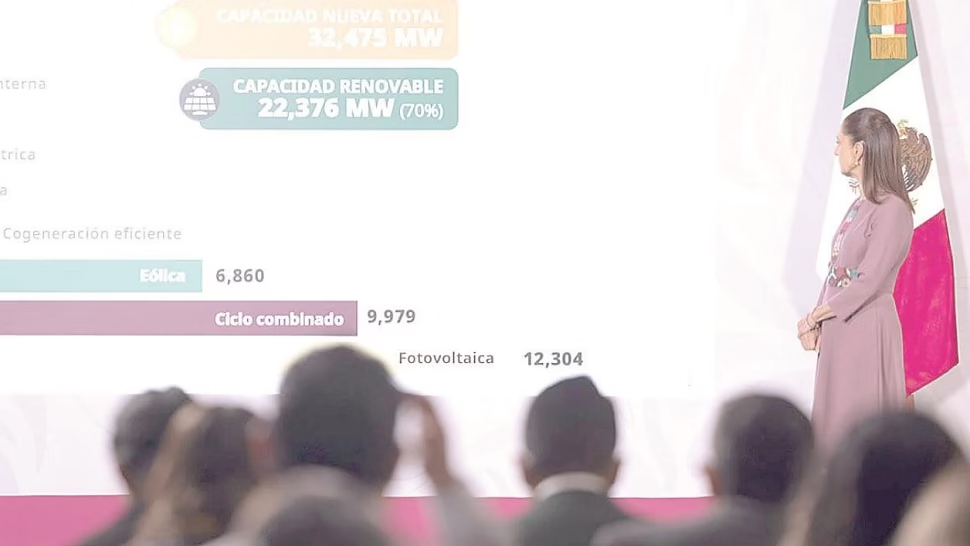
President Claudia Sheinbaum reported that, for the first time, Mexico has projects for 32 thousand megawatts of additional electrical capacity, of which 70% are renewable. “When we leave the government, natural gas consumption will decrease and energy generated by renewable resources will increase,” he stated.

Sheinbaum also highlighted economic growth. According to Inegi, the Global Indicator of Economic Activity (IGAE) rose 1.2% in April compared to March, the best advance since 2021. The annual rate reached 2.2%. The president attributed this to the boost in construction, especially the housing program.

Regarding inflation, the president pointed out that it fell to 3.55% annually in the first half of June, its lowest level since October 2025. This is due, she said, to agreements with gas stations to set maximum fuel prices and the Package Against Inflation and Scarcity (Pacic) to control the basic basket.

Energy transition with 32 thousand megawatts

The Secretary of Energy, Luz Elena González, explained that by 2030 32 thousand megawatts will be added; 22 thousand will be renewable. The goal is for at least 38% of generation to be clean to meet climate commitments. He assured that the CFE will maintain its majority participation, providing 61% of the electricity at the end of the six-year term.

The director of CFE, Emilia Calleja, explained the projects. In Baja California Sur, the Oasis System will combine solar energy, batteries and green hydrogen to supply Mulegé and 40 thousand homes. It includes a 72 megawatt plant, 20 megawatt storage and will produce 120 cubic meters of water per year, avoiding 94 thousand tons of CO2.

In Sonora, the “Rafael Galván” photovoltaic plant in Puerto Peñasco will reach one thousand megawatts of capacity and 246 megawatts of storage. It currently provides 400 megawatts. The investment exceeds 1.4 billion dollars. “They are environmental benefits that strengthen energy sovereignty,” concluded Secretary González.

Continue reading