Xiomara Castro begins official visit to strengthen ties with Mexico

The Honduran president begins a state visit to deepen the strategic alliance and regional development projects.

A Diplomatic Meeting to Consolidate the Strategic Alliance

The president of Mexico, Claudia Sheinbaum Pardo, will hold a high-level official meeting this Tuesday with her counterpart from the republic of Honduras, Xiomara Castro. The central objective of this presidential summit is to strengthen the bilateral bond between both nations, as well as to promote mechanisms of collaboration and mutual assistance that generate tangible benefits for the stability and progress of the Mesoamerican region. This diplomatic act represents a significant step in the redefinition of international relations under the new administrations.

Prior to the meeting at the National Palace, the Honduran head of state was received at the Military Air Base Number 19 by the Mexican Foreign Minister, Juan Ramón de la Fuente, who led the welcome ceremony with all the corresponding protocol honors. The reception ceremony, an essential component in State diplomacy, symbolizes the institutional respect and importance that Mexico attaches to this visit. The Ministry of Foreign Affairs (SRE) confirmed the agenda through its official communication channels, underlining the fraternal nature of the meeting.

RelatedSheinbaum and Castro strengthen bilateral cooperation in historic meeting

A Delegation That Reflects Bilateral Commitment

The welcoming committee was made up of a high-ranking delegation, demonstrating the meticulous planning and strategic relevance assigned to this visit. Among the personalities present were the undersecretary for Latin America and the Caribbean, Raquel Serur; the general director for Central America and the Caribbean, Imanol Belausteguigoitia; and the ambassador of Honduras in Mexico, Sonia Leticia Cruz Lozano. The participation of these officials is not merely protocol; It facilitates the continuity of technical dialogues and ensures the effective implementation of the agreements derived from the summit.

The Mexican Ministry of Foreign Affairs emphasized that both countries are in a process of strengthening their fraternal bilateral relationship, an association designed to directly benefit their populations and promote harmony and cooperation for the comprehensive development of the region. The adjective “fraternal” used by the chancellery is not coincidental; It denotes a relationship that transcends diplomatic formalisms to be based on historical, cultural and solidarity ties. The cooperation schemes that will be analyzed will probably cover critical areas such as socioeconomic development, regional security, commercial exchange and the management of migratory flows, all of them fundamental pillars for the stability of Central America and Mexico.

From an analytical perspective, this visit is framed in a broader geopolitical context, where Latin American nations seek to strengthen their autonomy and build blocks of south-south cooperation. President Sheinbaum’s administration has indicated that its foreign policy will prioritize relations with the countries of the region, and this meeting with a key leader like Xiomara Castro constitutes the first concrete action in that direction. For Honduras, this approach represents a strategic opportunity to diversify its international alliances and attract investment and knowledge that support its internal development. The success of these agreements will depend on the ability of both nations to establish clear goals, monitoring mechanisms and sustainable financing, transforming declarations of intent into measurable results for their citizens.

Did you find this analysis of diplomacy in Latin America interesting?Share this article on your social networks to expand the conversation and explore more content related to foreign policy and international relations on our platform.
Pride 2026: health, housing and education for trans people

Thousands march in CDMX to demand an end to discrimination and lethal violence.

Demands and resistance in the Zócalo

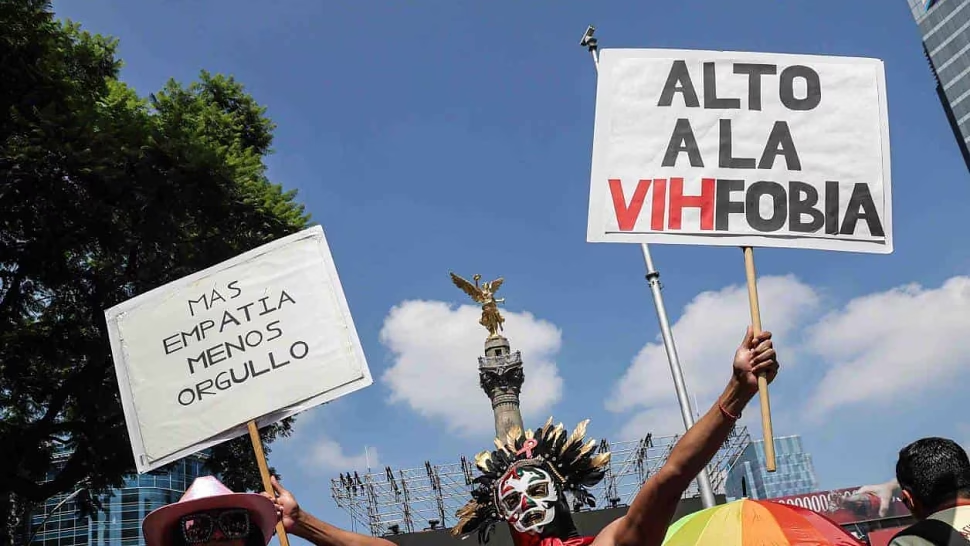
Neither the rain, the wind nor the World Cup Fan fest stopped the crowd. The Pride March, in its 48th edition, arrived at the capital’s Zócalo with a clear demand: guarantee health, housing and education for trans people.

Hundreds of thousands of people celebrated their identity, but also raised their voices for those who are no longer here. The protest reiterated the urgency of eradicating discrimination, stigma and hate crimes against the LGBTTTIQ+ community.

From 9 a.m. on Saturday, June 28, groups of relatives of missing people, organizations supporting trans women, LGBT people with disabilities, sex workers and HIV patients took to the streets. They demanded security and attention to these populations, and shouted between multicolored flags:

“It’s a march, it’s not a business. Companies with a homophobic history are marketing a historic movement.”

The speeches denounced the exclusion of sexual diversity from social programs. They demanded that the government and companies not take ownership of the fight. “This march does not belong to those who profit from our identities,” they stated.

People from various generations and states walked hand in hand. Mothers proudly accompanied their gay and lesbian children. In 2026, many LGBT youth still face family rejection.

Search groups demanded recognition of the social family—friends who search for their missing people. The Contingent Against LGBTTTIQ+ Disappearances pointed out in front of the Glorieta de Las y Los Desaparecidos:

“We demand that the State harmonize the General Law of Victims to fully recognize the social family.”

Trans and non-binary activists called for an end to the criminalization of the sit-in that they have held at the Ministry of the Interior for 10 days. They were the only group monitored by hundreds of police, despite their peaceful protest. They declared:

“They judge us for our sexual orientation, not for the human being we are. That has made our lives impossible.”

People with disabilities, patients with HIV, victims of hate and workplace discrimination joined in. The march traveled along emblematic avenues to the Zócalo, where there were open microphones and hours of joy. In the end, a slogan united everyone: stop hate crimes and transfemicides.

Continue reading

Mexico and the US inaugurate a binational sterile fly plant in Chiapas

The cooperation between Mexico and the United States produces results: 100 million sterile flies weekly to protect livestock.

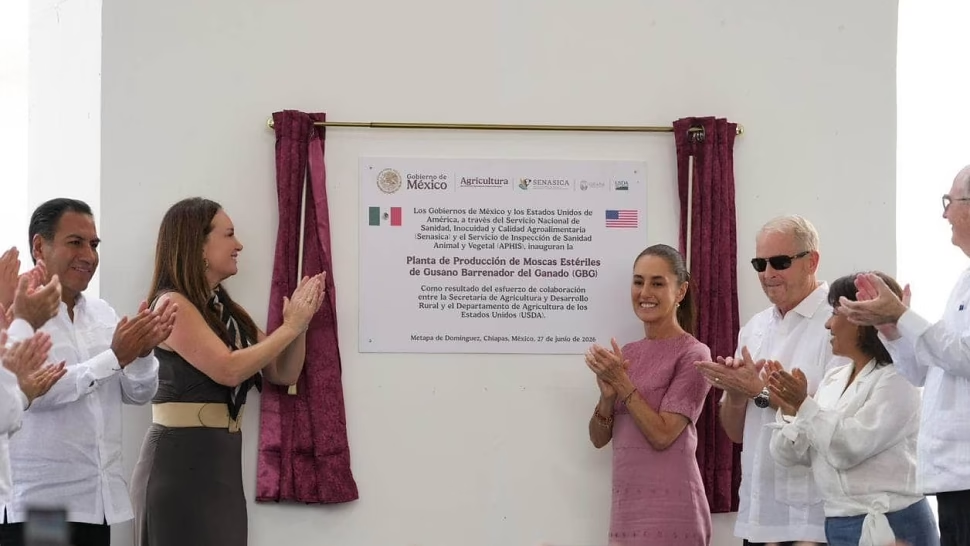
President Claudia Sheinbaum inaugurated the Production Plant for Sterile Livestock Screwworm Flies (GBG) in Metapa de Domínguez, Chiapas. It is a binational facility that will produce 100 million insects each week to control the pest that affects livestock.

Cooperation that pays off

The president highlighted that this project is the result of joint work between Mexico and the United States. The US government provided most of the resources, as well as technical expertise. Sheinbaum thanked President Trump and US Secretary of Agriculture Brooke Rollins.

“This Plant represents the conviction that development cooperation produces results. Animal diseases, pests and food security challenges know no borders,” said Sheinbaum.

Rollins called the inauguration a great achievement and recognized Sheinbaum as an extraordinary ally.

The United States ambassador to Mexico, Ronald Johnson, announced an additional investment of $83.8 million to strengthen pest control and increase the production of sterile flies in Mexico.

Operation details

Construction of the plant lasted 12 months. As part of the containment strategy, 5.3 million heads of cattle have been inspected, more than 84 thousand shipments have been verified and 7 billion sterile flies have been released. 2 thousand specialists, more than 400 thousand planters and 4 thousand technicians from the Sembrando Vida program participated. 578 thousand artisanal traps were installed, with which more than 13 million flies were captured.

Sheinbaum closed with a message: “Cooperation between sovereign countries will always be more powerful than confrontation when it comes to protecting the well-being of our people.”

Continue reading

One year after the discovery in a crematorium, families march for justice

One year after the discovery of 386 bodies, families demand justice and an end to corruption.

March for justice one year later

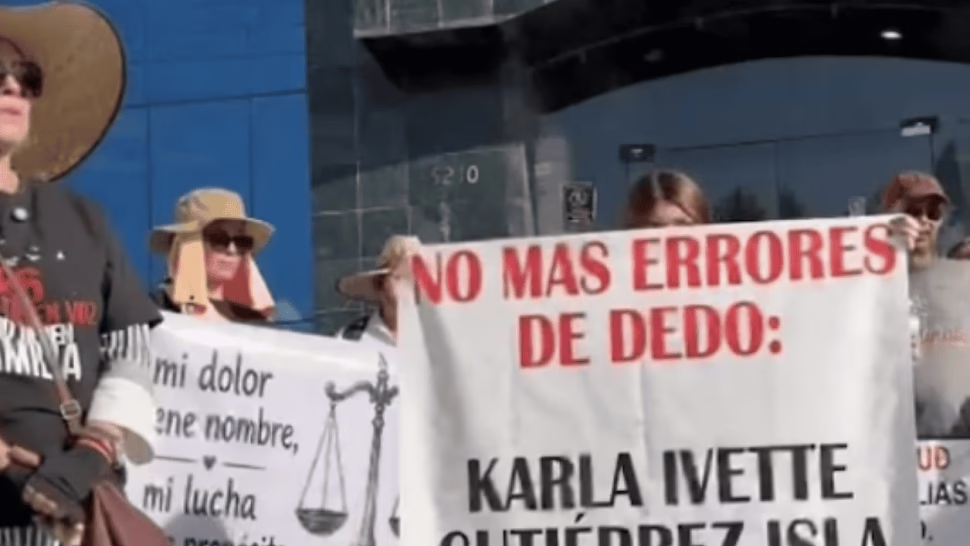
On Saturday afternoon, groups of families affected by the Plenitude crematorium case demonstrated. The discovery of 386 bodies turns one year old, and the bereaved demand answers.

The protest began at the Latinoamericana funeral home, one of those identified by family members. From there, the protesters walked towards the State Attorney General’s Office (FGE).

Dora Elena Delgado, spokesperson for the Justicia para Nuestros Deudos collective, reported that at least 1,500 families were affected. The central demand: no more impunity, no more corruption and full justice.

Actions pending by the authority

The protesters carried blankets with messages of justice. They demand action against Coespris officials involved in the case, as well as the recapture of José Luis A. C., owner of the crematorium. He was released by a federal judge, and a red card from Interpol is expected to arrest him again.

So far, of the 386 bodies found, the FGE reports that 135 remain to be identified. The identification process continues.

The collective Memory, Dignity and Justice joined the mobilization. They placed a permanent memorial in the shape of a cross outside the Prosecutor’s Office, as a reminder of the victims.

Continue reading