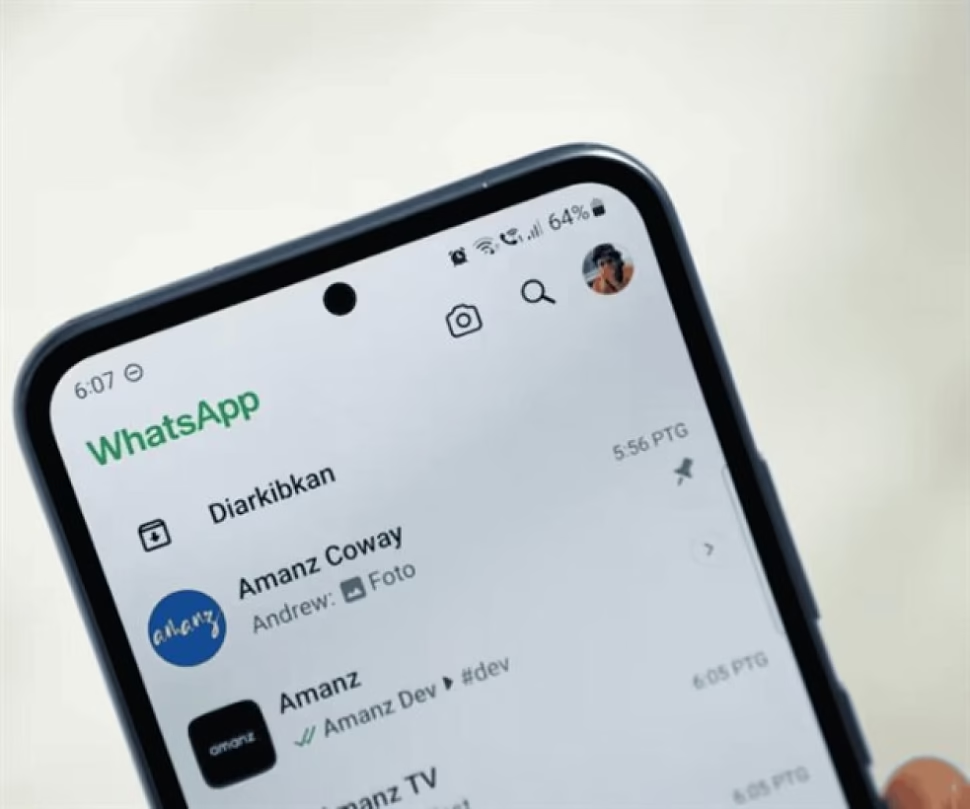
WhatsApp implements three functions to optimize communication

Discover the tools that will transform the way you send files and organize your group conversations on the platform.

Analysis of the new WhatsApp features

The instant messaging platform WhatsApp, owned by Meta Platforms, has recently deployed a set of three technological innovations designed to significantly optimize the user experience. This implementation responds to a continuous strategy of evolution of the application, focused on solving specific problems identified in contemporary usage patterns. The integration of these tools is progressively available for iOS and Android operating systems, following the usual protocol of staggered releases that characterizes the company.

Technical breakdown of the new features implemented

A close examination of the functionalities reveals a three-pronged approach that addresses organization, personal expression, and practical utility. First, contextual group search represents an advanced algorithmic solution to a common challenge: locating group conversations within an extensive list. This tool is not limited to searching by group name, but uses a cross-indexing system that allows you to find chats by identifying their members. The mechanism operates by analyzing the contact database and cross-referencing with the participants of each group, thus offering an alternative for retrieving information when memory of the specific name fails.

RelatedElimination of junk files in WhatsApp to optimize space

Secondly, the introduction of new seasonal sticker packages constitutes an expansion of the non-verbal communication repertoire available. These graphic elements, beyond their recreational function, facilitate the transmission of emotions and contexts that plain text may not fully capture. From a semiotic perspective, they enrich digital dialogue by providing a complementary visual language that can make interactions more expressive and dynamic. It is accessed through the standard emoji interface, maintaining consistency in the user experience.

The third and perhaps most substantial innovation is the integrated document scanner. This feature uses the mobile device’s camera sensor to capture, process and digitize physical documents with quality optimized for archiving or sending. The process involves edge detection algorithms and perspective corrections, allowing for the generation of clear digital versions of receipts, tickets or identification documents. The ability to export the result in PDF format and apply orientation adjustments and enhancement filters represents a significant step forward towards consolidating WhatsApp as a multipurpose tool, reducing the need for external applications for basic digitization tasks.

Deployment methodology and availability considerations

It is crucial to understand that the deployment of these functionalities follows a progressive distribution or “gradual rollout” methodology. This approach allows engineering teams to monitor performance, identify potential issues, and make adjustments in real time before a mass deployment. Therefore, immediate availability for the entire user base of approximately two billion people is not guaranteed. Factors such as operating system version, device model, and geographic region influence the timing of receipt of these updates. Patience and periodic checking of application updates in official stores are recommended for those users who do not yet see these tools in their interfaces.

From a technological evolution perspective, these additions reflect a broader trend in the messaging application ecosystem: the transition from basic communication platforms towards multifunctional environments that integrate diverse utilities under a unified user experience. This strategy responds to the growing user demand for applications that consolidate functionalities, reducing fragmentation between different digital tools and optimizing personal and professional workflow.

Did you find these innovations useful? Share this analysis on your social networks to inform your community and explore more content related to trends in technology and digital communication on our website.


Brain chips restore mobility and voice to patients

Two studies in Nature Medicine show advances in brain chips for ALS and Parkinson's.

Advances in brain-computer interfaces

Two investigations published in Nature Medicine confirm that neurotechnology is no longer science fiction. A man with severe amyotrophic lateral sclerosis (ALS) managed to communicate from home thanks to an implantable chip, used for two years. The study, led by Sergey Stavisky and David Brandman (University of California, Davis), is the first to demonstrate that these devices can be operated outside the laboratory.

“It is an important step forward, although it remains to be seen whether it can be generalized,” said Luca Berdondini, a researcher at the Italian Institute of Technology (IIT) in Genoa.

In the second study, coordinated by the Federal Polytechnic School of Lausanne (EPFL) and the University Hospital of Lausanne (CHUV), 40 Parkinson’s patients improved their gait. A chip combined with artificial intelligence interprets brain activity in real time and adjusts electrical stimulation autonomously. The technique, used for 30 years, is now becoming much more adaptable.

The challenge of bringing technology to the clinic

Both cases reflect a global career. Berdondini warns that “Europe risks falling behind the United States and China” due to regulatory barriers. Although European research has advanced, the transition from trials to clinical application needs to be accelerated, respecting ethics.

The arrival of Elon Musk’s Neuralink accelerated the pace. “These results are a stimulus for companies, because they show that the path is viable,” concluded the researcher. The challenge now is to bring these findings to more people and ensure that technological competition does not leave Europe behind.

Continue reading

World Cup 2026: the technology that will transform how you watch football

Data, AI and 3D avatars will change the fan experience at the trinational tournament.

Almost 50 teams, three countries and more than one hundred matches. The 2026 World Cup will not only be the largest in history, but it will also transform the way we watch football from home. Artificial intelligence and advanced statistics will be the protagonists.

Tools like Football AI Pro, created with Lenovo, will help coaches prepare for matches and detect weak points. For the viewer, the data will be converted into graphs and summaries that explain what is happening on the court.

How the experience changes

In Qatar 2022, 12 cameras were already used to track the ball and 29 body points of each player 50 times per second. By 2026, that level of detail will be the norm. Stats will no longer be cold numbers: defensive lines, heat maps and movement patterns will be displayed.

In addition, the organization announced 3D avatars to recreate plays and referee decisions. Thus, tactical concepts such as high pressure or compact block will be visual and easy to understand.

The 2026 World Cup will maintain the excitement of goals and surprises, but with tools that allow us to better understand the game. Technology does not take away passion, but rather adds context.

Continue reading

Meta faces failures on Facebook, Instagram and WhatsApp

Users report intermittencies in Meta applications during the morning.

Failures in Meta services

Since this Wednesday morning, users of Facebook, Instagram, WhatsApp and Messenger reported interruptions in the operation of these platforms. The DownDetector site, which compiles crash reports, recorded an increase in complaints starting at 7:41 a.m.

According to the data, Facebook reached its peak of reports at 8:11 with 5,245 incidents. The main problems were concentrated in the application (47%), login (33%) and connection to the server (16%).

Messenger also had bugs. Its highest peak occurred at 7:48 with 260 reports. The most common difficulties were logging in (67%), the app (24%) and messaging (7%).

In the case of Instagram, reports increased until 8:20 with 326 complaints. 68% of users reported problems with the app, 14% with the connection to the server and another 14% with the login. The Tech Bit team confirmed difficulties when trying to publish stories, which could be related to the same bug.

WhatsApp, for its part, also suffered interruptions. 47% of the reports indicated problems with the web version, while 23% mentioned errors in the app and 16% in the login.

So far, Meta has not issued an official statement about the causes of these failures. Users are advised to stay tuned for updates.

Continue reading