
Optimize WhatsApp performance by deleting cache memory

Discover the technical procedure to optimize the operation of the application and solve slowness problems effectively.

The Importance of Cache Management in WhatsApp

WhatsApp, Meta’s instant messaging application, implements a caching system that temporarily saves frequently used multimedia content and data. This mechanism is designed to speed up the loading speed of conversations, images and files, improving the user experience by reducing waiting times. However, when this temporary storage accumulates an excessive volume of data, it can generate the opposite effect: a significant slowdown in application performance, failures in the execution of specific functions and a disproportionate consumption of the device’s internal storage capacity.

The uncontrolled accumulation of temporary files not only affects WhatsApp, but can negatively impact the overall functioning of the smartphone’s operating system. Performing a free up space periodically is not a mere recommendation, but an essential digital maintenance practice. This procedure helps optimize performance, eliminate errors or ‘bugs’ that arise from conflicts with obsolete data, and ensures that critical application updates are installed correctly, taking full advantage of new features and security patches.

RelatedElimination of junk files in WhatsApp to optimize space

Technical Procedure for Deleting Cache in iOS

For users of the iOS ecosystem, the storage management process is carried out in an integrated manner within the application itself. The operating sequence is as follows: access the Settings application on your iPhone and scroll through the menu until you find the ‘Storage and data’ option. Within this section, select ‘Manage storage’. The interface will present you with a detailed analysis of the conversations, ordering them by the space they occupy.

In the ‘Search for chats or channels’ section, identify and select the conversation threads that contain the largest files. To proceed with deletion, long-press on a conversation and activate the ‘select’ button to choose multiple items. If your goal is to completely empty the media history of a specific chat, you need to enter the conversation, tap the contact or group name at the top of the screen, hold it, and finally choose the ‘Delete Messages’ option from the context menu. It is crucial to understand that this action is irreversible.

Cleaning Methodology for Android Devices

The Android operating system offers more granular control over the data stored by applications. To run a deep clean, go to your phone’s General Settings, then ‘Applications’ and select WhatsApp. Within the application information, tap on ‘Storage’. Here you will find two fundamental options: ‘Clear cache’ (which deletes only temporary files without affecting your personal conversations) and ‘Clear data’ (which resets the application completely, deleting all information and requiring a new login).

For more selective management, within the WhatsApp app itself, access ‘Settings’, ‘Storage and data’ and ‘Manage storage’. This utility will allow you to view all saved multimedia files, with the ability to filter them according to their weight (MB/GB) or age. You can individually select the items to delete or use the ‘Select All’ function for a mass purge. Confirm the action by pressing the ‘delete’ button, keeping in mind that this operation entails a permanent deletion of the files.

A scheduled review of storage space, either through the operating system tools or those integrated into WhatsApp, is essential to maintain a healthy device. The application itself usually notifies users when it detects data saturation that requires manual intervention to effectively free up space. However, it is important to note that some digital residue can persist in the internal memory of the cell phone. Therefore, it is recommended to complement this process with a periodic cleaning using the ‘Files’ or ‘File Manager’ app on your Android device, thus ensuring an optimal operating state of both the application and the system.

Did this tutorial help you optimize your WhatsApp? Share this technical guide on your social networks to help more users improve the performance of their applications and explore our related content to discover more advanced maintenance and digital productivity tips.

Satellite Internet, the bet to close the digital divide in Mexico

Mexican geography limits fiber deployment, but low orbit satellites are emerging as an alternative.

Satellite internet as a solution to the digital divide in Mexico

Mountains, jungles and deserts make Mexico one of the countries with the most complex orography in Latin America. Bringing fiber optics to isolated communities implies an investment that is difficult to recover with few users. As a result, one in five households still lack internet access or receive poor service.

Faced with this scenario, low orbit (LEO) satellite internet is emerging as a strategic alternative. “Deploying physical infrastructure in Mexico is expensive due to geography. In many cases, satellite internet represents the most viable option to connect areas where fiber will not reach in the short term,” explains Ernesto Piedras, director of The CIU. Companies like Starlink, with more than 10,300 active satellites, already operate in the country. Since May 2021, it obtained a concession and closed 2024 with 160,631 subscriptions, making Mexico its second Latin American market, only behind Brazil. Starlink has signed contracts with CFE Telecomunicaciones for up to 1,556 million pesos to connect remote communities.

However, cost remains a barrier. While a fiber optic plan costs an average of 544 pesos per month, satellite internet starts at 899 pesos, plus equipment and installation. “Commercially it is still not as viable because it is still more expensive and requires purchasing an antenna whose price remains high,” says Fernando Esquivel, from The CIU. The service makes economic sense when it is shared between communities or companies, and with the support of public policies.

Experts agree that this technology will not replace fiber optics, but will complement it. “Terrestrial services are faster and have lower latency. Satellite communication reaches areas that fixed internet would not reach,” says Hugo Simg, from MediaTek. Deployment also requires regulation and coordination between governments and companies. The race to connect Mexico is no longer only being fought underground, but from space, where a new generation of satellites promises to reduce the digital divide that keeps millions out of the digital world.

Continue reading

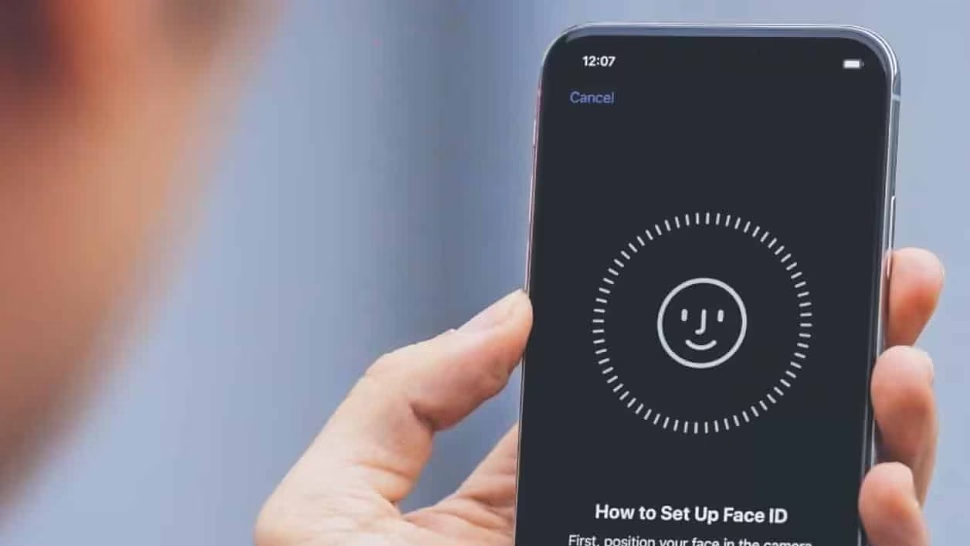
Banks prepare for biometric facial controls in October

Banks claim to be ready for facial biometrics in branches since October.

The main banking institutions in the country claim to be prepared for the new regulations on facial biometric controls when opening accounts, which will come into force next October.

What did the banks declare?

Marcos Ramírez, general director of Grupo Financiero Banorte, pointed out that the institution has made progress to reinforce the identification and security of its users. “We are in time and form with everything established by law and a little ahead, with the prudential limits of the law,” he indicated.

These measures will strengthen control over customer identification. Since 2018, by regulation, fingerprint biometrics are already required to open accounts.

Implementation details

On July 1, the National Banking and Securities Commission (CNBV) incorporated facial biometrics into the regulation for multiple banking in customer identification and authentication. Institutions that opt ​​for this mechanism must comply with technical, operational and security requirements.

Continue reading

AI detects breast cancer with 90% accuracy

An autonomous model analyzes thermographs and classifies tissues without human intervention.

An artificial intelligence model developed by Raúl Castro Ortega, a researcher at the Polytechnic University of Tulancingo, manages to identify breast cancer with an accuracy of 90%. The results were presented during the SPIE Photonics Europe 2026 International Congress, in Strasbourg, France.

How the system works

The system uses convolutional neural networks with attention mechanisms to analyze breast thermographs. Unlike traditional methods, the model autonomously learns the patterns of healthy and diseased tissue, without a specialist previously defining the characteristics of the images. This reduces processing time and improves consistency of results.

The study, titled “Breast thermography analysis using convolutional neural networks with attention mechanisms,” uses an algorithm based on the heat diffusion equation. This approach focuses analysis on thermogram regions of interest and classifies tissues with high levels of sensitivity and specificity.

Impact on early detection

The accuracy achieved represents a significant advance for the early detection of breast cancer, which can improve survival rates and facilitate timely treatment. The researcher highlighted that the system does not replace the specialist, but rather works as a support tool for faster and more consistent diagnoses.

Continue reading