WhatsApp fixes serious security flaw on Apple devices

A security breach exploited for months allowed unauthorized access to sensitive information on iOS devices.

Analysis of the Corrected Vulnerability in WhatsApp

The instant messaging application WhatsApp, owned by Meta Platforms Inc., has implemented a critical fix for a high severity security vulnerability. This breach, exploited in combination with a pre-existing flaw in Apple’s iOS and iPadOS operating systems, provided a highly effective attack vector against a select group of individuals. The nature of this exploitation allowed malicious actors, presumably hackers associated with surveillance services, to execute access and exfiltration operations of confidential information stored on victims’ Apple devices without requiring any interaction on the part of the user, which is known as a ‘zero-click’ attack.

Context and Duration of the Malicious Campaign

According to the investigation carried out and disclosed by Donncha Ó Cearbhaill, a specialized researcher at the digital security laboratory of Amnesty International, this malicious campaign remained active for a period of approximately 90 days. This extended time window suggests a sustained and meticulous operation, oriented towards specific objectives rather than a broad spectrum of users. Ó Cearbhaill also warned that although WhatsApp was the vector initially identified, it is plausible that other messaging and communication applications could have been affected by the same or similar intrusion methodology, which expands the potential scope of the threat.

RelatedMusk sues Apple and OpenAI for alleged collusion in artificial intelligence

The company that owns the platform, Meta, issued an official statement detailing that the number of users directly affected was less than two hundred, a figure that reinforces the hypothesis that it was a series of targeted attacks and not a mass dissemination campaign. The company claimed to have proactively notified each and every user whose device may have been compromised, thus complying with transparency protocols regarding privacy and data protection.

A crucial element that remains under investigation is the ultimate authorship of these incidents. So far, authorship has not been conclusively attributed to any specific actor or known commercial spyware provider. This panorama of uncertainty is common in the complex cybersecurity ecosystem, where technical sophistication is often accompanied by advanced concealment and false attribution tactics.

The coordinated response between technology companies was a key factor for mitigation. Apple, for its part, simultaneously recognized the existence of the vulnerability within its ecosystem of operating systems and immediately issued the corresponding security patches for its devices. This coordinated action between Meta and Apple underscores the interconnected nature of modern digital threats, where a flaw in an application can be exacerbated by a vulnerability in the underlying operating system.

The most immediate lesson for end users is the imperative need to keep all of their applications and operating systems updated to the most recent version available. Expeditious installation of these updates is the most effective protection measure against exploits that take advantage of already patched vulnerabilities. This incident serves as a stark reminder that cybersecurity is an ongoing process that requires vigilance from both providers and users.

Share this analysis on your social networks to help raise awareness about the critical importance of security updates. Explore our technology section to stay informed on the latest threats and digital protection best practices.
World Cup 2026: the technology that will transform how you watch football

Data, AI and 3D avatars will change the fan experience at the trinational tournament.

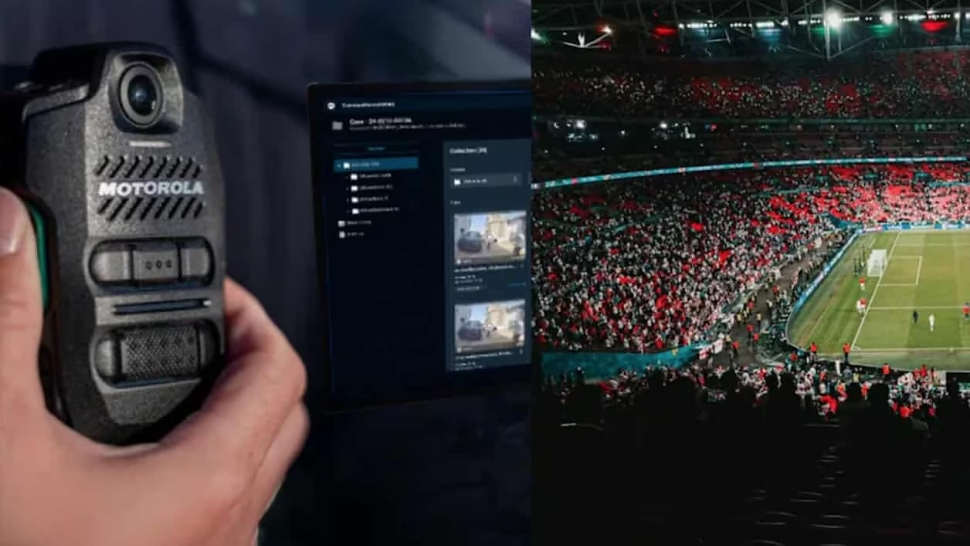
Almost 50 teams, three countries and more than one hundred matches. The 2026 World Cup will not only be the largest in history, but it will also transform the way we watch football from home. Artificial intelligence and advanced statistics will be the protagonists.

Tools like Football AI Pro, created with Lenovo, will help coaches prepare for matches and detect weak points. For the viewer, the data will be converted into graphs and summaries that explain what is happening on the court.

How the experience changes

In Qatar 2022, 12 cameras were already used to track the ball and 29 body points of each player 50 times per second. By 2026, that level of detail will be the norm. Stats will no longer be cold numbers: defensive lines, heat maps and movement patterns will be displayed.

In addition, the organization announced 3D avatars to recreate plays and referee decisions. Thus, tactical concepts such as high pressure or compact block will be visual and easy to understand.

The 2026 World Cup will maintain the excitement of goals and surprises, but with tools that allow us to better understand the game. Technology does not take away passion, but rather adds context.

Continue reading

Meta faces failures on Facebook, Instagram and WhatsApp

Users report intermittencies in Meta applications during the morning.

Failures in Meta services

Since this Wednesday morning, users of Facebook, Instagram, WhatsApp and Messenger reported interruptions in the operation of these platforms. The DownDetector site, which compiles crash reports, recorded an increase in complaints starting at 7:41 a.m.

According to the data, Facebook reached its peak of reports at 8:11 with 5,245 incidents. The main problems were concentrated in the application (47%), login (33%) and connection to the server (16%).

Messenger also had bugs. Its highest peak occurred at 7:48 with 260 reports. The most common difficulties were logging in (67%), the app (24%) and messaging (7%).

In the case of Instagram, reports increased until 8:20 with 326 complaints. 68% of users reported problems with the app, 14% with the connection to the server and another 14% with the login. The Tech Bit team confirmed difficulties when trying to publish stories, which could be related to the same bug.

WhatsApp, for its part, also suffered interruptions. 47% of the reports indicated problems with the web version, while 23% mentioned errors in the app and 16% in the login.

So far, Meta has not issued an official statement about the causes of these failures. Users are advised to stay tuned for updates.

Continue reading

Google integrates Gemini into Chrome for all of Latin America

Google expands its Gemini assistant in Chrome for users in the region.

Smart assistant comes to the browser

Google confirmed the expansion of Gemini, its assistant based on artificial intelligence, in Chrome for all of Latin America. Mexico is among the countries that already have access to this function, designed to simplify tasks within the search engine.

According to the company, Gemini helps users “understand information, stay organized, and complete tasks more easily.”

What does it allow you to do?

The integration eliminates the need to switch tabs to use the AI. In the upper right corner of Chrome the legend “Ask Gemini” appears.

With connections to Gmail, Maps, and Calendar, you can compose emails, check locations, and schedule meetings without leaving the current page. You can also compare products or summarize data from multiple open tabs. Google explains that “Gemini can understand the context between tabs and help you bring all the information together in one place.”

Additionally, Chrome incorporates AI-powered image editing tools, allowing you to transform photos directly from the browser with simple instructions.

Security and control

Google assures that these capabilities were “designed to always keep you in control” and developed with security as a priority. The models were trained to detect known threats, such as attempts to inject malicious instructions, in order to offer safer browsing.

The feature is now available for Chrome users in the region.

Continue reading