The core of Mars is solid as a rock according to new data

Seismic results reveal that the heart of the red planet is more complex and fascinating than initially thought.

The heart of Mars: harder than we thought

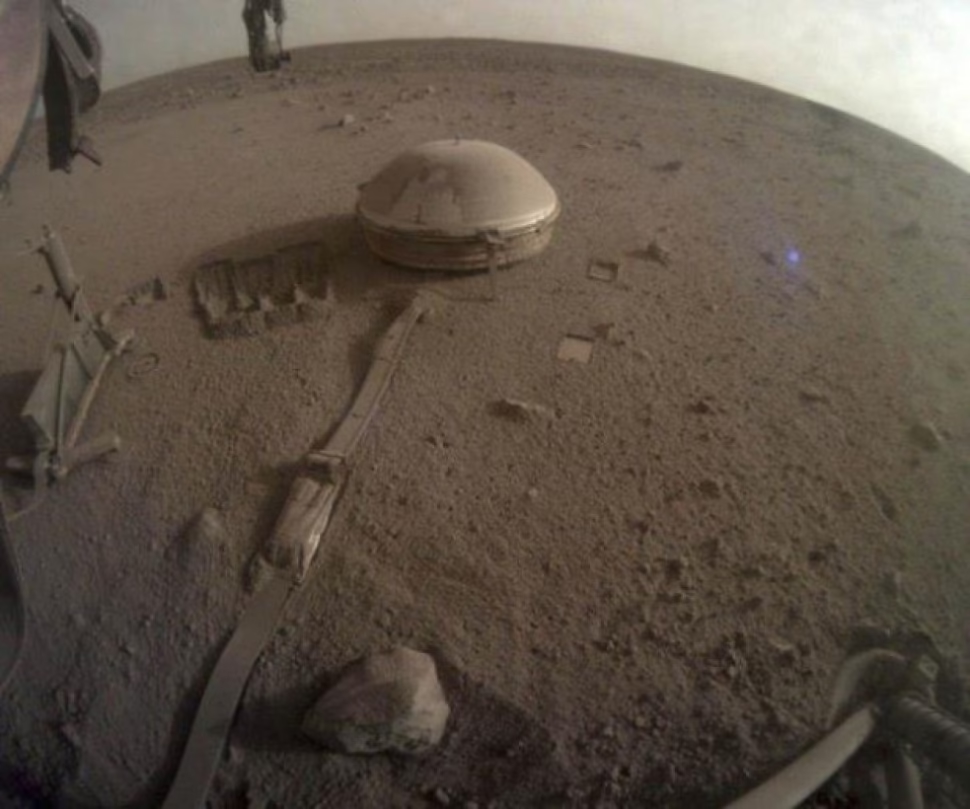
It seems that our red neighbor is not as soft inside as some believed. In a plot twist worthy of a scientific soap opera, a team of researchers, led by China, has come to tell us that the core of Mars is, in reality, a massive block of solid metal. Remember all those previous studies that talked about a liquid and emotional heart? Well, throw them in the cosmic recycling bin. The revelation, published in the prestigious journal Nature, is based on the last seismic rattles captured by NASA’s InSight module before it hung up its gloves in 2022. How appropriate that it decided to send this data just before its retirement, right? Almost as if he had planned it.

Poor InSight, stuck on a boring equatorial plain since 2018, spent its last days listening to the planet growl. He recorded more than 1,300 Marsquakes, of which 23, mostly of low intensity (because even when it comes to shaking, Mars is mediocre), were chosen to dethrone the previous theory. The epicenters of these planetary sobs were at a respectable distance from the lander, between 1,200 and 2,360 kilometers. Because, of course, the most crucial data always comes from afar, making the work of scientists even more… interesting.

RelatedNASA’s Perseverance finds possible signs of ancient life on Mars

A metal cake with solid filling

The delicious new theory suggests that Mars is like a cosmic bonbon: an outer shell of molten metal surrounding a solid inner core. This hard heart extends from the very center of the planet to a radius of approximately 613 kilometers. The liquid outer core surrounds it up to about 1,800 kilometers from the center. The likely composition is iron and nickel, with perhaps a touch of oxygen for flavor, much like that of Earth. What a coincidence! Although, as lead researcher Daoyuan Sun points out, perhaps it is just that, a coincidence. Let’s not think that we are special.

Sun of the University of Science and Technology of China speculates that crystallization of this nucleus may have started in the past and may continue today. Because in planetary evolution, everything is an eternal “work in progress.” What is not so clear is whether the outer core is a pure liquid or whether it has a pasty transition zone, a kind of cosmic custard, between the solid interior and the liquid exterior. What a crucial and yet delightfully absurd detail to investigate.

But not everyone is willing to celebrate with confetti. Nicholas Schmerr of the University of Maryland, who was not part of the study, uttered one of those phrases that journalists love: the questions about the Martian core “are far from resolved.” In other words: “Guys, this is just the beginning, don’t get too excited.” And he has a point. With InSight out of action, there will be no new recordings of seismic activity. We ran out of our microphone on the Martian soil, so we have to make computer models and speculate a lot.

Schmerr insisted that an entire network of seismographic stations is needed to unravel the remaining mysteries. Because a single probe is like trying to understand a conversation by listening to only one word out of ten. Sun agreed that more detailed models are needed to get a clearer picture of core formation and, more intriguingly, what it tells us about the history of the extinct Martian magnetic field.

Ah, yes. The magnetic field. Or the lack thereof. Schmerr suggested that the current absence of this protective shield on Mars could be due to the slow crystallization of its solid core. Wow, maybe the planet took its sweet time solidifying and lost its inner magnet along the way. A lesson for everyone: procrastination has consequences, even on a planetary scale.

What did you think of this trip to the center of Mars? Share it on your social networks and cause an earthquake of opinions! And be sure to explore our science section for more absurdly fascinating revelations about the universe.


Xbox Games Showcase 2026: los juegos que llegan este año y el próximo

Microsoft presentó en su evento anual los títulos que marcarán el futuro de la plataforma.

Microsoft celebró la séptima edición de su evento anual Xbox Games Showcase, donde reveló los lanzamientos más importantes para la segunda mitad de 2026 y principios de 2027. Fue también una oportunidad para celebrar el 25 aniversario de la marca y presentar a Asha Sharma como nueva CEO, tras la salida de Phil Spencer.

Principales anuncios

Gears of War: E-Day, de The Coalition, llegará el 6 de octubre de 2026 de forma exclusiva para Xbox Series X/S y PC. El avance mostró el Día de la Emergencia en Kalona, con Marcus Fenix y Dominic Santiago enfrentando la aparición de las criaturas Locust.

RelatedXbox reveals Forza Horizon 6 and more at Tokyo Game Show

Fable, de Playground Games, mostrará una historia renovada con Isabel, la villana interpretada por Hayley Atwell. Su estreno está previsto para el 23 de febrero de 2027.

Halo: Campaign Evolved es un remake con mejoras gráficas y un nuevo arco narrativo, “Operación: Meteorito”, que incluye tres misiones adicionales. Llegará el 28 de julio de 2026 a Game Pass.

State of Decay 3, de Undead Labs, se lanzará en 2027 tras pruebas alfa con jugadores.

Atlus anunció Persona 4 Revival (remake con mejoras visuales, 18 de febrero de 2027) y Persona 6, sin fecha definida.

SEGA presentó Crazy Taxi: World Tour, que llegará en 2027 con acrobacias y desafíos junto a Axel.

Otros títulos revelados

  • Resonance: A Plague Tale Legacy (Asobo Studio) — 27 de agosto de 2026 en Game Pass.
  • Minecraft Dungeons 2 — 29 de septiembre de 2026 en Game Pass.
  • Metro 2039 — febrero de 2027, supervivencia bajo Moscú.
  • Bad Magpie (Milktooth) — 2027, una urraca con una sola ala.
  • Wo Long 2: Wings of Ember (Team Ninja) — principios de 2027.
  • Senua (Ninja Theory) — 2027, tras Hellblade II.
  • Spyro: A Realm Beyond (Activision/Toys for Bob) — primavera de 2027.

Además, se confirmó la edición especial Xbox Series X25 con color verde transparente, disponible en noviembre de 2026.

Continue reading

Registro obligatorio de celulares: vence el 30 de junio

El registro obligatorio de líneas celulares vence el 30 de junio. Conoce cómo hacerlo.

Plazo final para registrar tu línea celular

Por disposición oficial, los mexicanos tienen hasta el 30 de junio para registrar todas sus líneas telefónicas móviles. El trámite es obligatorio y busca combatir delitos como extorsión, fraude y acoso, al vincular cada número con la identidad de una persona.

Para realizarlo necesitas tu identificación oficial (INE o pasaporte) y tu CURP. Aplica para cualquier compañía y tanto para personas físicas como morales.

RelatedMandatory cell phone registration comes into force in Mexico

¿Cómo hacerlo?

Puedes acudir presencialmente a una sucursal de tu operador con los documentos mencionados. O hacerlo en línea a través del portal de tu compañía o en [portal.crt.gob.mx](https://portal.crt.gob.mx/gestion-de-lineas-telefonicas-moviles).

El proceso en línea es similar en todos los casos:

  • Ingresa tu número celular y autentícate con un código SMS.
  • Selecciona el tipo de identificación oficial.
  • Toma fotografías de tu credencial (ambos lados).
  • Completa el reconocimiento facial.
  • Confirma tus datos y acepta el aviso de privacidad.

Cada operador tiene ligeras variaciones, pero los pasos esenciales son los mismos. Telcel, Movistar y AT&T ya tienen habilitados sus portales. Al finalizar, la línea quedará vinculada a tu identidad.

No dejes el trámite para el último día. Si no registras tu línea antes del 30 de junio, podrías enfrentar restricciones en el servicio.

Continue reading

CURP y celulares: cómo consultar líneas a tu nombre

Revisa si hay números desconocidos vinculados a tu CURP y evita fraudes. Proceso gratuito en línea.

Desde enero de 2026, registrar los celulares con la CURP es obligatorio. Esto abrió una pregunta entre los usuarios: ¿cuántos números están realmente asociados a mi identidad?

Consulta en línea y gratuita

La Comisión Reguladora de Telecomunicaciones habilitó una plataforma para verificar las líneas registradas a tu nombre y detectar irregularidades. El proceso es gratuito y se realiza en el sitio oficial: portal.crt.gob.mx/plataformas-de-consulta-de-las-companias-telefonicas.

RelatedYour cell phone asks for identification from 2026

Debes seleccionar tu compañía telefónica y proporcionar tu CURP. El sistema mostrará los números vinculados. Solo el titular accede a la información, con el objetivo de proteger los datos personales.

Si detectas un número desconocido

Las autoridades recomiendan iniciar la baja desde la misma plataforma o contactar a la operadora para reportar un posible uso indebido de tu identidad. Revisar periódicamente ayuda a prevenir fraudes, extorsiones o contrataciones sin consentimiento.

Continue reading