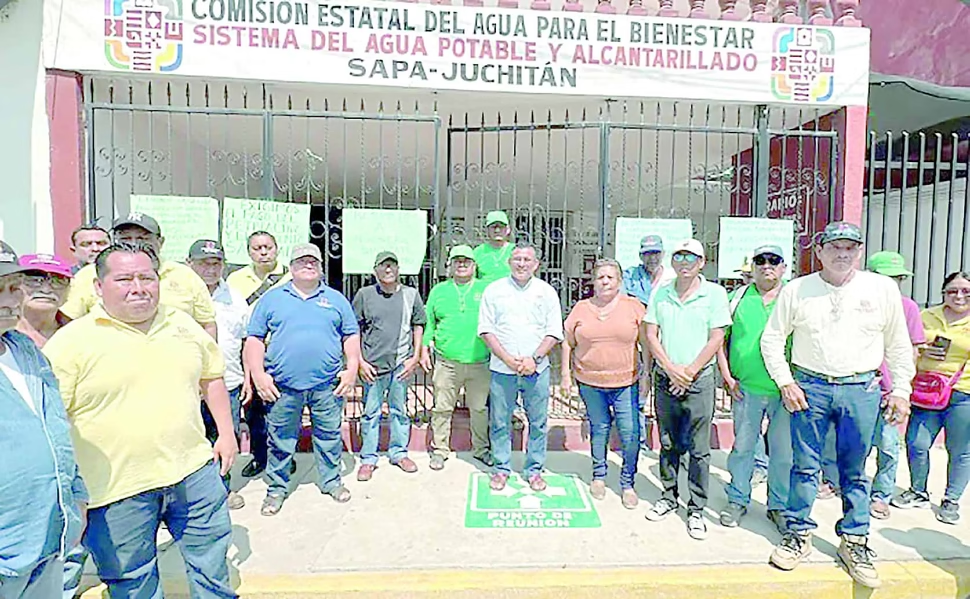
Water workers take over offices in the Isthmus of Tehuantepec

Taking over offices in Oaxaca demands salary improvements and pending benefits.

Workers from the State Water Commission for Wellbeing (Ceabien) occupied the agency’s offices in several municipalities of the Isthmus of Tehuantepec. They demand job improvements, a salary increase and the payment of benefits that are owed to them.

The protest spread to the 14 operating organizations in Oaxaca. This was reported by Milton López Hernández, Secretary of Organization of the Ceabien Workers Union.

“It is a measure of pressure for the authorities to meet our demands,” he declared.

The protesters warn that the occupation will continue until they receive a concrete response from state officials. So far, no violent incidents or confrontations with the authorities have been reported.

RelatedIMSS identifies injured people after derailment on the Isthmus of Tehuantepec

IMSS Bienestar announces record investment of 46 thousand million pesos in health

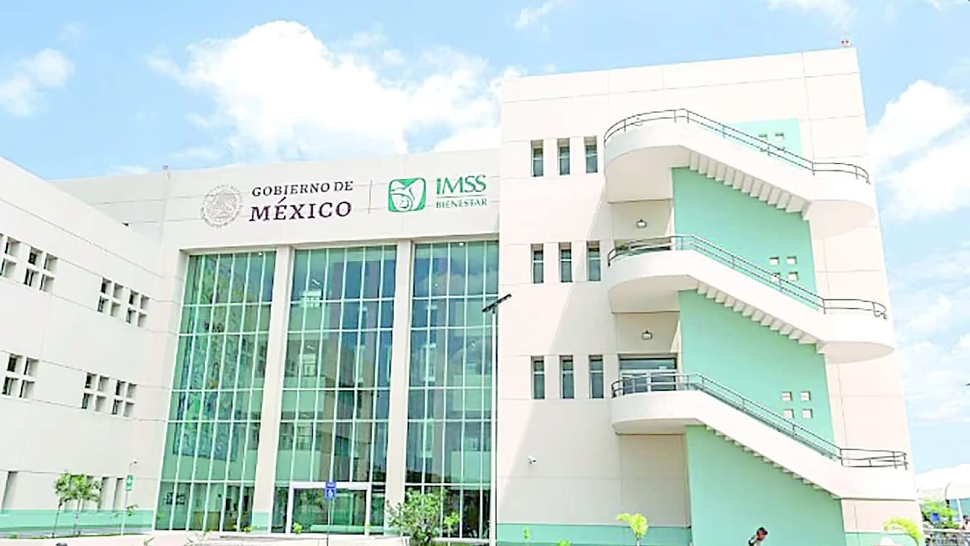
The IMSS Bienestar will invest 46 billion pesos in 87 hospital infrastructure projects.

The IMSS Bienestar will allocate 46 billion pesos to strengthening the public health system during the rest of the six-year term. The plan includes 87 strategic projects to expand medical coverage in different regions of the country.

Key projects

Alejandro Svarch, general director of the organization, explained that 43 hospitals will be built, of which 35 will replace obsolete facilities. In addition, 21 hospitals will be rehabilitated and expanded, and 23 health centers will be built, some with expanded services to strengthen the first level of care.

Between 2024 and 2026, IMSS Bienestar has already opened 19 hospitals in states such as Baja California, Guerrero, Michoacán and Oaxaca. Svarch assured that these units offer highly specialized services and free consultations for the population without social security.

New openings

In the coming weeks operations will begin:

  • Center of Excellence in Midwifery and Wellbeing, in San Miguel de Allende, Guanajuato.
  • Clinic for addiction care and community rehabilitation in Apatzingán, Michoacán.
  • Health Center with Expanded Services (CESSA) of San Pablo Yaganiza, Oaxaca.

The strategy seeks to consolidate a modern hospital network with greater care capacity, prioritizing those who do not have social security.

Continue reading

Ernesto Ruffo Appel presents new protection against the FGR

The PAN member challenged 17 acts of the FGR from the maximum security prison.

New legal resource from the Altiplano

The former governor of Baja California, Ernesto Ruffo Appel, filed a new amparo against the Attorney General’s Office (FGR). They accuse him of alleged organized crime and smuggling linked to the so-called fiscal huachicol.

Ruffo Appel, held in the Altiplano prison, challenged 17 acts. Among them: the arrest warrant, his transfer out of Baja California, the deprivation of his freedom and possible irregularities during his capture.

Complaints of lack of communication and lack of medical attention

The defense claims that the former president was held incommunicado, without informing his family or lawyers about his whereabouts. They also point out that he was denied access to essential medications for his treatment.

A federal judge admitted the lawsuit, although it has not been reported whether he granted a provisional suspension. Last Friday, a judge in Ensenada granted an outright suspension to prevent Ruffo Appel from being held incommunicado or suffering acts of abuse.

The FGR detained him while he was at a meeting in Ensenada, Baja California. The case is still in judicial process.

Continue reading

Criticism for an extra 30 billion to the Mayan Train

Losses of 2,283 million pesos in three months question the viability of the project.

The federal deputy of the PAN, Ernesto Sánchez Rodríguez, questioned the allocation of 30 billion additional pesos to the Mayan Train. He noted that the project continues to incur economic losses.

Questions about spending on the Maya Train

During the first quarter of 2026, accumulated losses reached 2,283 million pesos. This represents an average of 25 million 373 thousand pesos per day, according to the legislator.

The income generated is not enough to cover operating costs. Sánchez Rodríguez considered that the extra expense is not justified given these figures.

The lack of profitability has been a recurring point in the debate about the viability of the Mayan Train. Now, with a new budget, doubts about its economic future deepen. The legislator joins other voices that have expressed concern about the financial management of the project, controversial since its beginning.

Continue reading