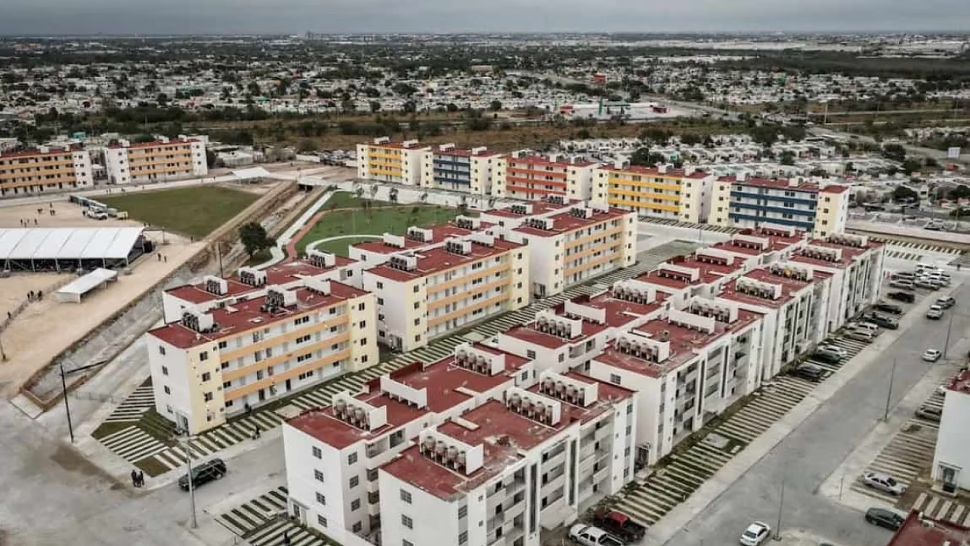
Bienestar Housing reschedules its third stage of registration

An unexpected turn delays the expected registration. Discover the requirements and the new crucial date so as not to miss this opportunity.

A Dream in Suspense: The Procrastination That Shocked Miles

In the heart of a nation eager for hope, a government program stood as a beacon of redemption. The Housing for Wellbeing, a monumental initiative promoted by the National Housing Commission (CONAVI) in alliance with the Secretariat of Welfare and the Secretariat of Agrarian, Territorial and Urban Development, was not just a construction plan. It was a promise carved by fire into the souls of those most in need, an oath that the right to a decent home would cease to be a privilege and become a tangible reality. Its mission, epic and noble, focused on indigenous communities and those citizens plunged into the shadows of marginalization and social deprivation. The battle for adequate housing had begun, and the fate of thousands hung in the balance.

The tension was palpable in the air. The long-awaited third stage of registration was approaching, a period from October 13 to 19 that promised to be the gateway to a better future. The families, with their documents in hand and hope as their only shield, awaited the crucial moment. But fate, that unpredictable master of ceremonies, had other plans. Overnight, an official statement, spread through CONAVI’s social networks, fell like a bolt of lightning on a sunny day: registration was postponed. The reason was as powerful as the forces of nature: heavy rains had hit various regions of the country, unleashing chaos that demanded the absolute attention of public servants, who, turned into anonymous heroes, dedicated themselves body and soul to supporting the population and taking censuses in the midst of the tragedy. The installation of the modules and the long-awaited process would be put on hold, being rescheduled for October 20. Disappointment was a bitter whisper, but reason was an inescapable truth.

RelatedConavi begins second stage of registration for Bienestar Housing

The New Frontier: A Quickly Closing Window of Opportunity

With the new day, October 20, a new chapter will open in this saga. Although the exact time that the registration modules will remain operational is a secret that CONAVI still guards with suspicion, rumors and forecasts suggest that this window of opportunity could close on October 26. A short deadline, a race against time where every minute will be gold. During this period, those aspiring to have their own roof must fight their personal battle, presenting the required documentation, unraveling the mysteries of the Diagnosis Certificate and handing over with a trembling hand the registration sheet that could change their lives forever. Preparation is the sword and shield in this final duel.

And what are the talismans, the objects of power that one must carry to cross this threshold? The requirements for this application, forged in the two previous stages, emerge as the gatekeepers of the entrance. Those who wish to venture must present themselves with:

The original and a copy of a current official identification with a photograph, a document that proves its existence to the State. The voting credential (INE), the professional card or the passport become identity keys.

A proof of address, a testimony of your place in the world, no older than three months. A paper that screams “here I reside, here I deserve a home.”

And the updated Unique Population Registry Code (CURP), the code that unites them to the great national fabric, the seal of their citizenship.

This story, full of mixed emotions, of plans truncated by the fury of nature and of a hope that refuses to die, is more than news. It is the reflection of a collective fight for dignity. The Housing Wellbeing program represents that titanic effort to close the gaps of inequality, offering a housing solution to those who have been historically forgotten. The postponement, although painful, underscores the magnitude of the challenges facing the country and the adaptive capacity required. Now, the clock is ticking again. The appointment is October 20. The world watches. Will they be ready?

Don’t let this epic opportunity pass you by! Share this crucial report on your social networks so that no one is left without knowing the details of this new date and help more people find their way to decent housing. Explore more content related to social support programs and always stay informed.
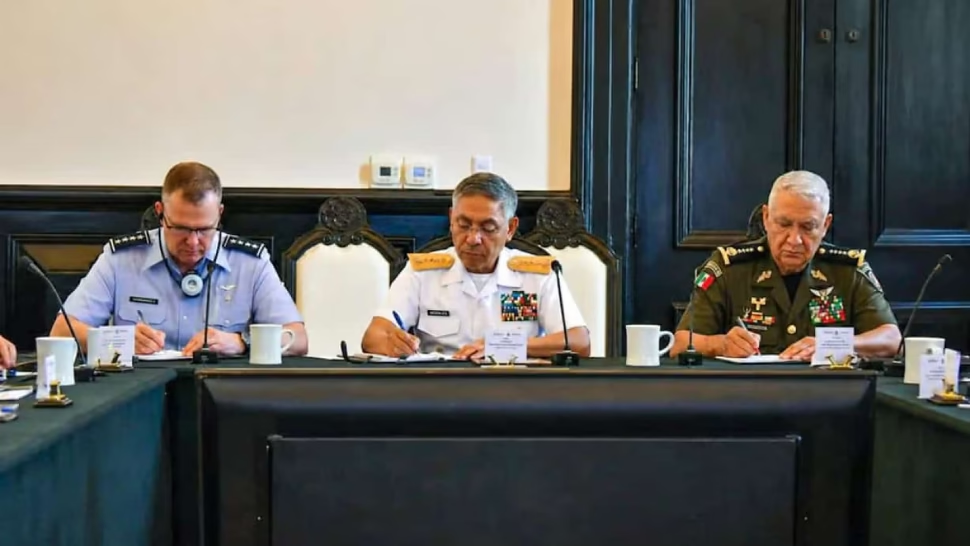

Semar denuncia mancha de hidrocarburos en Bahía de Manzanillo

Pemex informa que la Marina presentó denuncia por mancha aceitosa en Manzanillo. No hay vínculo directo aún.

La Secretaría de Marina, a través del Departamento de Protección al Medio Ambiente Marino (PROMAM), interpuso una denuncia ante las autoridades competentes por la mancha aceitosa detectada el 2 de junio en aguas de la Bahía de Manzanillo. El objetivo es que se realicen las investigaciones y se determinen responsabilidades, informó Petróleos Mexicanos (Pemex).

Inspecciones sin hallazgos concluyentes

Pemex detalló que tras verificaciones terrestres, marítimas y aéreas no se identificaron anomalías operativas, fugas ni evidencia que vincule su infraestructura con los hechos observados. Los recorridos se realizaron el 4 y 5 de junio con personal de la Semar, Semarnat, Profepa, Agencia de Seguridad, Energía y Ambiente, Asipona Manzanillo, Protección Civil y autoridades estatales.

RelatedPemex niega evidencia de derrame en la Bahía de Manzanillo

Como parte de la atención, se ha recuperado el material observado en coordinación con distintas dependencias. Las actividades se centran en monitoreo y verificación de las condiciones ambientales de la zona.

Mitigación y seguimiento

Pemex ha participado en la limpieza suministrando barreras de contención, cordones oleofílicos y material absorbente, en conjunto con las autoridades que dan seguimiento a las investigaciones para determinar el origen del material. Asimismo, la Asipona Manzanillo estableció recorridos de inspección y vigilancia marítima, así como monitoreos permanentes para identificar cualquier situación que contravenga la normatividad.

La paraestatal reiteró su compromiso con la protección del medio ambiente, la seguridad de sus operaciones y la colaboración institucional para atender este evento.

Continue reading

Tarjetas de búsqueda al estilo del Mundial 2026 en Jalisco

Familiares usan fichas estilo álbum mundialista para visibilizar más de 134 mil desaparecidos en México.

Familias de personas desaparecidas en Jalisco transformaron las fichas de búsqueda en tarjetas similares a las del álbum de jugadores del Mundial 2026. El objetivo: visibilizar los más de 134 mil casos de desaparición forzada en México, a días del inicio del torneo.

Durante la semana, pegaron las fichas alrededor del FIFA Fan Festival y otros puntos turísticos de Guadalajara, una de las sedes mundialistas. Buscan que los turistas —se esperan tres millones— conozcan la crisis que vive el país.

“Es para conectar con todos los fans del fútbol y dar un mensaje de que no está mal el Mundial, no está mal festejar. Lo que está mal es dejar de nombrar a quien hace falta y dejar de buscar”, dijo a EFE Héctor Flores, de la organización Luz de Esperanza.

Rostros con camisetas de la selección

Las imágenes de las personas desaparecidas se editaron con camisetas de la selección mexicana y fondos similares al álbum mundialista. “Cada ‘cartita’ pegada en un muro representa la posibilidad de encontrar a la persona”, afirmó Flores.

RelatedColectivo Luz y Esperanza sticks cards in Zapopan to search for missing people

El colectivo critica que el gobierno de Jalisco y el ayuntamiento de Guadalajara hayan invertido millones de pesos en obras para el Mundial, mientras la Vicefiscalía estatal de personas desaparecidas no contrató personal este año por falta de presupuesto. La Comisión Ejecutiva Estatal de Atención a Víctimas tiene solo 15 asesores para 16 mil carpetas de investigación.

“Esos recursos hacían más falta en otro lado. No estamos pidiendo todo ese dinero, si una parte se hubiera apoyado, un porcentaje para poder ir avanzando”, subrayó.

El colectivo continuará con estrategias de visibilización durante el Mundial, pese a los operativos de seguridad que restringen el acceso a zonas turísticas. “Es apostar por la buena voluntad del turismo internacional y de los medios internacionales para ejercer presión al país y que las cosas puedan cambiar”, concluyó Flores.

Las fichas de búsqueda pasaron de ser un registro impreso a una protesta de familias que llevan décadas buscando, frente al desamparo de las autoridades.

Continue reading

FGR habilita micrositio para turistas en el Mundial 2026

FGR lanza sitio web para turistas durante el Mundial 2026. Denuncias en línea y ubicaciones disponibles.

Nueva herramienta digital para turistas

La Fiscalía General de la República (FGR) puso en marcha un micrositio dirigido a turistas nacionales y extranjeros durante el Mundial de Fútbol 2026, que inicia el próximo jueves.

El sitio, disponible en [https://fgr.org.mx/en/FGR/Mundial2026](https://fgr.org.mx/en/FGR/Mundial2026), ofrece información sobre derechos y obligaciones de los extranjeros, así como el número de emergencia 911. También permite iniciar denuncias en línea y ubicar las oficinas de la FGR más cercanas.

RelatedAntigentrification march in CDMX concludes without serious incidents

Mediante un código QR, los usuarios pueden acceder a datos de la Ventanilla Única de Atención. La FGR destacó que el micrositio facilita la presentación de denuncias por cualquier delito federal. Además, incluye un directorio de embajadas y consulados.

Las sedes mundialistas en Ciudad de México, Guadalajara y Monterrey cuentan con atención presencial o virtual. En la capital, las oficinas están en Dr. Lucio 135, colonia Doctores, y en las Terminales 1 y 2 del AICM. En Guadalajara, en Avenida 16 de septiembre 591, Mexicaltzingo, y en el aeropuerto internacional. En Monterrey, en Carretera Monterrey-Nuevo Laredo km 14.5, colonia Nueva Castilla, municipio de General Escobedo, y en el módulo del aeropuerto internacional.

La FGR recordó que cuenta con oficinas en las 32 entidades del país, con atención las 24 horas los 365 días del año a través del CEDAC.

Continue reading