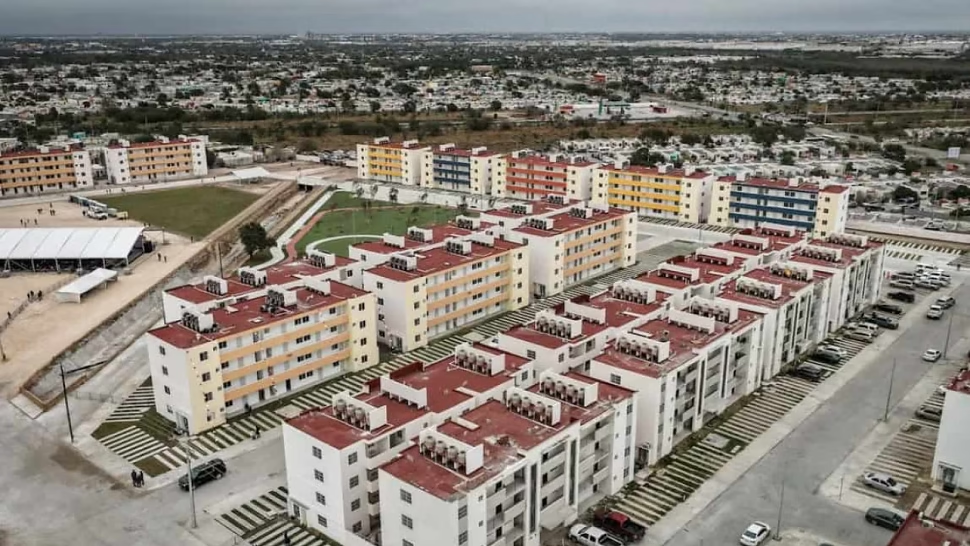
Federal government signs agreement for decent housing program

A coordinated effort by 16 federal institutions to materialize an ambitious construction project at the national level.

An Interinstitutional Agreement for the Construction of Housing

The Secretariat of Welfare, under the direction of Ariadna Montiel Reyes, has formalized the Interinstitutional Collaboration Agreement corresponding to the Housing for Wellbeing Program. This initiative, promoted directly by the President of the Republic, Claudia Sheinbaum Pardo, represents a consolidated effort of the federal cabinet. According to statements by Secretary Montiel Reyes, the fundamental objective is “to join forces to guarantee decent housing and social justice for the families of Mexico.” This statement transcends mere political rhetoric to become the guiding axis of a broad-spectrum social development and right to the city strategy.

Coordination Mechanisms and Scope of the Program

The signed legal instrument establishes the frameworks for cooperation and articulation between a network of first-level government agencies. Among the key institutions are the Secretariat of Agrarian, Territorial and Urban Development (Sedatu), the Secretariat of Infrastructure, Communications and Transport (SICT) and the Secretariat of Environment and Natural Resources (Semarnat). This joint work scheme includes a total of 16 entities, whose collective purpose is to define the mechanisms, protocols and operational strategies necessary for the execution of the program.

RelatedFederal government signs agreement to strengthen social programs

The quantifiable goal, and of a historic nature, is the construction and delivery of one million 800 thousand housing solutions. The materialization of this objective falls on the coordinated action of the National Housing Commission (Conavi), the Institute of the National Housing Fund for Workers (Infonavit) and the Housing Fund of the Institute of Security and Social Services of State Workers (Fovissste). This tripartite model seeks to address the needs of various sectors of the population, from formal workers to groups in vulnerable situations.

Territorial Advancement and State Coverage

According to official reports provided by Sedatu, as of September 1, the Housing for Wellbeing Program has demonstrated tangible and significant progress. Construction works have already formally begun in 29 states of the Mexican Republic, which demonstrates accelerated implementation and extensive geographic coverage. The list of states where the program is active includes Aguascalientes, Baja California, Baja California Sur, Campeche, Chiapas, Mexico City, Coahuila, Colima, Durango and the State of Mexico.

The geographical distribution is complemented by the start of works in Guanajuato, Hidalgo, Jalisco, Michoacán, Morelos, Nayarit, Nuevo León, Oaxaca, Puebla, Querétaro, Quintana Roo, Sonora, Tamaulipas, Tabasco, Tlaxcala, Veracruz, Yucatán and Zacatecas. This broad subnational dispersion suggests a programmatic design aimed at reducing regional imbalances and combating the housing deficit uniformly throughout the national territory, prioritizing both high-density urban areas and rural regions.

The success of this public initiative does not depend only on constructive capacity, but also on effectiveness in intergovernmental management. Semarnat’s participation will ensure that housing developments comply with regulations regarding environmental impact and sustainable use of resources. For its part, the SICT will guarantee that the new housing estates are integrated into the national communications and transportation network, a critical factor for the connectivity and quality of life of its future inhabitants. This agreement, therefore, lays the foundations for a comprehensive approach where housing is the first link in a chain of well-being that includes mobility, sustainability and access to services.

Do you think that this model of massive collaboration between agencies can be the key to solving the housing problem in the country?Share this analysis on your social networks to expand the conversation and visit our social policy section to explore more content on development and well-being programs.


Reynosa reanudará fumigación contra el dengue tras lluvias

Autoridades retoman fumigación en Reynosa tras pausa por lluvias para frenar el dengue.

Campaña contra el dengue

Las autoridades de Salud Bienestar en Reynosa reanudarán en breve la fumigación en distintas colonias, una vez que las condiciones climáticas lo permitan. Las lluvias recientes obligaron a suspender las labores, pero el terreno debe secarse para retomar la eliminación de mosquitos.

“Cuando se ausenten las lluvias y seque el terreno, volveremos a recomenzar los trabajos porque sabemos que están proliferando los zancudos. Vamos a seguir trabajando en la eliminación de estos insectos para prevenir más casos de dengue”, explicó Iliana Villarreal Cantú, titular de Salud Bienestar en la ciudad.

La funcionaria informó que en lo que va del año se han detectado tres casos de dengue con síntomas graves, además de varios sospechosos. Hasta ahora, ninguno de los pacientes ha requerido hospitalización.

RelatedJulión Álvarez conquers Reynosa with a historic concert

Medidas de prevención

Villarreal Cantú recomendó a la ciudadanía evitar acumular agua en recipientes para eliminar criaderos de mosquitos. También pidió deshacerse de objetos en desuso donde los insectos puedan anidarse, y cambiar el agua de floreros con frecuencia.

El personal de fumigación regresará a las colonias una vez que cese la lluvia, para continuar la campaña contra el mosquito en todas sus etapas.

Continue reading

PrevenIMSS aplica vacunas en centro comercial del Bulevar Morelos

PrevenIMSS instala módulos en centros comerciales para vacunar contra sarampión, neumococo y más.

Jornada de vacunación en espacio comercial

Personal de PrevenIMSS mantiene puestos de inmunización en distintos centros comerciales. Además de aplicar dosis, ofrecen acciones preventivas.

El módulo instalado sobre Bulevar Morelos atendió este viernes a niños de 0 a 9 años. Se suministraron vacunas contra rotavirus, hexavalente y DPT para menores de 4 años.

RelatedMexico contains measles outbreak with 8.8 million vaccines

También se administró la vacuna contra sarampión a personas de 10 a 49 años. Adultos mayores de 60 años recibieron la dosis contra neumococo.

Mujeres embarazadas accedieron a la vacuna TDPA, que protege contra tos ferina, difteria y tétanos tanto a la madre como al bebé.

Acciones complementarias

El equipo de salud distribuyó vitamina A, sobres de Vida Suero Oral y preservativos masculinos. Todo forma parte de una estrategia integral de prevención.

El horario de atención fue de 9:00 a 15:00 horas. La comunidad respondió acudiendo al módulo para vacunarse.

Continue reading

Niños de primaria arrasan en certamen de innovación tecnológica

Dos alumnos de primaria ganan primer y segundo lugar en etapa regional del certamen de innovación.

Logros que trascienden el aula

Dos estudiantes de la Escuela Primaria “Narciso Mendoza” obtuvieron el primer y segundo lugar en la etapa regional del Certamen Estatal de Creatividad e Innovación Tecnológica. El resultado les asegura un pase directo a la fase estatal.

Saúl Azarel Martínez García se llevó el primer sitio con su proyecto. Luis Damián Martínez García consiguió el segundo lugar. Ambos demostraron talento, preparación académica y capacidad innovadora.

RelatedMexico promotes technological sovereignty with fund for students

Los proyectos fueron guiados por el docente Héctor Escobedo Hernández. Él acompañó a los alumnos desde el desarrollo hasta la presentación final, fortaleciendo sus habilidades en investigación y creatividad.

Reconocimiento al esfuerzo colectivo

Autoridades educativas señalaron que estos logros son fruto de la disciplina y el compromiso de los menores, así como del respaldo de maestros y familias. Ahora, los campeones regionales se alistan para representar a su institución en la fase estatal.

Con estos resultados, los alumnos ponen en alto el nombre de su escuela y evidencian el potencial de la niñez en el ámbito de la innovación tecnológica.

Continue reading