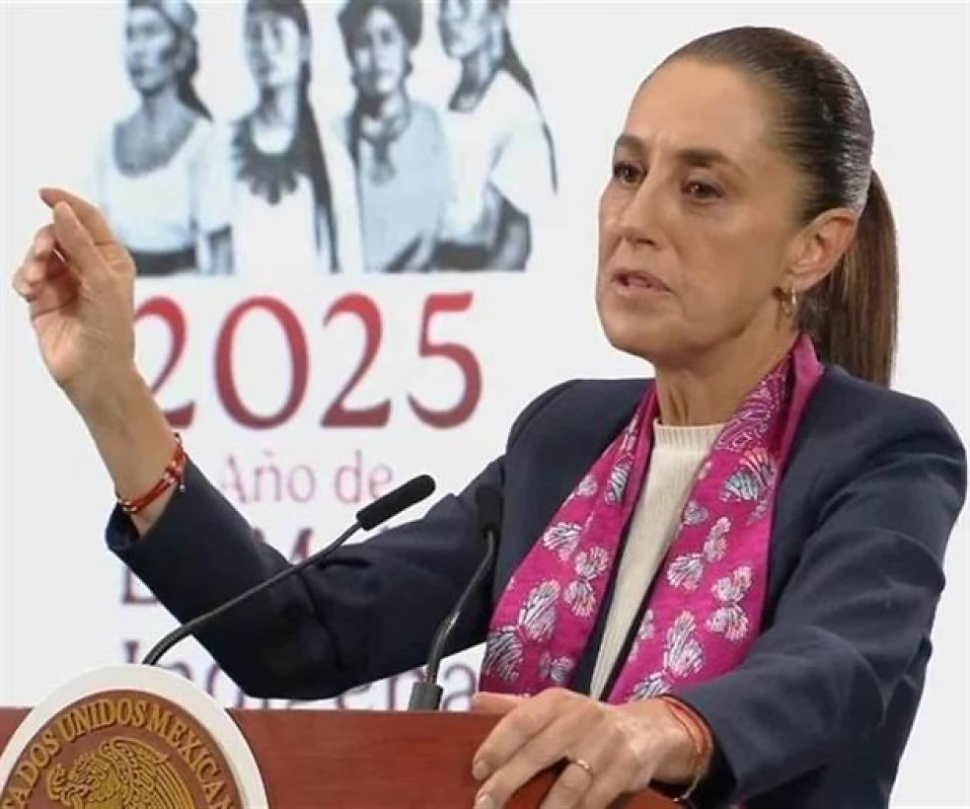
Federal government launches national mental health program for youth

The federal government is preparing a comprehensive strategy with safe spaces to address the psychological well-being of the country's young population.

Analysis of the National Youth Mental Health Program

The President of Mexico, Claudia Sheinbaum, has announced the preparation of a comprehensive federal program aimed at the mental health of young people. This government initiative arises as a direct response to the murder of a student inside the College of Sciences and Humanities (CCH) of the National Autonomous University of Mexico, which occurred on September 22. The event, where a student was deprived of his life by another classmate, has acted as a catalyst, evidencing an urgent need to address the psychological and emotional well-being of the adolescent and young population in educational settings.

The design of this strategy is framed within the Days for Peace and Against Addictions, seeking to constitute a holistic proposal. The main objective is to establish a network of safe and trustworthy spaces at the national level, where young people can go not only to make complaints, but also to find personal and collective support. The president explained that these centers will be designed to address the problems inherent to the stage of youth development, as well as the emerging challenges linked to the use of digital social networks and the influence of groups that are formed from certain sociocultural phenomena.

RelatedFederal government guarantees supply of medicines with the Health Routes program

Strategy and Multidimensional Approach

The implementation of this program represents a significant change in the focus of public policies, moving from a reactive to a preventive perspective. The federal administration recognizes that crime and violence that manifest in school environments may have their roots in unaddressed psychological disorders, social isolation or the influence of harmful online content. Therefore, the initiative is not limited to crisis intervention, but aims to build resilience mechanisms and socio-emotional tools among youth.

The participation of Clara Brugada, head of government of Mexico City, in the weekly Cabinet sessions, underlines the intention to create a replicable model that, starting in the capital, extends to the entire Republic. Interinstitutional collaboration is a fundamental pillar to ensure the coherence and national scope of the project. Sheinbaum emphasized the importance of young people perceiving the proximity of their Government, feeling that there are official structures dedicated to listening to and containing them.

Regarding the handling of the specific incident at UNAM, the President clarified that, although she has not maintained direct communication with the rector Leonardo Lomelí, the Secretary of the Interior, headed by Rosa Icela Rodríguez, together with the Security Cabinet, maintain a permanent collaboration channel with the highest house of studies. This support focuses on the research that the autonomous institution needs to carry out. Sheinbaum emphasized university autonomy and explained that the closure of some campuses has been a decision that mixes provisions of the authorities for protection and requests from the students themselves.

Context and Future Projections

The program promises to clearly differentiate between legitimate political protest and criminal acts that constitute a threat to the integrity of the student community. The distinction is crucial to not criminalize dissent and, at the same time, to act firmly against behavior that constitutes criminal violence. The strategy is articulated in two main fronts: one of security and investigation, led by the specialized Cabinet and in coordination with the corresponding prosecutor’s offices, and another, of a care and preventive nature, focused on mental health.

This dual approach responds to a deeper analysis of the problem. Experts in educational psychology and sociology of violence have repeatedly pointed out that fractured family and school environments, added to constant exposure to violent content or that promote hate ideologies through digital platforms, can generate a breeding ground for extreme acts. The federal program seeks, therefore, to intervene in these risk factors, providing adolescents with a support ecosystem that counteracts these negative influences.

The formal presentation of this comprehensive plan is expected in the immediate future. Its success will depend on a clear budget allocation, the training of professionals in psychology and social work, and the creation of standardized care protocols. The measure is seen as a necessary step to modernize public health care in Mexico, fully incorporating the mental component as an essential element for the healthy development of new generations and for the construction of a more peaceful and cohesive society. It represents an institutional recognition that psychological well-being is as fundamental as physical well-being, and that its neglect can have serious social consequences.

Do you think it is crucial to prioritize mental health in schools?Share this information on your social networks to make this initiative visible and help us generate conversation about the well-being of our youth. Explore more content related to public policies and education on our site.

Canicula 2025: dates, regions and effect of El Niño in Mexico

The heatwave will arrive in July; El Niño could intensify the heat and reduce rain.

Canicula 2025: dates, regions and effect of El Niño in Mexico

With the official start of the rainy season, a common question resurfaces: when does the heat wave arrive? This period, the driest and hottest of the year, is characterized by clear skies, less precipitation and high solar radiation.

According to the National Meteorological Service (SMN) of Conagua, the heatwave occurs between July and August, in the middle of the rainy season. It does not have an exact date, but it usually begins after the summer solstice (June 21). For this 2025, it is expected to start in the second week of July.

Possible influence of El Niño

This year, the El Niño phenomenon could alter the behavior of rainfall. According to Meteored, El Niño is estimated to last until spring 2027. Its presence could reduce precipitation and increase temperatures from the dog days to autumn.

Most affected states

The most exposed regions are Veracruz, Tabasco, Tamaulipas, Nuevo León, San Luis Potosí, Colima, Michoacán, Guerrero, Oaxaca and Chiapas. In these areas, temperatures can exceed 37 °C.

In contrast, states such as Zacatecas, Aguascalientes, Coahuila, Querétaro and Mexico City will not suffer the direct impact of the “veranillo”, according to the National Center for Disaster Prevention (Cenapred).

The name “dog days” comes from the constellation Canis Major, as the Romans believed that the heat of the sun added to that of the star Sirius, increasing the temperature in summer.

Continue reading

CNTE: protest thins out but mobilizations continue

Despite the reduction of camps, the CNTE maintains its protest in the Zócalo.

Mobility and divisions in the CNTE sit-in

15 days before the national strike, the presence of the National Coordinator of Education Workers (CNTE) in the streets of the Zócalo has decreased significantly. In streets like Madero, the road has practically been freed for pedestrian crossing, unlike the first days of the sit-in.

Other areas such as Simón Bolívar, 5 de Mayo and Isabel la Católica also register fewer blockades. Although there are still tents, vehicular traffic is now possible in some points. However, in Tacuba, Ignacio Allende and Donceles the presence is greater, with more robust camps, although not comparable at the beginning.

In the Republic of Cuba, Palma Norte and Belisario Domínguez, the kitchens and dining rooms of the teaching profession are concentrated. Here the tents still crowd the roads. But even at that point, some members began to pack their belongings to leave, according to this medium.

Internal divisions have arisen due to teacher fatigue. On June 12, the National Representative Assembly moved forward amid discussions and signs of wear. While some contingents proposed withdrawing, others insisted on maintaining pressure.

Despite everything, the CNTE has announced that it will continue with its mobilization days. These began with the release of access booths to the capital and in states where they have a greater presence.

Continue reading

Sheinbaum reports 274 thousand homes under construction

274 thousand homes under construction; six-year goal of 1.8 million.

Progress of the Housing for Wellbeing program

President Claudia Sheinbaum reported that 274 thousand houses are under construction throughout the country, as part of the Housing for Well-being program. Currently, the scheme serves 6.8 million families.

“Today housing is accessible for construction workers, for women who earn a minimum wage and who paid very high rents.”

The six-year goal is to build 1.8 million homes. Contracts, properties and projects of 604 thousand are already ready; Of them, 274 thousand are built.

Economic impact and employment

Sheinbaum highlighted that the program boosts the economy through the construction industry. For each house or apartment, three to four jobs are generated.

The Secretary of Agrarian, Territorial and Urban Development, Edna Elena Vega Rangel, pointed out that progress is 33% in the housing goal. It benefits 2.1 million people, through Conavi and Infonavit.

In addition, there is 32.2% progress in the delivery of support or credits for housing improvements: 579 thousand beneficiaries, equivalent to two million people.

Legal certainty and credits

The federal government has delivered 293 thousand deeds, settlement certificates and credit cancellations. This represents 29.3% of the six-year goal, benefiting one million families.

Infonavit and Fovissste have restructured, reduced balances and interest rates on 5.1 million loans.

Sheinbaum was accompanied at the event by: the executive member of Fovissste, Jabnely Maldonado Meza; the general directors of Infonavit (Octavio Romero Oropeza), Conavi (Rodrigo Chávez Contreras) and Insus (Víctor Rubén Guzmán Dagnino); the head of Profeco, César Iván Escalante Ruiz; and the political advisor Alfonso Suárez del Real.

Continue reading