


The Trump Doctrine: Shoot first, tweet later, ask… maybe never
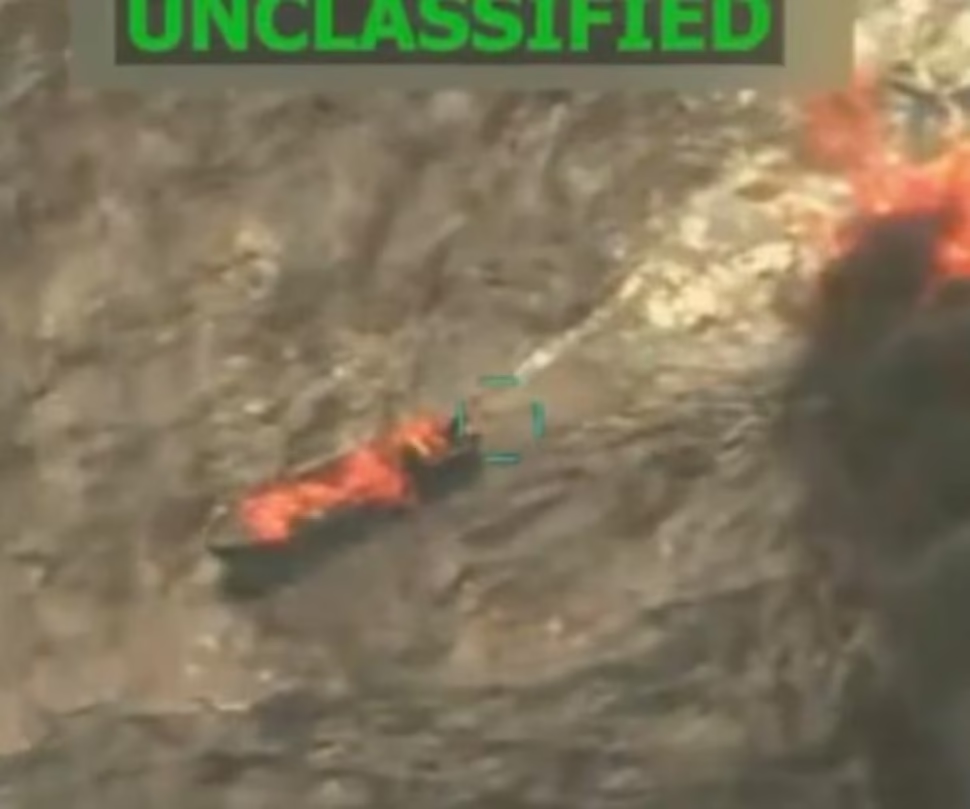
In a display of diplomatic sophistication that can only be adequately communicated with sustained capital letters and through a social network called, ironically, “Truth,” President Donald Trump announced this Monday that the United States Military Forces had carried out its second “kinetic action”. Because, what better way to address complex international relations than with a euphemism that sounds like a science fiction movie and an internet post?
The objective, according to the presidential statement: “drug trafficking cartels and narcoterrorists, clearly identified and extraordinarily violent”. The location: international waters. The result: three dead men, whom the message refers to with the scientific precision of “three male terrorists”, in case anyone thought they could be female terrorists or, worse still, terrorists of a non-binary gender. Thank you for the clarification, Mr. President!
The drug war machine (and coherence)
According to the Administration’s narrative, these alleged Venezuelan drug traffickers represented an imminent threat to national security that justified a preemptive military strike. Of course, all of this is based on irrefutable intelligence that, for some strange reason, is never made public. Do you remember those communications interceptions that confirmed everything in the first attack? Yes, we haven’t seen them either. They must be in the same safe where they keep Trump’s health test results and the infrastructure plan.
The Republican president, in an outburst of quixotic protectionism, warned that he will hunt down those who transport drugs that “kill Americans.” “They have done it for decades,” he wrote. “But not anymore.” Because it is well known that an international armed conflict is the definitive and consequence-free solution to a public health and domestic addiction problem. Who needs rehabilitation centers, education and mental health policies when you have aircraft carriers and tweets in all caps?
The Venezuelan response and the spectacle of the Caribbean
On the other side of the ring, the president of Venezuela, Nicolás Maduro, is not far behind in this absurd rhetorical duel. He accuses Trump of looking for an excuse to invade his country and overthrow him, while the US administration points to him as the boss of all bosses. Meanwhile, eight military ships and a US submarine patrol the Caribbean in the most intimidating anti-narcotics operation in recent history. Because nothing says “we’re here to help with your drug problem” like a display of military might capable of taking down a small government.
Maduro recounted an independent episode that sounds like a comedy of errors: a US Navy destroyer boarded and detained a tuna boat for eight hours. “That is an embarrassment,” said the Venezuelan president. “What they were looking for was a military incident.” And one can’t help but imagine the scene: elite sailors, armed to the teeth, boarding a boat full of tuna, desperately searching for cocaine among the cans. Operation Dorado! Tuna-liminar Mission! The humorous possibilities are endless.
Trump, for his part, playing golf at his Bedminster course, responded with characteristic geopolitical depth when asked about more attacks: “We’ll see what happens. There certainly aren’t many ships out there since the first attack.” And he added, with the satisfaction of someone who has solved drug trafficking forever: “We hardly see any boats, which is good.” Of course, because if you don’t see ships, the problem has magically disappeared. It’s the same logic you would use if you close your eyes and don’t see the national debts: poof, they disappear!
While leaders play war and rhetorical display, the United States suffers the worst drug crisis in its history, with hundreds of thousands of deaths from opioids such as fentanyl. But hey, at least we have three less “male terrorists” at sea. That will surely solve the addiction problem in Ohio or Pennsylvania. Right?
This tragicomic spectacle on the high seas serves as a perfect metaphor for our era: complex problems reduced to simple slogans, military actions announced as if they were Black Friday sales, and a humanitarian crisis treated as if it were a video game where points are accumulated for enemy casualties. Legality? Transparency? Proportionality? Those are too long words for a tweet, and they probably don’t fit in all caps.
What’s next in this chapter of “Power Games”? A third attack announced via TikTok? A nuclear submarine chasing a suspicious kayak? With this administration, everything seems possible as long as there are guaranteed likes and retweets.
Has this new turn in foreign policy surprised you? Share this analysis on your social networks and continue exploring our content to stay informed about the geopolitical absurdities that shape our world.


