Analysis of the Approval and the Fiscal Context
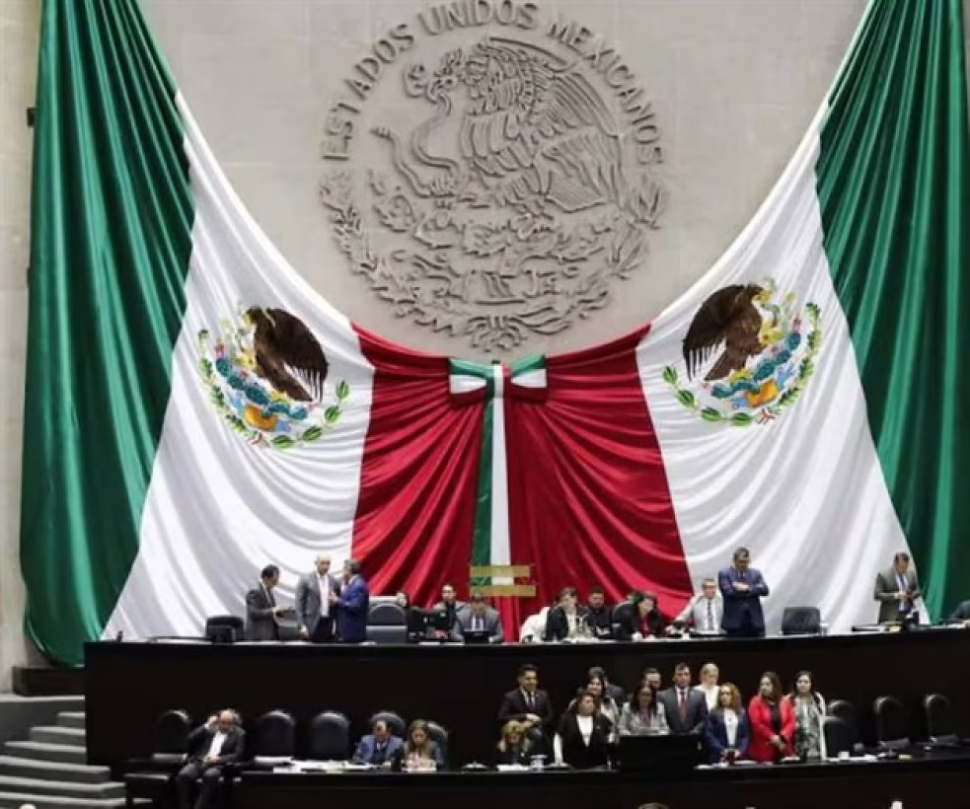
In the midst of a scenario marked by substantiated claims about alleged embezzlements exceeding 51 billion pesos, the plenary session of the Chamber of Deputies proceeded to formally approve the results of the exhaustive examination of the Public Account 2023 of the Federal Public Administration. This resolution was endorsed by 335 votes in favor cast by the legislators of Morena, the Party of Labor (PT) and the Green Ecologist Party of Mexico (PVEM). In opposition, 127 votes were registered against by the benches of the Institutional Revolutionary Party (PRI), the National Action Party (PAN) and Citizen Movement (MC).
The audit process had its starting point the previous week, when the Superior Audit of the Federation (ASF), the highest control body of the national public finances, presented the consolidated findings of its analysis to the Audit Oversight Commission of the Lower House. The official report, which would be made public later on Wednesday, conclusively established that the legal deadlines for government entities to correct the observations had expired. Despite this expiration, the clarification of debts for an approximate amount of 52 billion pesos, distributed between the central federal government and the various federative entities, was not achieved.
Methodology and Results of the Audit
The third and last installment of the audits corresponding to the Public Account 2023 was published on February 20 of the current year. At the time, this medium documented that the comprehensive audit of that fiscal year consisted of a total of 2,369 individual audits. As a result of this meticulous process, precise observations were issued for a value of 53 thousand 741 million pesos, attributable to both the federal government and the state governments. Of this global figure, the recovery of 1,762 million pesos had been achieved, leaving a balance pending clarification of 51,979 million 42,400 pesos, for which a peremptory period of 30 business days was granted.
The final document sent by the supervisory body to the San Lázaro campus is categorical: once the established deadline expired, not a single additional peso was recovered. Consequently, the total amount that remains opaque and without due justification remains at 51 thousand 979 million 42 thousand 400 pesos. Given this situation of non-compliance, the ASF found it necessary to implement more than 6,129 corrective and responsibility actions. Of this set of measures, 2,508 are specifically focused on the imposition of administrative responsibilities of a sanctioning nature against identified public servants.
A detailed breakdown of the outstanding observations reveals a significant distribution. The charges to the federal government amount to 11,177.7 million pesos, which represents 22 percent of the unsolved total. For its part, the observations related to federalized spending, that is, the resources transferred to the federal entities, reach the figure of 40 thousand 801.3 million pesos, equivalent to 78 percent of the global amount. This disparity points to a critical focus of attention in the management of decentralized resources.
Nature of the Irregularities and Observed Entities
The irregularities identified and cataloged by the ASF are diverse and complex in nature, evidencing structural flaws in financial controls. The catalog of anomalies includes, but is not limited to: excess payments over the contractual amounts, improper payments for unauthorized concepts, awards with unjustified overruns, realization of expenses not foreseen in the authorized budget catalogue, disbursements without accreditation of resources to support them, operations without supporting documentation that check, execution of works without a master program that directs them, differences in amounts between what was budgeted and what was carried out, contracting with documents without current budgetary authorization, and differences between payments made for the same concept but with different amounts.
The agencies and entities of the federal public administration that concentrated the greatest volume of observations were the Secretaries of Tourism, Health, Communications and Transportation, Environment and Natural Resources, Agriculture and Rural Development, and Marine. Likewise, large decentralized organizations such as the Mexican Social Security Institute (IMSS) and Petróleos Mexicanos (Pemex) figured prominently in the report.
An analysis of specific cases sheds light on the magnitude of the problem. The Secretary of Tourism (Sectur) was accused of probable damage to the treasury for a total of 2,593 million pesos. These observations were predominantly caused by various irregularities detected in the construction of the emblematic Maya Train project, particularly in sections 1 Palenque-Escárcega, 2 Escárcega-Calkiní, 4 Izamal-Cancún, and 5 Playa del Carmen-Tulum, located in the states of Chiapas, Tabasco, Campeche, Yucatán, and Quintana Roo.
For its part, Pemex accumulated observations for 2 thousand 058 million 900 thousand pesos. The causes lie in irregularities accounted for in the Equity Contributions destined for the Fertilizer Chain, deficiencies in the control of the inventory of stored materials, failures in the maintenance processes of the Minatitlán Refinery, and unjustified expenditures in the concepts of loading, transportation, storage and dispatch of hydrocarbons.
The Secretary of Health presented an unpaid balance of 1,257 million pesos. Within this area, indications stand out