White House redefines AI policy with strategic action plan
President Donald Trump has transformed discussions about artificial intelligence, initially promoted in private technology circles, into formal state policy. This Wednesday, the administration presented the AI Action Plan, developed in six months by key advisors, including David Sacks, AI and cryptocurrency czar. The initiative arises after the immediate revocation, on the first day of government, of the regulations established by the Biden administration.
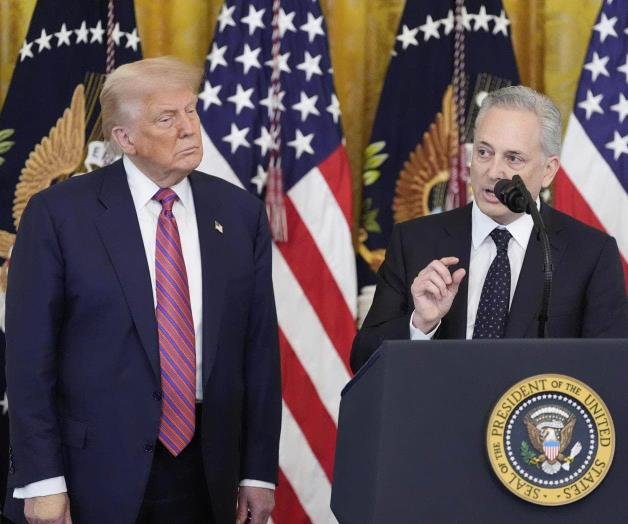
David Sacks, head of AI and cryptoassets, explains details of the GENIUS Act while the president listens attentively in the East Room of the White House.
Strategic pillars and regulatory controversies
The document, co-developed with the Hill and Valley Forum (bipartisan group) and the influential All-In podcast, prioritizes:
- Commercial expansion: Expediting exports of AI technology and making permits more flexible for data centers, critical infrastructure for model training.
- Ideological neutrality: Prohibition of government contracts with companies that do not certify the absence of “liberal bias” in their algorithms, a measure that directly affects tools such as ChatGPT or Gemini.
- Elimination of criteria: Removal of references to climate change, DEI (Diversity, Equity and Inclusion) and misinformation in AI risk assessments.
Analysts point out that these measures reflect the influence of venture capitalists like Peter Thiel, who financed Trump’s campaign and promote a vision of AI as an apolitical tool. However, critics warn that requiring “objectivity” could silence recognition of historical biases in data sets.
International context and energy disputes
The plan coincides with efforts by the EU and China to dominate global AI governance. While Brussels is committed to ethical frameworks, the US strategy emphasizes commercial competitiveness, although it generates debates about the environmental impact: data centers consume 1.5% of global electricity, according to MIT.
A spokesperson for the Department of Energy confirmed that the new rules will relax environmental requirements to speed up construction, a decision that climate organizations describe as a “regression.”
What’s next? Congress has 60 days to review the plan before its partial implementation through executive orders. Experts anticipate legal battles over possible violations of anti-discrimination laws in neutrality clauses.
Share this analysis on your social networks and follow our portal for updates on how this policy will reconfigure the technological ecosystem. Explore more content on digital regulation and AI geopolitics.