
Trump announces historic deal with China on TikTok

A pact that redefines the digital future and avoids a technological war between the two largest world powers.

The Digital Iron Curtain Cracks

In a turn of events that has shaken the foundations of global technological geopolitics, President Donald Trump has burst onto the international scene with a thunderous announcement. From the vibrant city of Madrid, Spain, the epicenter of this modern drama, he has proclaimed from the rooftops that this Monday’s tense meeting between commercial titans has culminated in a monumental agreement. It was not just any pact, but the fate of a company that had become the symbol of a generation, the digital jewel that millions of young people longed to protect: TikTok.

The air in the negotiation room, charged with an almost palpable tension, dissipated to give way to an understanding that few dared to predict. “The big trade meeting in Europe between the United States and China has gone very well,” Trump exclaimed on his Truth Social network, with the euphoria of a general who has just won a decisive battle. But the real bombshell was the revelation of an upcoming telephone communication with his Chinese counterpart, Xi Jinping, scheduled for Friday, sealing this digital truce with fire with a “The relationship remains strong!”.

RelatedTrump anticipates a trade agreement with China in the next summit

An Imminent Threat and a Race Against the Clock

The shadow of the ban hung like a sword of Damocles over the popular application. The Trump Administration, in a masterstroke of geopolitical chess, had kept the world in suspense, watching how TikTok’s Chinese parent company, ByteDance, fought for its survival on North American soil. Joe Biden’s Government had launched the final ultimatum: a law that required the sale of the application before January 19 or face absolute banishment, a digital blackout that would have left millions of users in complete darkness.

In this high-stakes thriller, Trump granted crucial extensions, each one more dramatic than the last, weaving a web of hope as the clocks ticked inexorably toward the fateful date. The meeting in Madrid was not a simple meeting; It was the battlefield where the fate of a giant would be decided. On the North American side, the Secretary of Commerce, Scott Bessent, held the banner of national interests. In front of him, Chinese Vice Premier He Lifeng fiercely defended his nation’s technological pride. Two colossi, one table, and the future of social networks hanging in the balance.

This agreement transcends the merely commercial; It is a clash of titans, a reflection of the new technological cold war where data is the new oil and applications are the battlefields. The resolution avoids an abrupt tear in the global digital ecosystem, but proposes a new order where technological sovereignty and national security are irreversibly intertwined. The message is clear: in the digital age, borders are no longer on maps, but in codes and servers.

The world watches, holding its breath, waiting for the fine details of this pact that will redefine the rules of the game. Will this be the first step towards regulated technological coexistence between East and West? Only time, and the next moves of these global chess masters, will have the answer.

Do you think this agreement will set a precedent for other Chinese applications in the West? Share this crucial news on your social networks and stay up to date with our ongoing analysis of the geopolitics of technology.
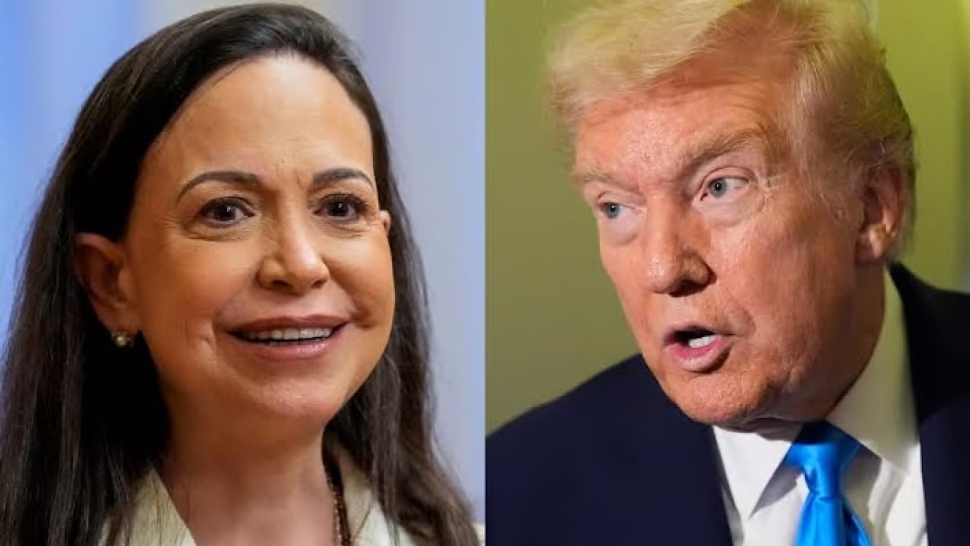
The US blocked the return of María Corina Machado to Venezuela

The return of the opposition leader to Venezuela was stopped by pressure from the US, according to reports.

Trip frustrated by American pressure

The return of the Venezuelan opposition leader María Corina Machado to her country was stopped by the opposition of the United States government, as revealed by The Wall Street Journal. Machado boarded a private jet on June 26 from Virginia bound for Curacao, but the airline was ordered to return to Washington as the aircraft flew over North Carolina.

Sources cited by the newspaper indicated that Donald Trump’s administration warned that an early return would put US support at risk, arguing that his eventual detention would unleash a crisis in foreign policy towards Caracas.

Trump held a call with the president in charge of Venezuela, Delcy Rodríguez, to ask her not to interfere with the opposition’s security. However, Secretary of State Marco Rubio insisted that “the time was not right” for the trip.

Stranded in Panama and accusations

The New York Times added that the White House told Machado that he was “on his own” after ignoring recommendations to wait. Stranded in Panama, Machado accused the Rodríguez government of blocking her entry into the country, which she left last December. In a television interview, he reaffirmed his intention to return and continue coordinating his return plans, expressing his commitment to the fight for democracy in Venezuela.

Continue reading

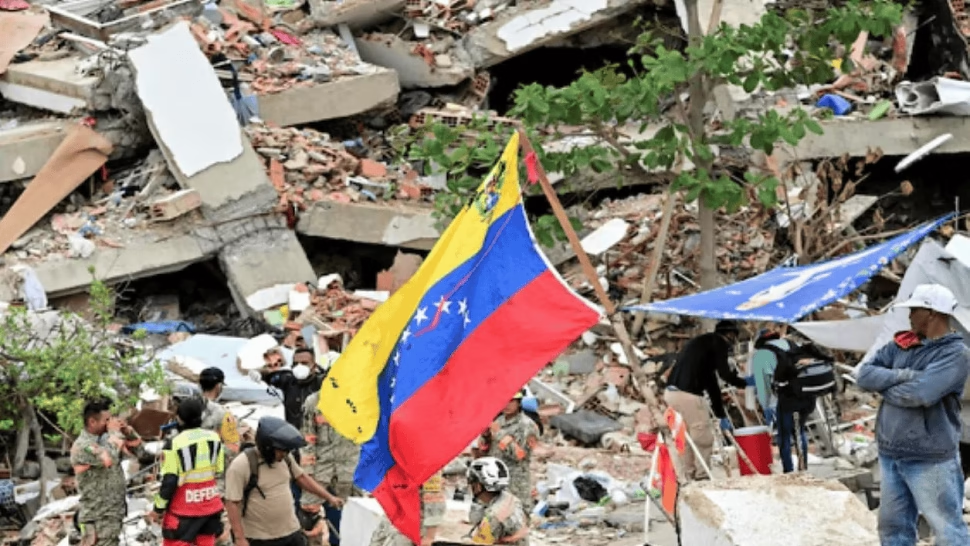
Venezuela reports 2,645 deaths from earthquakes

More than 2,600 dead and 12,000 injured after the earthquakes on June 24 in Venezuela.

Updated figures after the earthquakes in Venezuela

The official number of deaths from the June 24 earthquakes in Venezuela amounts to 2,645, while the injured total 12,666, according to the latest report from the Ministry of Popular Power for Communications and Information. The information was released today by the president of Parliament, Jorge Rodríguez.

The authorities have rescued 6,462 people. In addition, there are 15,050 displaced people, 885 buildings damaged and 189 collapsed. To date, 890 aftershocks have been recorded.

In terms of humanitarian aid, the government has distributed 78,478 food packages, 453,326 liters of water and 9,486 liters of liquid food. The patients treated total 20,909. A total of 29,567 workers and 3,305 international rescuers participate in emergency operations.

Rodríguez reported that 59 temporary camps have been set up to house the displaced and that 25,846 volunteers have joined the assistance tasks. More than 86 thousand families receive support.

Continue reading

Heat wave in France leaves 2,000 additional deaths

At least 2,000 additional deaths in a week due to record temperatures in France.

The heat wave that hit France at the end of June left a tragic toll. According to Public Health France, deaths increased by almost a third during the hottest week, with at least 2,000 more deaths than the previous week.

Preliminary and revised figures

The agency reported 8,973 deaths between June 22 and 28, 29% more than the 6,948 recorded between June 15 and 21. The difference of 2,025 deaths is attributed to extreme heat. This figure doubles the initial estimate of 1,000 additional deaths.

Public Health France warned that the numbers are partial and that the real mortality will be higher.

Impact on hospitals and communities

Dr. Nicolás Gonzales, head of emergencies at Paris-Saclay Hospital, told The Associated Press:

“Patients with heat exposure began arriving on June 20. We treated cases of heart attacks, dehydration and kidney failure, from children to elderly people who lived alone.”

Deaths in private homes shot up 91% compared to the previous week. In nursing homes they increased by 37%, and in hospitals by almost 20%. The Paris region was the most affected, with an increase of 63%.

Overload in funeral services

In Paris, funeral directors reported difficulties storing bodies before burial or cremation. Several morgues were at their limit and rejected bodies.

France recorded its hottest days in history between June 22 and 28, with day and night records in multiple locations. The wave also affected other European countries.

Health authorities continue to monitor the situation while awaiting definitive data.

Continue reading