Agreement between TikTok and China gives control to American companies

A crucial pact redefines control of the algorithm and data of millions of users, avoiding an imminent ban.

An Epic Pulse for the Digital Soul

In the heart of an unprecedented geopolitical battle, where the fate of one of the most powerful applications in the world hung in the balance, an agreement was forged that promises to rewrite the rules of the digital game. The White House, in an announcement that shook the foundations of international technology diplomacy, revealed that an emerging pact with China will guarantee, nothing more and nothing less, that American companies exercise absolute control over the enigmatic algorithm that powers TikTok’s addictive video feed. This was not a simple business transaction; It was the outcome of a titanic struggle between two superpowers, a fight for domination of the global digital landscape.

The central question, the Gordian knot of this drama, had always been the same: would the popular video platform retain its digital soul, its algorithm, after a potential and traumatic divestment from its Chinese parent company, ByteDance? The United States Congress had brandished the sword of the ban, decreeing that it would take effect in January, a ruling that threatened to silence the app for millions of users. However, President Donald Trump, in a suspenseful masterstroke, signed a series of executive orders that kept the application alive, breathing artificially while his administration waged a negotiation on the brink to force ByteDance to sell its operations in the country.

RelatedTrump announces meeting with Xi at APEC and progress on TikTok deal

The Details of a Pact that Shocks the World

The White House press secretary, Karoline Leavitt, emerged as the herald of this bombshell news. With the solemnity of someone announcing a change of era, he declared that the technology giant Oracle would be invested with supreme responsibility for data and application security. But the most dramatic twist, the revelation that changed everything, was that the Americans would control six of the seven seats on a newly conceived oversight board, a power structure designed to oversee every heartbeat of operations on American soil.

“We are one hundred percent sure the deal is done,” Leavitt proclaimed with a conviction that electrified the air, during an appearance on Fox News. “Now it just needs to be signed and the president’s team is working with their Chinese counterparts to get it done.” This statement followed a long and crucial phone call between Trump and the president of China, Xi Jinping, a conversation full of tension and subplots where the fate of TikTok was the invisible protagonist.

That was when Leavitt dropped the final bombshell, the piece of the puzzle that everyone was eager to hear: “the algorithm will also be controlled by the United States.” These seemingly simple words resounded like thunder in the silence of the technological cold war. The algorithm, that mysterious digital oracle that dictates what millions of eyes see, would eventually be plucked from the shadows and placed into American custody. The authorities had been warning for years about his vulnerability, about his potential to be manipulated by the Chinese authorities in a way so subtle that it would be almost undetectable, an instrument of influence capable of shaping perceptions and realities.

After his call with Xi, President Trump was enigmatic, calling the Chinese leader “a gentleman” on the matter and stating that American investors were aligned. “Everything is working out,” he murmured, as if he knew a secret the world could not yet understand. “We are going to have very good control.” However, the official statement from the Chinese government after the conversation was a wall of ambiguity, an eloquent silence that did not clarify what exactly Xi had agreed to regarding the sale of a controlling stake to avoid the ban in the United States, fueling intrigue about what was really agreed behind the scenes.

Leavitt, trying to bring this thriller full circle, argued that Trump had achieved the impossible: “he recognized the need to protect Americans’ privacy and data while also keeping this app open.” He then launched a phrase that will remain engraved in history: “TikTok is a vital part of our democratic process.” A recent survey by the Pew Research Center added an unexpected twist to the plot, showing that only a third of Americans now support the ban, a figure that has plummeted from 50% in March 2023. Almost a third are openly opposed and another similar percentage remains uncertain, waiting for the outcome. Among supporters of the ban, the overwhelming majority cited the security of user data as their biggest fear.

With a tone of unwavering conviction, the press secretary expressed her certainty that the agreement would be finalized in a matter of days. “Now we just need this agreement to be signed,” he declared, putting an end to his intervention. “And that will happen, I anticipate, in the coming days.” The world waits, with bated breath, for pen to paper and seal a pact that could forever redefine technological sovereignty and the balance of power in cyberspace.

Do you think this agreement will mark a before and after in digital geopolitics?Share this shocking story on your social networks and explore more content about the future of technology in our specialized section.
The rescue that gave hope in the midst of the tragedy in Venezuela

Rescuers celebrate the discovery of a survivor after eight days under rubble in Venezuela.

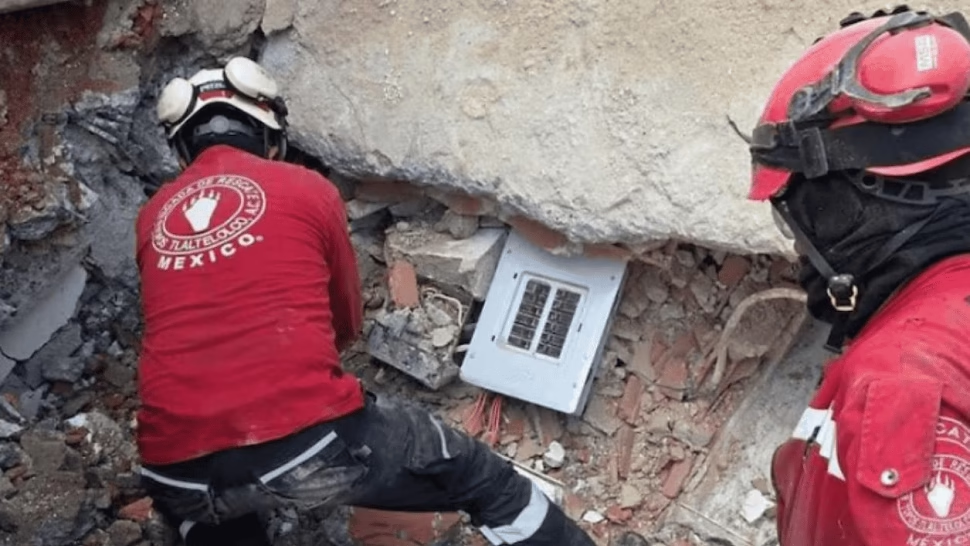
The stench of decomposing bodies spread through the streets of La Guaira as rescue brigades moved from searching for survivors to recovering remains. However, unexpected news restored spirits to the international and local teams.

The rescue of Hernán Alberto Gil Flores

Venezuelan and foreign officials celebrated the discovery alive of a 43-year-old security guard, trapped for almost eight days under the rubble of a shopping center. Television cameras captured the emotional moment when he was extracted and placed on a stretcher, while the crowd burst into applause.

Hernán survived thanks to an air pocket and the food and water that the rescuers sent him through the cracks. It far exceeded the critical threshold of 72 hours, when experts consider it most likely to find people alive.

The other side of tragedy

In other areas of the state of La Guaira, the most affected, the outlook was bleak. The port city of Catia La Mar saw officials moving around carrying body bags and stacking coffins. Equipment with seismic sensors was removed without detecting signs of life.

The government of the interim president, Delcy Rodríguez, reported at least 2,295 deaths and more than 11,000 injuries. His management has been criticized for its slowness and disorganization. Thousands of people sleep in shelters or outdoors, and doctors warn of a health crisis due to infections and untreated injuries.

Among the victims is Daniel Alejandro Núñez Ramírez, 28, deported from the United States hours before the earthquake. He had arrived on a flight with more than a hundred Venezuelans and was transferred to a hotel in La Guaira that his mother, Oswadeliz Núñez, described as a prison. Thirty minutes after a phone call, the building collapsed. His mother collected his ashes in a morgue.

“My son was not a criminal. Why do they treat people with no criminal record as criminals?” —Oswadeliz told The Associated Press.

Support from the United States

Washington supports Rodríguez and has allocated more than $300 million in assistance. John M. Barrett, US chargé d’affaires in Venezuela, assured that funds from Venezuelan oil production will be available for reconstruction. However, organizations such as the Washington Office on Latin American Affairs ask for transparency in the use of that money.

The government’s response remains under scrutiny, as the 180-day term of Rodríguez’s interim presidency expires.

Continue reading

Dog “Sarita” rescued alive from rubble in Venezuela

Mexican rescuers found "Sarita" alive under rubble in La Guaira, giving hope to affected families.

Rescue in La Guaira

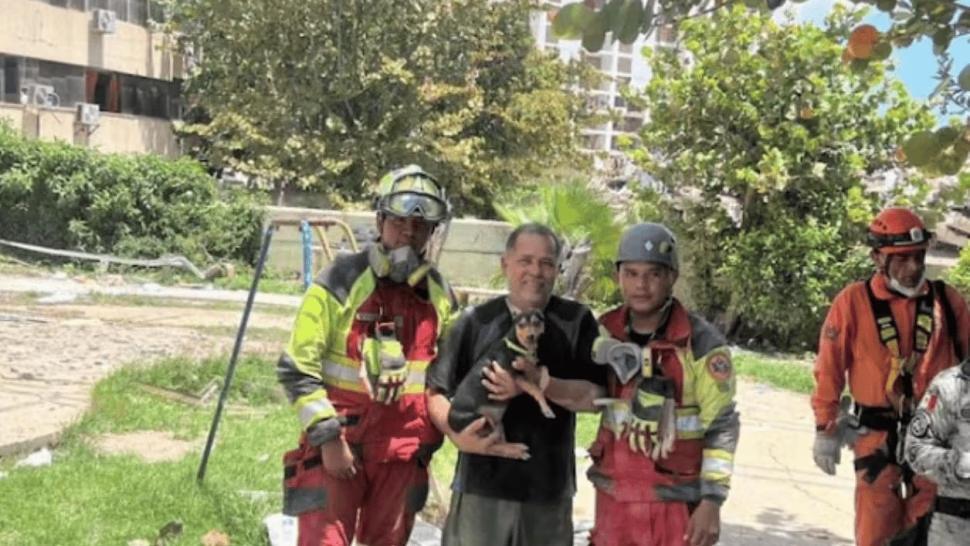
During search efforts after the June 24 earthquakes in Venezuela, elements of the Mexican Army and the National Guard located a dog named “Sarita” alive. The discovery occurred in the Vargas municipality, La Guaira state, when a man was looking for his missing daughter. Upon hearing noises among the rubble, he alerted the uniformed officers.

The canine team made up of the national guard Tonantzin Arroyo Sarmiento and the rescue dog “Kai” located the animal. After cutting and removal work, Sergeant Julio César Castro Díaz managed to extract “Sarita” alive. The owner burst into tears when he met her again and expressed that this fact renewed his hope of finding his daughter.

The tasks continue in the area as part of the “Yumare” Humanitarian Aid Group.

Humanitarian support from Mexico

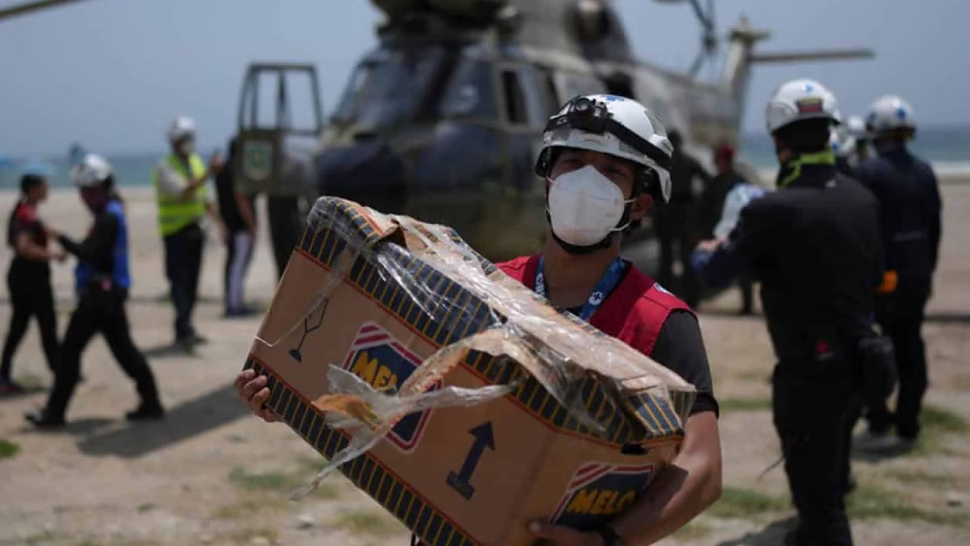
On Wednesday, a C-130 Hercules aircraft of the Mexican Air Force took off from Santa Lucía bound for Maiquetía, Venezuela. It transported medical and electronic supplies, as well as first aid material from the Mexican Red Cross and five electric power generating plants.

Since June 24, there have been five humanitarian aid flights with 240 members of the Army, including 151 rescuers, 60 doctors and health personnel, eight dog lovers from the Army and 10 from the National Guard, 11 from the Mexican Air Force. 13.1 tons of medicines have also been sent – 8.3 from Defense and 4.8 from IMSS-Wellbeing -, four tons of rescue equipment and eight generating plants.

The aid seeks to restore basic services and care for the population affected by the earthquakes that left thousands dead and injured.

Continue reading

Mali: the Belgian shepherd who rescues lives in Venezuela

The Belgian pastor Mali has located four people after the earthquakes in Venezuela.

A Belgian shepherd in the disaster zone

Mali, a seven-year-old Belgian shepherd, is part of the Topos Azteca rescue group. Since the earthquakes of June 24 in Venezuela, their work has been key to locating four people in the rubble. Two of them were found alive, along with a puppy.

Miguel Ángel García, their human guide, explains that rescue dogs speed up searches thanks to their keen sense of smell and hearing. Mali has tirelessly toured the most affected areas of Caracas and other towns.

Behind every find are years of training and unwavering determination. While machines remove debris, Mali searches for the most valuable thing: a sign of life. His work reminds us that hope can also come on four legs.

Topos Azteca rescuers continue at ground zero, searching for more survivors.

Continue reading