Occupation traffic light for massive events in CDMX

MC legislators propose a system similar to that of Jalisco to avoid crowds.

Federal legislators from Movimiento Ciudadano (MC) are promoting a proposal to implement an occupation traffic light in public spaces in Mexico City. The measure seeks to prevent incidents during mass gatherings, especially ahead of the 2026 FIFA World Cup.

Proposal for CDMX

Representative Laura Ballesteros pointed out that what happened during the celebrations at the Angel of Independence could have been avoided with better planning and risk management. For this reason, he asked to adopt a system similar to that of Jalisco, which reports the occupancy level in real time using colors.

RelatedAntigentrification march in CDMX concludes without serious incidents

The traffic light – green, amber or red – would allow attendees to know the capacity available in each area and decide whether to enter or wait. Ballesteros maintained that the security strategy should not be limited to placing screens to distribute to the public, but rather include a comprehensive civil protection plan.

The proposal is presented as a tool to prevent incidents such as that of the Angel of Independence from being repeated. With the 2026 World Cup, CDMX will receive massive events that require clear protocols.
Mexico and PAHO/WHO sign health strategy 2026-2030

Mexico and PAHO/WHO sign agreement to strengthen the health system and reduce the burden of diseases.

Bilateral agreement to strengthen the health system

The Government of Mexico, through the Ministry of Health, and the Pan American Health Organization/World Health Organization (PAHO/WHO) signed the Country Cooperation Strategy 2026-2030. The goal: strengthen the national health system and reduce the burden of disease.

The agreement includes priority actions to address non-communicable diseases, cancer and mental health disorders. It also promotes prevention strategies and timely care throughout the population’s life course.

In addition, it seeks to strengthen the stewardship of the Ministry of Health and the coordination between the institutions of the National Health System. The goal is to move towards a model of universal access to quality medical services.

Among the central axes are the strengthening of the capacity to respond to health emergencies, the promotion of health self-sufficiency and the strengthening of the national regulatory authority.

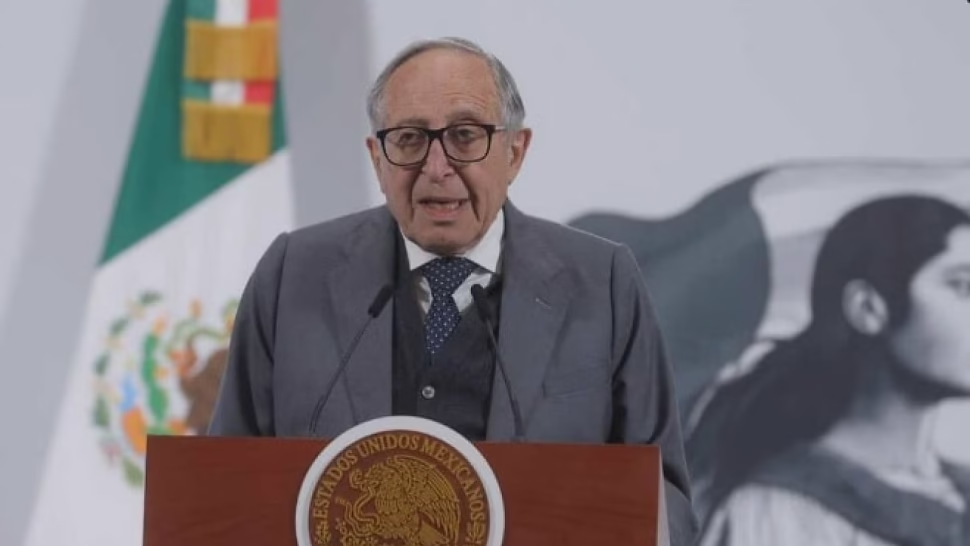
Health Secretary David Kershenobich said:

The strategy will allow national priorities to be aligned with the technical experience of PAHO/WHO, which will contribute to expanding access to health services, with emphasis on prevention, primary care and universal coverage.

The agreement lays the foundations for technical cooperation that addresses the country’s main health challenges in the next five years.

Continue reading

Mexican peso recovers after confirming the validity of the T-MEC

The peso recovers after confirming the validity of the T-MEC until 2036 with annual reviews.

The peso recovers ground against the dollar

The national currency registered an appreciation of 0.4% this Thursday, closing at 17.48 units per dollar in wholesale operations. At bank windows, the greenback stood at 17.91 pesos for sale, breaking a streak of two consecutive days with losses.

The recovery occurs after the continuity of the Treaty between Mexico, the United States and Canada (T-MEC) was confirmed until 2036, under the annual review scheme agreed upon by the three countries.

The details of the official announcement

The Secretary of Economy, Marcelo Ebrard, reported that the first formal review will begin on July 20 with the visit of a US delegation to Mexico. During the virtual meeting with their counterparts from the United States and Canada, Washington’s concern about the trade deficit was addressed.

Ebrard highlighted that more than 80% of Mexican exports to the United States continue to be tariff-free, with no changes to that scheme expected. The next working groups will focus on strengthening regional integration in strategic sectors such as the pharmaceutical industry and semiconductors, with the aim of reducing dependence on imports from other regions.

He specified that negotiations on the future of the treaty are limited exclusively to trade issues and do not include security issues.

Continue reading

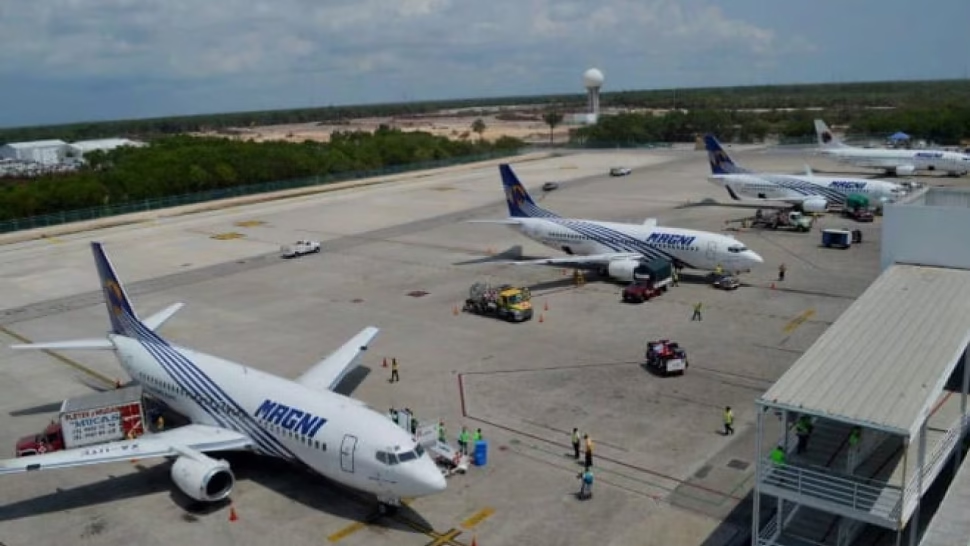
AFAC revokes Magnicharters certificate after non-compliance

The airline could not prove regulatory compliance after an extraordinary verification.

Regulatory decision

The Federal Civil Aviation Agency (AFAC) revoked Magnicharters’ air services operator certificate. The measure was notified on June 29, after a regulatory review process.

The Secretariat of Infrastructure, Communications and Transportation (SICT) reported that the company’s right to a hearing was respected throughout the procedure. It was granted legal deadlines to present information and evidence that demonstrated compliance with current aeronautical regulations.

However, the documentation provided was insufficient. The airline was unable to prove that it met the necessary requirements to continue operating as a provider of passenger air transportation.

Origin of revocation

The decision derives from an extraordinary major verification carried out in January 2026. In it, non-compliance with the regulation of the sector was detected. This led to formal requirements and, subsequently, the temporary suspension of operations in April, as a preventive measure.

The SICT stressed that the revocation is based on the lack of sufficient evidence on the part of Magnicharters to prove its regulatory status. The company now faces the loss of its certificate, which prevents it from offering commercial air services.

Continue reading