Travelers without REAL ID will be able to fly but with restrictions

The Secretary of Homeland Security reveals how those who do not comply with the new identification requirement will fly.

An unexpected twist in the travelers’ drama

In a world where every move is under the relentless scrutiny of national security, American travelers face a crucial moment. The shadow of REAL ID, that document that seems to decide the destiny of those who cross the skies, hangs over them. But, be careful! All is not lost for those who did not manage to obtain it in time. Homeland Security Secretary Kristi Noem has thrown an unexpected lifeline: “People will be allowed to fly,” she solemnly declared before a congressional panel. However, the road will not be easy.

The price of not being prepared

Those who do not carry the sacred REAL ID identification will not be ostracized, but they will face additional scrutiny. They will be separated like lost sheep, directed to special lines where every look, every question, will resonate like an echo of suspicion. “Maybe they will be taken to a different line or they might have to take an extra step,” Noem warned, as if recounting an initiation ritual full of obstacles. But, in the end, heaven will continue to be their destiny… if they manage to overcome the tests.

RelatedThe TSA evaluates relaxing liquid restrictions at airports

Meanwhile, in the offices of the Department of Motor Vehicles, chaos reigns. The lines extend like endless snakes, and desperate citizens wait for hours under the weight of bureaucracy. Renel Leggett, a college student from West Chester, Pennsylvania, is one of the victims of this ordeal. “I’ve been here for three hours to get an ID when I already had one that should have lasted me until about 2029,” he lamented, his voice thick with frustration. For her, as for many, this process is nothing more than an absurd ritual, a waste of time in a system that seems designed to test her patience.

The origin of the storm

But how did we get to this point? The story of REAL ID is one of those plots that mix tragedy and bureaucracy. It was born from the ashes of 9/11, when terror shook the world and governments swore they would never be vulnerable again. In 2005, it became law, a shield against the shadows that lurk in airports. Today, it is the seal that divides travelers between the worthy and those who must prove their worth.

Noem revealed that 81% of travelers have already crossed to the safe side, carrying IDs that meet the requirements. For those left behind, there is still hope: passports and tribal IDs will be accepted. But the message is clear: time is running out, and the final deadline, that Wednesday that approaches like a sword of Damocles, will wait for no one.

The clock keeps ticking, and every second counts. Are you ready to face the judgment of heaven?

Share this story and discover more about the challenges of traveling in the era of extreme security!
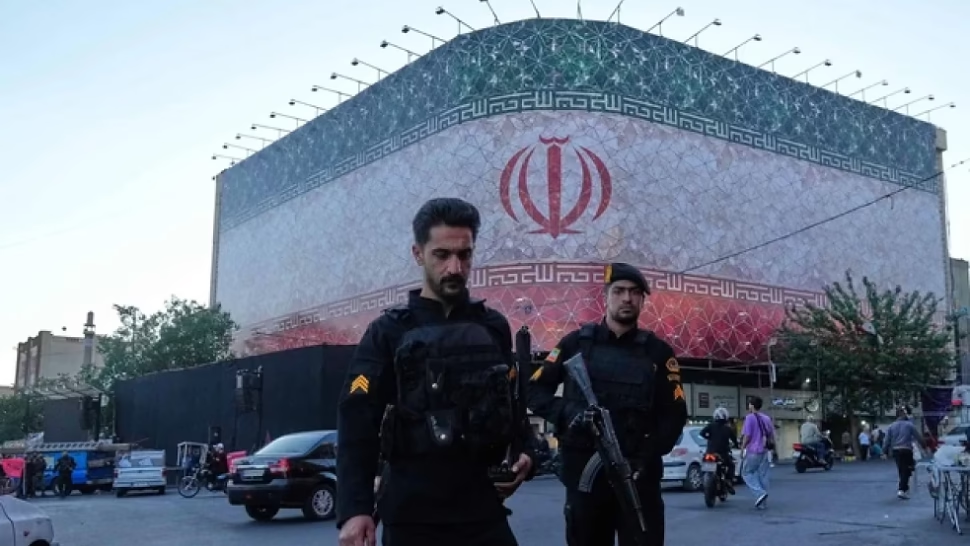
US and Iran reach provisional agreement to reopen Hormuz

The US and Iran agree to reopen the Strait of Hormuz and extend the truce.

The United States and Iran closed a provisional agreement that seeks to end the armed conflict and reopen the Strait of Hormuz, one of the most strategic maritime routes on the planet. The understanding also contemplates extending the fragile ceasefire in force in the region, amid years of military and political tension.

What does the pact contemplate?

The announcement opens the door to a formal signing next Friday in Switzerland, although authorities acknowledge that previous similar attempts have failed. As of Monday, the final content remained in dispute, especially on issues of regional security, nuclear verification and conditions for the lifting of sanctions.

The crisis between both nations has deep roots, from the Iranian nuclear program initiated with international cooperation to the Islamic Revolution of 1979. Since then, relations have been marked by diplomatic ruptures, economic sanctions and indirect clashes in the Middle East. The new agreement could mark a turning point, but doubts remain over its implementation.

Continue reading

Israel criticizes Netanyahu over US-Iran deal

The provisional pact between the US and Iran sparks internal criticism against Netanyahu for possible loss of influence.

Reactions in Israel

Israel is experiencing an intense internal debate after the provisional agreement between the United States and Iran. The pact has generated widespread criticism across the political spectrum, who consider it a strategic setback.

Prime Minister Benjamin Netanyahu has not yet issued an official position. Meanwhile, opposition figures, former officials and analysts react harshly. They point out that the Israeli government overestimated its ability to influence Washington’s strategy during the conflict with Tehran.

Another point of complaint is that the agreement could limit Israel’s freedom of military action, especially on the Lebanon front, where tensions with Hezbollah persist. Government sectors warn that resuming attacks could complicate the relationship with the United States.

International analysts point out that the pact alters the power dynamics in the Middle East. Israel would come under greater strategic pressure. Furthermore, the eventual partial lifting of sanctions on Iran would strengthen its economic and military capacity in the medium term.

Continue reading

Russian attack leaves 11 dead and damages cathedral in Ukraine

The massive bombing of kyiv and Kharkiv affected an 11th century temple.

A cathedral located in one of the oldest religious complexes in Eastern Orthodox Christianity was burned during a wide-ranging Russian attack on Ukraine. The Ukrainian government reported at least 11 people dead and dozens injured.

Details of the bombing

The attack occurred early Monday morning. Russia launched hundreds of drones and dozens of missiles against major Ukrainian cities, including kyiv and Kharkiv. Local authorities reported damage to residential buildings, markets and civil infrastructure.

Emergency teams work to rescue survivors from the rubble. President Volodymyr Zelenskyy condemned the bombing, calling it a new aggression against the civilian population and the country’s cultural heritage.

Continue reading