Federal government expands immigration operations in Chicago

The federal administration announces the reinforcement of troops in the city, unleashing a strong political and legal controversy.

Expansion of federal immigration operations in Chicago

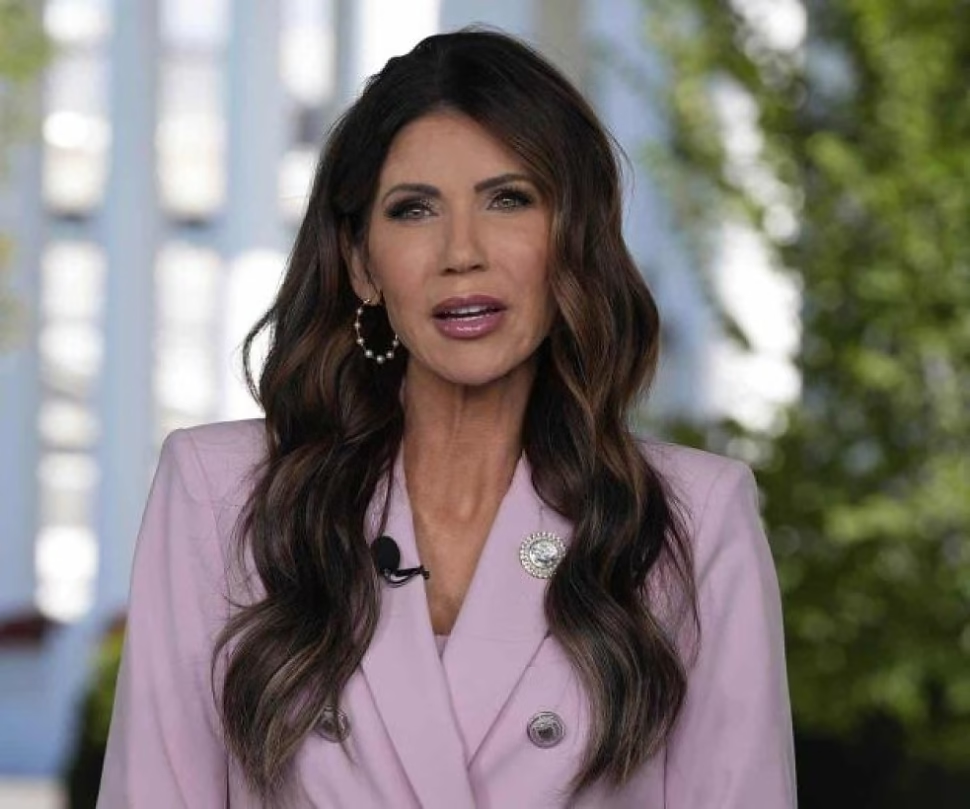
The Secretary of the Department of Homeland Security, Kristi Noem, confirmed this Sunday during an appearance on the CBS News program “Face the Nation” that the federal administration has concrete plans to expand immigration operations in Chicago. This statement constitutes the most explicit confirmation to date of the intention to increase the presence of federal agents in the third most populous city in the United States. The announcement is part of a broader strategy by President Donald Trump, who has maintained a constantly confrontational stance with the Illinois Democratic leadership.

The logistical rationale for this deployment began to materialize last week, when the Department of Homeland Security issued a request for limited logistical support to officers at Naval Station Great Lakes. This military installation, located approximately 35 miles north of downtown Chicago, would serve as a support operations base for the agency’s anticipated activities. Noem, in her remarks, referred to ongoing operations with Immigration and Customs Enforcement (ICE) in the city, but emphasized the intention to add more resources and personnel to those initiatives. However, he declined to provide specific details about the scale of the planned increase in federal officers or the exact timeline for its implementation.

RelatedTrump announces federal intervention in Chicago and Baltimore

A pattern of federal intervention and state reaction

This measure represents the continuation of a pattern of actions by the Trump administration, which previously deployed elements of the National Guard to Washington, D.C., to address issues of crime, immigration and homelessness. Likewise, two months ago, troops were sent to Los Angeles, a move that Noem vehemently defended. He stated: “I know LA would not be standing today if President Trump had not taken action. That city would have burned if it had been left at the mercy of the mayor and governor of that state.”

The expansion of operations in Chicago comes on the heels of President Trump lashing out at Illinois Gov. JB Pritzker in a social media post on Saturday. In it, he warned the governor that he must quickly resolve Chicago’s crime problems “or we are going to intervene.” The Republican president has also openly expressed his criticism of Chicago Mayor Brandon Johnson.

In the face of this federal pressure, the response of the local Democratic leadership has been one of firm opposition. Both Johnson and Pritzker have categorically rejected the federal move, arguing that crime rates have seen a significant decline in the city. Both leaders are preparing a legal lawsuit that they will present in case the Trump administration definitively moves forward with its plan. As an immediate preventive measure, Mayor Johnson signed an executive order expressly prohibiting the Chicago Police Department from cooperating or providing assistance to federal authorities in matters related to civil immigration law enforcement. The ban extends to any joint patrol activity, traffic control or establishment of checkpoints linked to this increase in personnel.

The historical context and political implications

Chicago is home to one of the largest and most established immigrant populations in the country. Both the city and state of Illinois have enacted some of the strictest legislation nationwide limiting cooperation with the federal government’s immigration enforcement efforts. These regulations, known as sanctuary laws, have created a constant legal and political confrontation with the Trump administration, which seeks to promote an agenda of mass deportations and strict immigration control.

The tension transcends the operational and enters the realm of political rhetoric. In an interview also broadcast Sunday on “Face the Nation,” Governor Pritzker suggested that Trump’s plans may be part of a more sinister strategy whose ultimate goal would be to “stop the election in 2026 or, frankly, take control of those elections,” hinting at a political motivation that goes beyond the framework of public safety and law enforcement.

For her part, Secretary Noem defended the president’s prerogative to deploy National Guard troops to Chicago, as was done in Los Angeles in June amid immigration-related protests. This complex scenario paints a panorama of deep division, where the interpretation of federal authority, states’ rights and the management of immigration policy collide, configuring an institutional crisis with profound repercussions for the residents of Chicago and for the future of governance in the United States.

Does this analysis of the federal-state conflict seem relevant to you? Share this article on your social networks to expand the conversation and explore more content related to national security policies.

Double earthquake in Venezuela leaves 164 dead

Two earthquakes of magnitude 7.2 and 7.5 hit the north of the country with serious damage.

Earthquakes in Venezuela: more than 160 dead and international call

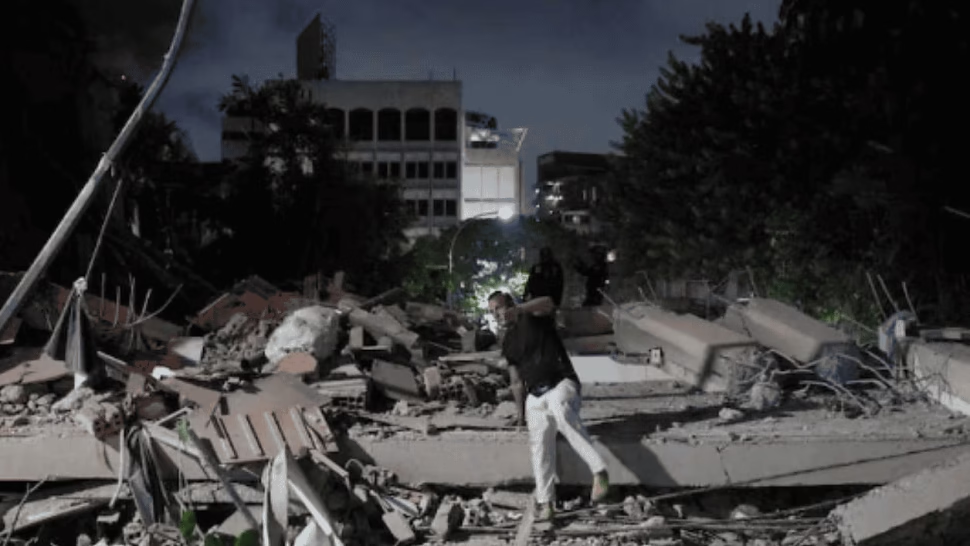
Two earthquakes of magnitude 7.2 and 7.5 shook northern Venezuela on Wednesday afternoon, leaving at least 164 dead and nearly a thousand people injured, according to President Delcy Rodríguez. The most affected region is the state of La Guaira, with “dozens” of collapsed buildings.

“We can say that the state of La Guaira is a true tragedy and is becoming a disaster zone,” declared Rodríguez.

The United States Geological Survey (USGS) estimates that the final number of victims could be between 10,000 and 100,000, with a 42% probability. It warns that aftershocks of magnitude greater than 6 are almost certain to occur. Economic damages could reach between $10 billion and $100 billion.

US Secretary of State Marco Rubio said the immediate priority is to clear debris and rescue possible survivors in the first 48 hours.

“We are sending search and rescue teams from Virginia and Los Angeles. Others will join,” he said from Bahrain.

Rubio added that the Venezuelan airport suffered severe damage, so the Department of Defense must coordinate the sending of humanitarian aid. Countries such as Qatar, Chile and El Salvador have already offered support.

Local authorities continue rescue efforts as the country faces one of the worst natural disasters in its recent history.

Continue reading

SRE rules out Mexicans affected after earthquakes in Venezuela

SRE reports that there are no Mexicans affected by earthquakes in Venezuela.

The Ministry of Foreign Affairs (SRE) reported that, as of this Wednesday afternoon, there were no reports of Mexican people affected by the earthquakes registered in Venezuela.

No effects reported

Through a statement, the Foreign Ministry expressed its solidarity with the Venezuelan people and regretted the damage that had occurred.

“The Ministry of Foreign Affairs expresses all its solidarity with the Venezuelan people and deeply regrets the damage and harm caused,” said the agency headed by Roberto Velasco.

The Mexican embassy in Venezuela remains attentive to the development of the situation. So far, there are no compatriots who have required assistance.

Support channels

For those who need consular protection, the Mexican representation has enabled the emergency number: +58 412 2524675. The authorities recommend staying calm and following local instructions.

The international organization continues to monitor possible aftershocks. For now, no changes are expected in travel recommendations for Mexicans in the region.

Continue reading

Colombia and the Amazon: a turn towards extractive development

De la Espriella's triumph in Colombia raises questions about the future of the Amazon rainforest in the region.

Abelardo de la Espriella’s victory in Colombia’s presidential elections marks a possible change in environmental policy in the region. The businessman, backed by Donald Trump, defeated Iván Cepeda by just 251,000 votes, according to official results.

What will happen to the Amazon?

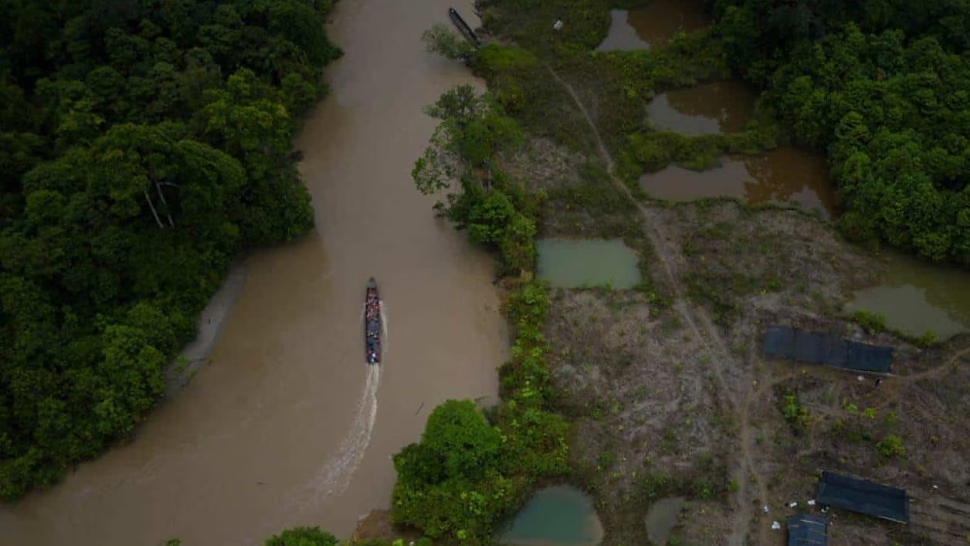
The Amazon rainforest, which absorbs carbon dioxide and slows climate change, faces a new scenario. Around 40% of Colombian territory is in the Amazon basin. During the government of Gustavo Petro, the country positioned itself as a defender of the jungle. De la Espriella promises to reactivate the oil sector, support fracking and further exploit natural resources.

Elizabeth Dickinson of the International Crisis Group noted that many governments now believe that economic development and conservation can move forward together. However, environmentalists warn that expanding fossil fuel production could increase pressure on sensitive ecosystems.

Peru and Brazil also join this trend. Keiko Fujimori, close to winning in Peru, supports mining. In Brazil, the election between Flávio Bolsonaro and Lula will define the direction of deforestation. Cristiane Mazzetti of Greenpeace Brazil said: “The elected administration sets budget priorities and regulates exploitation. The result is measurable, as shown by the rate of deforestation.”

Illegal gold mining is one of the biggest drivers of destruction in the Amazon. Dickinson added: “It’s very hard to disagree with going after illegal mining, one of the most damaging industries.” But he warned that governments often focus on seizing equipment, without dismantling criminal networks.

Julio Cusurichi, indigenous leader in Peru, stated: “Biodiversity and our territories can help climate change. In our territories we do governance for the planet.” Indigenous organizations denounce that governments do not adequately consult them before approving extractive projects.

Analysts such as Sergio Guzmán indicate that environmental concerns will compete with economic ones. “Many emissions concerns will take a backseat to energy self-sufficiency,” he said. He also mentioned that aerial fumigation of coca crops could resume, affecting Amazonian communities.

In Leticia, the Ticuna indigenous Arnaldo Rufino expressed his fear: “That means cutting down the trees that allow humanity to breathe.” The future of the Amazon will depend on the decisions made by the new governments in the region.

Continue reading