They arrest the alleged femicide of an activist in Taxco

The capture of the suspect in Taxco revives the cry for justice in the face of the wave of violence against women.

The alleged feminicide of Taxco could not escape justice (or at least, arrest)

In a twist that no one saw coming (100% sarcasm), Guerrero’s ministerial elements finally arrested José “N”, the main suspect in the femicide of Karen Monserrat Barrera, his ex-partner. Yes, the same guy who thought he could get away with this in a country where the hashtag #NiUnaMenos is still trending for the saddest of reasons.

According to the official statement from the Guerrero Prosecutor’s Office (which sounds more credible than a WhatsApp meme), the arrest occurred on the Taxco-Iguala highway, in the Arroyo neighborhood. In other words, the guy didn’t even make it far. Escape plan? Zero. Intelligence? Less.

RelatedThe alleged feminicide wanted in Puebla is extradited from the United States

Peer pressure works (sometimes)

The arrest came after feminist groups and Karen’s family took to the streets of Taxco to demand justice. Because, of course, in Mexico it seems that you have to march, shout and make cases go viral for the authorities to lift a finger. Karen was found in her home, in the Fundiciones neighborhood, in an advanced state of decomposition (and with signs of violence). To make matters worse, the victim was an animal lover who took care of stray dogs. The perfect crime for a soap opera villain? Almost, but real life doesn’t have scriptwriters to save it.

Her friends last saw her on July 25, one day before her birthday. Afterwards, she ghosted everyone (literally): she didn’t go to work, she didn’t answer messages, and when her friends went to look for her, they found only silence. Until, obviously, the worst appeared.

The authorities confirmed that Karen had a blow to the head, stab wounds and injuries to her private parts. In other words, a panorama so horrible that even Netflix would reject it for “too shady.”

Taxco: money, tourism… and femicides

Last Friday, the feminist collectives of Taxco marched again, this time to demand that Governor Evelyn Salgado Pineda (morenista, in case anyone doubted the partisan effectiveness) to do something against femicides and the sale of girls in Guerrero. Spoiler: the answer will probably be another “we’re working on it.”

In case anyone believed that this was an isolated case, in April 2024, the kidnapping and femicide of Camila, a girl from Taxco, unleashed a scandal so big that it ended in a lynching. Yes, like in the Wild West, but with cell phones recording.

Moral (because all this should have one): in Mexico, being a woman is still an extreme sport. And although there is an arrest today, the system continues to fail more than an iPhone with iOS beta.

Did this note outrage you? Share it on your networks and stay tuned for more stories like this. Visibility is the first step to change things (or at least, so that those responsible do not sleep peacefully).

INEHRM becomes a research and teaching center

The INEHRM is transformed into a research and teaching center under the new secretariat.

Transformation of the INEHRM

President Claudia Sheinbaum signed the decree that transfers the National Institute of Historical Studies of the Revolutions of Mexico (INEHRM) to the Secretariat of Science, Humanities, Technology and Innovation (SECIHTI). The institute becomes a decentralized public body with an academic focus.

Rosaura Ruiz Gutiérrez, head of SECIHTI, explained that the new scheme will train specialists in history to strengthen national capacities in social sciences and humanities.

Felipe Arturo Ávila Espinosa, director of the INEHRM, explained that the study plans will link historical knowledge with social, economic, political and cultural problems of the country, and will address the needs of the Federal Public Administration.

Hybrid educational offer

The offer will include bachelor’s degrees in History, Social Sciences and Humanities, and Public Administration and Good Government. In postgraduate studies, master’s degrees will be added in Mexican Humanism, Gender and Feminism Studies, and Social Movements and Rescue of Historical Memory. There will also be specialties in Political Communication and History Teaching.

Graduates will cover topics such as agrarianism, health, migration, artificial intelligence, violence and human rights.

Headquarters and call

The new headquarters will be at 80 Guatemala Street, Historic Center of Mexico City. The first admission call will be launched in July, and classes will begin in September.

Continue reading

Prosecutor’s Office grants protection measures to victim of family violence

The Morelos Prosecutor's Office issued protection measures after a complaint of family violence against the former director of Pemex.

The Morelos Attorney General’s Office activated protection measures in favor of Felicia Jiménez Lavie, who filed a complaint for family violence against her husband, Víctor Rodríguez Padilla, former director of Pemex. This was reported by prosecutor Fernando Blumenkron Escobar.

The measures, the official explained, will be available when the victim requires them. The complaint was filed in Mexico City and the Women’s Secretariat of the Government of Mexico directly follows up on the case.

Investigation in progress

Until now, Jiménez Lavie has not gone to the local Public Ministry to contribute more elements to the investigation folder. This was initiated ex officio last Friday, June 26, after a video was broadcast with images of attacks against the woman.

Blumenkron assured that the portfolio continues its integration. “The proceedings have not stopped and we are going to continue to guarantee justice for the victim,” he said. In addition, he indicated that there is coordination with the Women’s Secretariat and the capital’s Prosecutor’s Office, under the care route for victims of family violence.

Among the actions carried out, the Morelos Prosecutor’s Office seeks to locate the address where the physical assault occurred, to carry out expert reports in accordance with the images of the video broadcast by the victim herself.

Continue reading

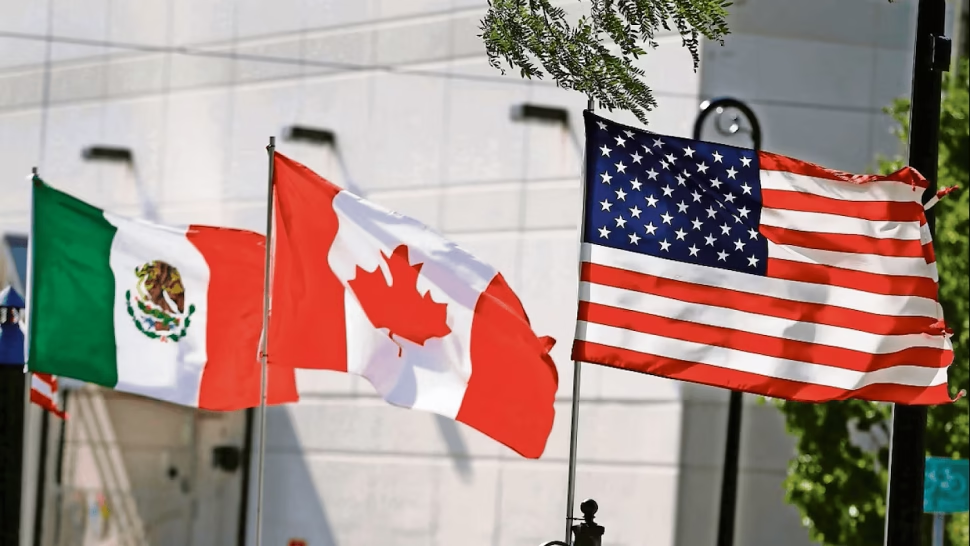
Trump does not extend T-MEC: Mexico faces annual review

US rejects automatic extension of the T-MEC; validity is reduced to 10 years with annual review.

Rejection of automatic extension

The United States decided not to automatically renew the Treaty between Mexico, the United States and Canada (T-MEC) for 16 years. This reduces its validity to a decade with an annual review. The measure generated concern among Mexican legislators.

Ricardo Monreal, coordinator of Morena in San Lázaro, explained that the treaty remains in force for another 10 years, but subject to evaluation each year. He noted that the United States presented 54 observations, including issues such as the vaquita porpoise and piracy. Mexico, for its part, raised 13 points, including clause 232 on tariffs.

“Only it will be reviewed year after year, but the Treaty is not finished, it continues for another 10 years because that is how it was signed six years ago,” declared Monreal.

The legislator warned that Donald Trump has been a constant critic of the USMCA and called for considering the benefits it has brought to the three nations.

Reactions of the opposition

Héctor Saúl Téllez, vice economic coordinator of the PAN, considered that the US position shows a lack of strategic anticipation on the part of the federal government.

“The US decision not to automatically extend the USMCA for 16 years in today’s review is not the end of the treaty, but it does reveal a lack of strategic anticipation by the federal government,” he stated.

Téllez recalled that Article 34.7 of the agreement had been known since 2018. Reaching July 1 without a clean extension represents a risk that, he said, should have been avoided.

The annual review will allow adjustments, but uncertainty about the future of regional trade persists. Mexico and Canada will seek to maintain the stability of the agreement for the next ten years.

Continue reading