Analysis of the incidence of femicides in Mexico: January to July 2025
A meticulous examination of the official data provided by the Executive Secretariat of the National Public Security System (SESNSP) reveals critical patterns in the commission of femicides at the national level during the first seven months of the current year. The information, systematically updated and available in the Violence against Women Report, constitutes the fundamental statistical basis for understanding the magnitude and geographical distribution of this gender crime.
According to the quantitative analysis, during this period 394 victims of feminicide were registered throughout Mexican territory. This figure represents a significant decrease of 22 percent compared to the same period in 2024, when 507 cases were documented. The disaggregation of the data by age groups indicates that 330 women were adults, 36 were minors, while in 28 files the ministerial authorities failed to specify the age of the victims, which suggests possible deficiencies in the investigation protocols.
Geographic distribution and priority entities
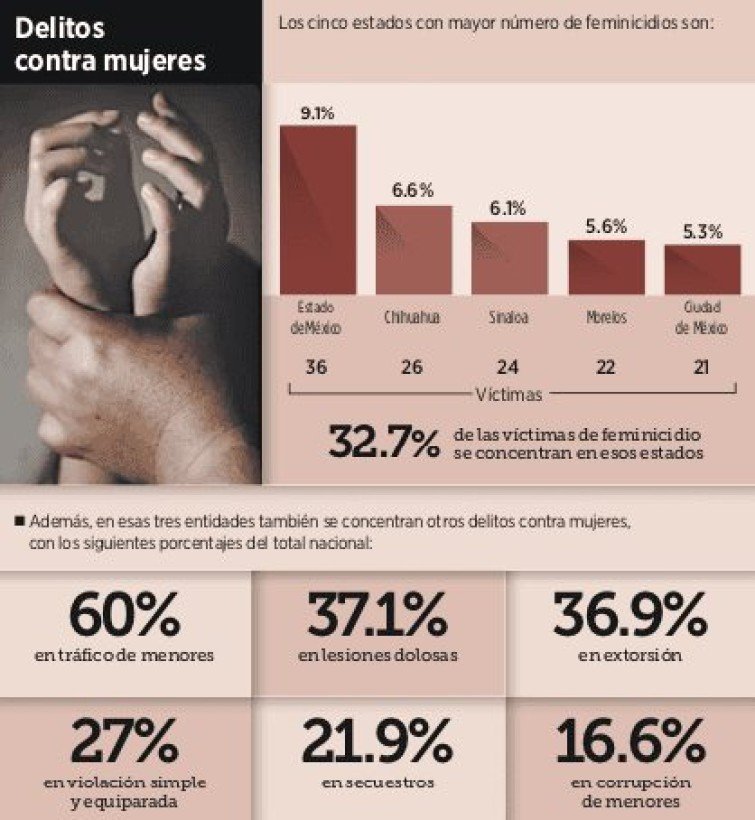
The geographical analysis shows a particularly alarming concentration in the central region of the country. The State of Mexico, Morelos and Mexico City—entities that share territorial boundaries and are currently administered by the Morena political party—collectively accounted for 20 percent of femicides nationwide, with a total of 79 documented cases. The specific distribution by federal entity shows 36 femicides in the State of Mexico, 22 in Morelos and 21 in the country’s capital.
Within these jurisdictions, municipalities and mayor’s offices with critical indices were identified. In the State of Mexico, municipalities such as Chimalhuacán and Ecatepec are in a red alert situation due to the recurrence of this crime. Morelos presents red lights in municipalities such as Cuernavaca, Tlaltizapán, Tlaltenango, Yautepec and Ayala. In Mexico City, the Álvaro Obregón Mayor’s Office registered the highest rate, with four cases recorded.
Completing the list of the five entities with the highest incidence are Chihuahua, with 26 femicides, and Sinaloa, with 24 victims. Other entities with worrying figures include Tabasco (20 victims), Tamaulipas (19), Chiapas, Jalisco and Veracruz (17 cases each), and Baja California and Michoacán (16 victims each).
At the opposite end of the spectrum, the entities with the lowest incidence were San Luis Potosí and Aguascalientes, with two femicides each; Colima and Baja California Sur, with three cases; and Zacatecas, with four victims. It is crucial to highlight that, although all federal entities registered at least one case, the disparity in the figures reflects profound differences in socioeconomic contexts, the effectiveness of public prevention policies and the implementation of gender violence alerts.
Broader context: intentional homicides of women
The SESNSP report also provides vital contextual data by including figures for intentional homicides of women. Between January and July 2025, 1,276 cases were recorded, representing a reduction of 18 percent compared to the 1,566 documented in the same period in 2024. This parallel decrease in both crimes—feminicide and intentional homicide—suggests a general downward trend in lethal violence against women, although the absolute numbers remain at unacceptable levels and demand the continuity and strengthening of measures. intervention strategies.
The legal distinction between intentional homicide and feminicide is fundamental. While the first refers to the intentional murder of a woman, feminicide implies that the crime was committed for reasons of gender, that is, due to the fact of being a woman. This categorization, established in Mexican legislation, seeks to make misogyny visible as a motivation for crime and forces authorities to investigate from a gender perspective, applying specialized protocols that consider the context of systematic violence.
The persistence of these crimes highlights the urgent need to strengthen prevention mechanisms, improve inter-institutional coordination and guarantee access to justice for victims and their families. The rigorous analysis of this data not only makes it possible to identify the highest risk areas, but also to evaluate the impact of the implemented policies and redirect resources towards strategies based on empirical evidence.
Share this analysis on your social networks to contribute to making this problem visible and explore more content related to security and human rights statistics on our portal.