The war between Israel and Iran fractures the Democratic Party

The cracks in the Democratic Party are deepening in the face of the escalation of war in the Middle East, revealing an internal battle for the future of its global strategy.

A game on the brink of the abyss

The fate of the Democratic Party hangs in the balance, torn by a storm of conflicting passions. What began as tactical disagreements over Gaza has become a political earthquake that threatens to crack the very foundations of their unity. The shadow of Iran, that ancient enemy of the West, looms over Washington like a specter that divides leaders between duty and rebellion.

The ghost of nuclear war

From the depths of the Iranian desert, where nuclear facilities burn under missile fire, a question emerges that shakes the Capitol: Is the United States on the brink of an unsanctioned war? Progressives, with voices trembling with indignation, cry in unison that this is the definitive moment to draw a red line. Meanwhile, the party’s veterans, hardened in a thousand political battles, observe with icy eyes, calculating each word as if they were pieces on a geopolitical chess board.

RelatedAmy Schumer reveals her physical transformation and new approach

Bernie Sanders, the prophet of the left, launches a war cry against what he calls “Netanyahu’s recklessness,” while Chuck Schumer, the silent strategist, avoids signing statements that could burn him in the future. Loyalty to Israel or political survival? The answer could define not only the fate of millions in the Middle East, but the course of the 2028 elections.

Words as weapons

In an ironic twist worthy of Shakespeare, Democrats have drawn Trump’s sword against himself. Ro Khanna, a name that resonates increasingly louder in the corridors of power, puts forward the same isolationist arguments that the former president used to seduce the masses. “Why spend on distant wars when our people suffer?” he asks before microphones that amplify his message to progressive bases thirsty for change.

Meanwhile, in the shadows, the presidential candidates maintain an eloquent silence. Their tactical teams whisper electoral calculations: a misstep today could cost them the nomination tomorrow. Joel Rubin, a veteran of the Obama administration, sums it up starkly: “They are watching their backs in a minefield where support for Israel has become an act of high treason for their base.”

The price of division

The scars of 2024 still bleed. Biden’s support for Israel cost the party dearly, and now Trump stalks like a predator, ready to capitalize on every fracture. The Arab-American communities and Orthodox Jews, formerly Democratic pillars, become pawns in a game where loyalties are worth more than gold.

Chris Murphy launches a poisoned dart against Trump from the networks: “He sowed this chaos.” But words are no longer enough. With the midterm elections on the horizon and the presidential race warming up, the party faces its litmus test: reconciling radical isolationists with traditional hawks before it is too late.

Jacky Rosen, with the caution of someone walking on broken glass, insists on historical support for Israel. Schumer talks about “unwavering commitment.” But in the suburbs and universities, where the progressive movement is growing, those words sound like betrayal. Can the party find a middle path before the bombs decide for them?

Share this analysis and join the debate about the future of American foreign policy! Explore more content on the geopolitical tensions that are redefining the global map.

La guerra entre Israel e Irán...

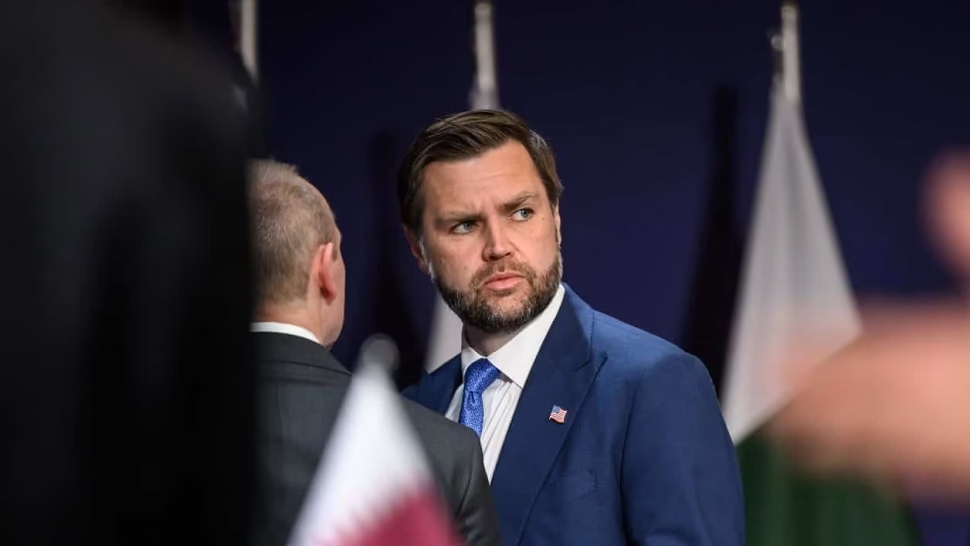
Vance reports progress in negotiations with Iran in Switzerland

Progress in dialogue between Washington and Tehran due to crisis in the Middle East.

Diplomatic advances in Switzerland

The Vice President of the United States, JD Vance, affirmed that the talks with Iranian representatives in the Bürgenstock complex, Switzerland, achieved relevant progress. According to Vance, the foundations were laid for an agreement that would reduce tensions in the Middle East.

During the meeting – which also included mediators from Pakistan and Qatar – two key issues were addressed: the reopening of the Strait of Hormuz and the conflict between Israel and Hezbollah in southern Lebanon.

The Strait of Hormuz, a strategic route for global oil transportation, had been closed by Iran after attacks by the United States and Israel. This skyrocketed international fuel prices. Although some ships have resumed transit, the main route still faces safety risks.

As part of the process, the US Treasury Department issued a temporary license allowing exceptions to sanctions related to Iranian oil. Technical talks will continue over the next 60 days.

The mediators indicated that there was progress in maintaining a ceasefire in Lebanon, but differences persist over the Iranian nuclear program and other key points of the agreement that Washington and Tehran seek to finalize.

Continue reading

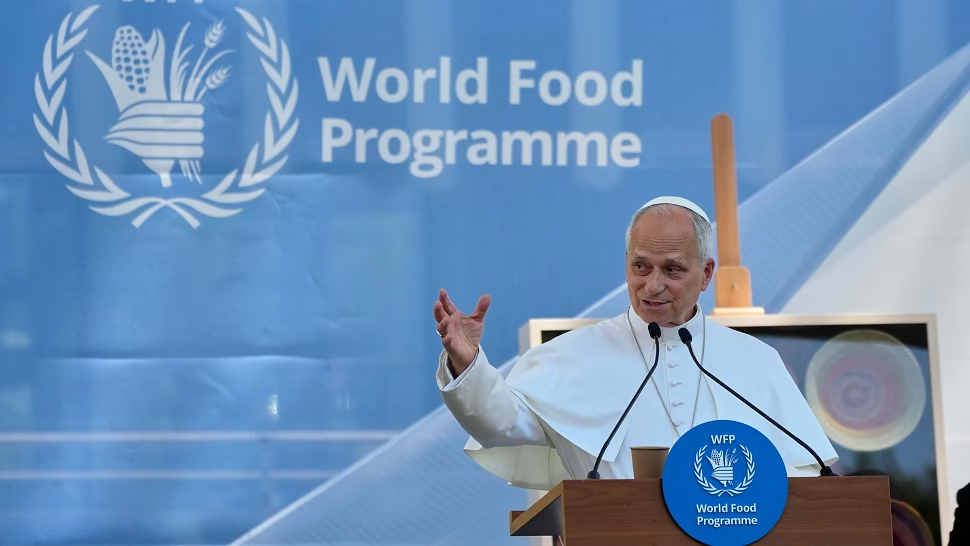
Leo XIV criticizes the ease of financing wars and not hunger

The pontiff warned about the drop in financing for food assistance from 2022.

Call from the pontiff in the face of the food crisis

Pope Leo XIV urged governments to allocate more resources to combat hunger. During a meeting in Rome with the UN World Food Program (WFP), he pointed out that it is easier to finance armed conflicts than to guarantee food for millions of people in vulnerable situations.

The pontiff warned that political and administrative obstacles delay humanitarian aid. In contrast, military spending is advancing with fewer obstacles. This paradox reflects a serious inequality in global priorities.

Leo XIV indicated that funding for food assistance has decreased considerably since 2022. Although needs increased due to conflicts, climate crises and economic problems, funds did not grow at the same pace.

He highlighted that recent international contributions, such as the one announced by the United States for the WFP, will benefit millions of people. However, he stressed that there is still a significant gap to cover the necessary resources.

Before the UN body, the pope called on world leaders to place human dignity at the center of their decisions. Strengthening international cooperation is key to confronting hunger and inequality.

Continue reading

Explosion at gas plant in Qatar leaves 13 dead

Explosion at gas terminal in Qatar leaves 13 dead and dozens injured.

Explosion in Ras Laffan: 13 dead and dozens injured

An explosion rocked the gas export terminal in Ras Laffan, one of Qatar’s most important energy facilities. The preliminary balance is 13 people dead and dozens injured.

The incident occurred while workers were trying to resume operations in the area. Work had stopped after previous clashes related to the conflict between Qatar and Iran.

Details of the accident

State-owned Qatar Energy confirmed that the explosion originated at the Barzan gas supply facility. The full extent of the damage caused by the fire is still unknown.

Ras Laffan is home to one of the world’s leading gas liquefaction plants. Disrupting its operations could lead to tensions in global energy markets, given that Qatar is a key exporter of natural gas.

Local authorities are investigating the causes of the explosion. It is not ruled out that technical problems or human failures may have contributed to the incident.

The accident adds to a context of instability in the region. The war with Iran had already affected the Qatari energy infrastructure, and this new fact complicates the recovery of the sector.

Continue reading