The US and Venezuela resume dialogue after Maduro’s capture

The US military chief meets in Caracas to promote a security and migration agenda, seven weeks after the fall of Maduro.

Is there really a new chapter?

General Francis L. Donovan, the man who commands US forces in Latin America, was in Caracas this Wednesday. He met with Delcy Rodríguez, the president in charge since Nicolás Maduro was deposed and captured by a US raid almost two months ago.

The US diplomatic office in X said they were “productive meetings.” Sounds good, right? But after years of sanctions and complete breakdown, one wonders: productive for whom?

“The conversations focused on the security environment, on the steps necessary to guarantee the implementation of President Donald Trump’s three-phase plan—particularly the stabilization of Venezuela—,” the official statement highlighted.

There is the key. It’s not just a courtesy visit. It’s about the Trump administration’s plan for the country. A plan that now needs the Venezuelan military on Maduro’s side to work.

RelatedVenezuela navigates chaos after the spectacular capture of Maduro

The hidden agenda: drugs and migrants

Donovan didn’t just see Rodriguez. He also sat down with the Minister of Defense, Vladimir Padrino López, and with Diosdado Cabello, a historic Chavista. According to Venezuelan Minister Miguel Ángel Pérez Pirela, they agreed to design a joint agenda.

“Both countries agreed to work on the design of a bilateral cooperation agenda to combat the trafficking of illicit substances in our region, terrorism and migration,” said Pérez Pirela.

Translation: Washington needs Caracas to stop the flow of cocaine into its streets and control the massive departure of Venezuelans to its borders. In return, it offers… stability.

It’s a brutal turn. The same Padrino López and Cabello who for years were pointed out by Washington as part of the problem, are now necessary partners for “shared security.” Realpolitik in its purest form.

Rodríguez has harshly criticized the capture of Maduro—who remains imprisoned in New York, declaring his innocence—but since he took office he has pushed to resume ties. He knows that without some type of understanding with the United States, the economy will not recover.

The embassies have been closed since 2019, when Trump recognized Juan Guaidó as interim president. Now everything is different. Or at least that’s what they want to make it seem like.

Is this a true reset or just a marriage of convenience while the crisis lasts? The history between these two countries suggests the latter. But for now, they talk.
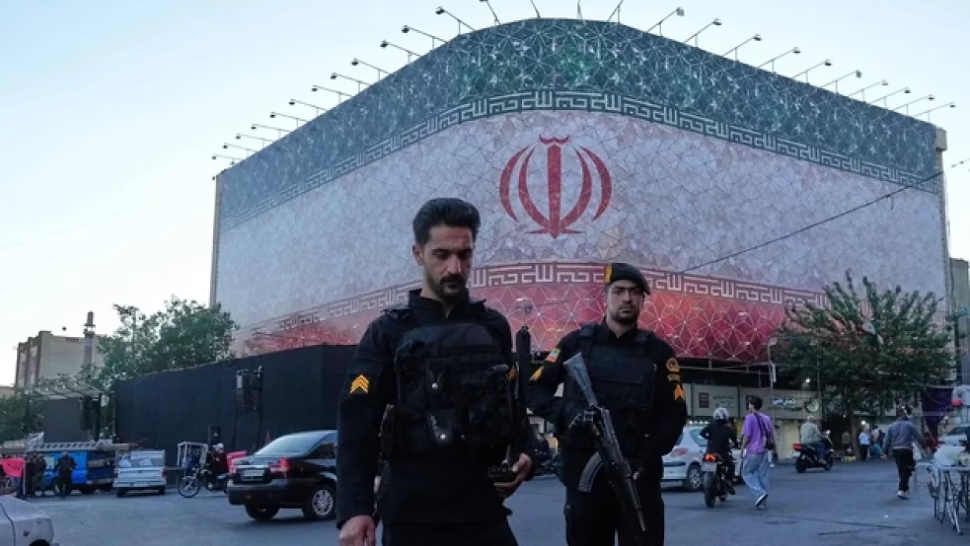
US and Iran reach provisional agreement to reopen Hormuz

The US and Iran agree to reopen the Strait of Hormuz and extend the truce.

The United States and Iran closed a provisional agreement that seeks to end the armed conflict and reopen the Strait of Hormuz, one of the most strategic maritime routes on the planet. The understanding also contemplates extending the fragile ceasefire in force in the region, amid years of military and political tension.

What does the pact contemplate?

The announcement opens the door to a formal signing next Friday in Switzerland, although authorities acknowledge that previous similar attempts have failed. As of Monday, the final content remained in dispute, especially on issues of regional security, nuclear verification and conditions for the lifting of sanctions.

The crisis between both nations has deep roots, from the Iranian nuclear program initiated with international cooperation to the Islamic Revolution of 1979. Since then, relations have been marked by diplomatic ruptures, economic sanctions and indirect clashes in the Middle East. The new agreement could mark a turning point, but doubts remain over its implementation.

Continue reading

Israel criticizes Netanyahu over US-Iran deal

The provisional pact between the US and Iran sparks internal criticism against Netanyahu for possible loss of influence.

Reactions in Israel

Israel is experiencing an intense internal debate after the provisional agreement between the United States and Iran. The pact has generated widespread criticism across the political spectrum, who consider it a strategic setback.

Prime Minister Benjamin Netanyahu has not yet issued an official position. Meanwhile, opposition figures, former officials and analysts react harshly. They point out that the Israeli government overestimated its ability to influence Washington’s strategy during the conflict with Tehran.

Another point of complaint is that the agreement could limit Israel’s freedom of military action, especially on the Lebanon front, where tensions with Hezbollah persist. Government sectors warn that resuming attacks could complicate the relationship with the United States.

International analysts point out that the pact alters the power dynamics in the Middle East. Israel would come under greater strategic pressure. Furthermore, the eventual partial lifting of sanctions on Iran would strengthen its economic and military capacity in the medium term.

Continue reading

Russian attack leaves 11 dead and damages cathedral in Ukraine

The massive bombing of kyiv and Kharkiv affected an 11th century temple.

A cathedral located in one of the oldest religious complexes in Eastern Orthodox Christianity was burned during a wide-ranging Russian attack on Ukraine. The Ukrainian government reported at least 11 people dead and dozens injured.

Details of the bombing

The attack occurred early Monday morning. Russia launched hundreds of drones and dozens of missiles against major Ukrainian cities, including kyiv and Kharkiv. Local authorities reported damage to residential buildings, markets and civil infrastructure.

Emergency teams work to rescue survivors from the rubble. President Volodymyr Zelenskyy condemned the bombing, calling it a new aggression against the civilian population and the country’s cultural heritage.

Continue reading