The UN denounces the forced recruitment of children in the Colombian conflict

The shadow of war continues to steal childhoods in Colombia, while the UN reveals chilling figures and cruel methods.

A heartbreaking cry from the depths of Colombia

In the lands where the green of the jungle is dyed red, Colombian children live a nightmare that no human being should suffer. The Office of the United Nations High Commissioner for Human Rights has raised its voice with a roar that resonates in every corner of the planet: the armed conflict continues to devour the most innocent, ripping away their future with hands of steel.

The figures that shake the world

Between 2022 and 2024, the UN documented 658 cases of atrocious rapes against minors, a number that barely scratches the surface of this tragedy. Of these, 474 were forced recruitments, while 89 children suffered the clutches of gender violence. But the year 2025 has brought with it a terrifying escalation: 51 new cases in just a few months, a harbinger of what could be the darkest year for children in decades.

RelatedLegal battle for Guatemalan migrant minors in the United States

“The pre-electoral context has turned children into currency,” declared Scott Campbell, UN representative, with a voice full of indignation. Armed groups, hungry for power, have perfected their recruitment methods, using videos on social networks and popular music as bait to cajole their victims.

But this is not just a cold statistic. Behind each number there is a face, a name, a truncated story. Seven young souls lost in the clashes in Guaviare, two more fallen in Catatumbo, where the border with Venezuela has become an implacable battlefield.

The silence that screams loudest

The UN urgently warns about the high underreporting of cases, a wall of silence built with the bricks of fear of reprisals and the normalization of violence. The indigenous and Afro-descendant communities, ancestral guardians of these lands, see how their traditions fade along with their children, torn from their roots by the war.

President Gustavo Petro, with his policy of total peace, tries to weave dialogues in the shadows, but each negotiating table seems like a house of cards about to collapse. Meanwhile, the recruited minors are turned into toy soldiers, forced to handle weapons and explosives, their laughter replaced by the echo of gunshots.

Until when? The question hangs in the air like an omen. The international community cannot continue to be a spectator of this tragedy. Share this story, spread the voice of the voiceless, and demand action before another childhood is stolen.

Don’t let this pain be forgotten! Share now and help break the cycle of violence.
Venezuela: ten days after earthquakes, hope persists among rubble

Ten days after the earthquakes, families are still searching for loved ones under rubble. Rains complicate rescues.

Ten days of tireless search

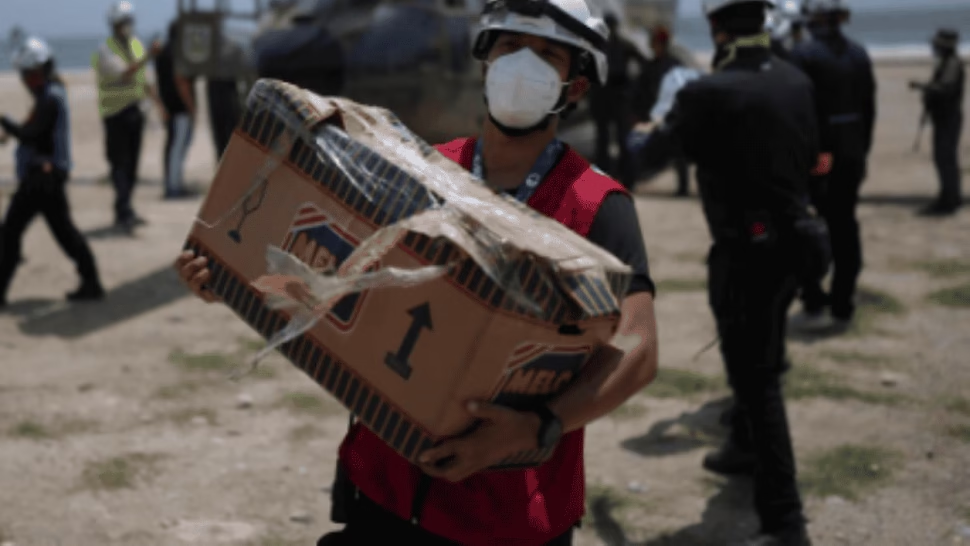
Ten days after the June 24 earthquakes, families in the most affected areas in Venezuela continue to remove debris in the hope of finding their loved ones alive. In La Guaira, the hardest hit region, parents and relatives cling to the possibility that their children may appear under the remains of collapsed buildings.

Pedro Fernández, 50, lost his mother, wife, two daughters, a nephew and his wife’s grandmother at a family kiosk on the beach. “It’s not easy at all, but I have to get up,” he summarizes.

Official figures and climate challenges

The official balance sheet for Friday, July 3, released by the president of the National Assembly, Jorge Rodríguez, reported 2,645 deaths and 12,666 injuries. The authorities count 6,462 people rescued alive, 15,050 displaced without housing and 885 buildings damaged, of which 189 completely collapsed. 59 temporary camps have been set up to serve 86,117 families. Since the earthquake, 890 aftershocks have been recorded.

The arrival of Tropical Wave 22 this Saturday could complicate rescue operations. The rains increase the risk of landslides in unstable areas and make working with heavy machinery difficult. In the camps, humidity and possible leaks increase vulnerability to respiratory diseases.

In Aragua, authorities confirmed 15 deaths: 13 of them in the collapse of Tower 4 of the Bosque Lindo residential complex. Rescue efforts continue with canine brigades and volunteers. 843 properties were evaluated; 45 are in critical condition.

Resumption of classes and international aid

School activities remain suspended in the affected areas (La Guaira, Caracas, Aragua, Carabobo, Miranda and Falcón). The Ministry of Education announced that this Monday, July 6, classes will resume in regions without direct damage, with security measures and risk management content. The 2025-2026 school year will conclude on July 31 with discreet events.

International aid continues to arrive from Latin America, Europe, the United States, the UN and the Red Cross, with rescue equipment, food and medical supplies. However, families and volunteers are requesting greater logistical support to accelerate the removal of debris and serve the thousands of displaced people facing reconstruction and inclement weather.

Continue reading

Rescuers from Spain, Chile and Mexico return after earthquakes in Venezuela

Rescue teams from three countries conclude work after the earthquakes that devastated La Guaira and Caracas.

Return of the rescue teams and continuity of aid

The teams of rescuers from Spain, Chile and Mexico began their return to their countries after completing the search tasks in the areas affected by the two earthquakes of magnitude 7.2 and 7.5 that shook northern Venezuela on June 24. The earthquakes, occurring just 39 seconds apart in what is described as a “seismic doublet,” caused hundreds of buildings to collapse, mainly in La Guaira and some areas of Caracas.

Venezuelan authorities and international organizations report thousands of deaths, tens of thousands of injuries and a still undetermined number of missing people. Property damage is estimated in the billions of dollars, with tens of thousands of structures affected.

In this transition scenario towards recovery, the firefighters of A Coruña (Spain) have already returned home. The Galician body broadcast images of the game and received thanks from the local population. The second Spanish contingent, which included the Immediate Disaster Response Team (ERICAM), arrived this Saturday in Madrid-Barajas, where it was received by Civil Protection authorities.

Chile coordinated the return of its rescuers aboard an Air Force Boeing 767. The same flight transports a second shipment of assistance: 35,000 doses of vaccines, medical supplies and food, managed by Senapred, the Ministry of Health and other entities, in collaboration with the private sector.

In Mexico, the “Los Topos” team received an emotional farewell at the Valencia airport, Carabobo state. Citizens and local authorities paid tribute to the Mexican rescuers for their professionalism.

Help that keeps coming

As the teams return, the help continues. Uruguay announced that a Hercules plane will depart in the next few hours with donations collected by the population, companies and the resident Venezuelan community. Spain donated a modular field hospital through the AECID, which will be installed this weekend in the Parque del Este in Caracas.

The United States will maintain a prolonged presence to support assistance and debris removal, especially in La Guaira, the most devastated area. American teams are also involved in repairing port infrastructure to facilitate the arrival of supplies.

In total, the international community mobilized more than 3,000 rescuers from dozens of countries, along with canine teams, vehicles and tons of supplies. The UN and the Red Cross have deployed field hospitals. Venezuelan authorities highlighted the value of this solidarity, but sources agree that the needs remain urgent: medical care, shelter, food, drinking water and safe debris removal.

Continue reading

Leo XIV asks the US to welcome migrants during the 4th of July

The pontiff called on the United States to welcome migrants and asked Europe for a more humane response.

A message from Lampedusa

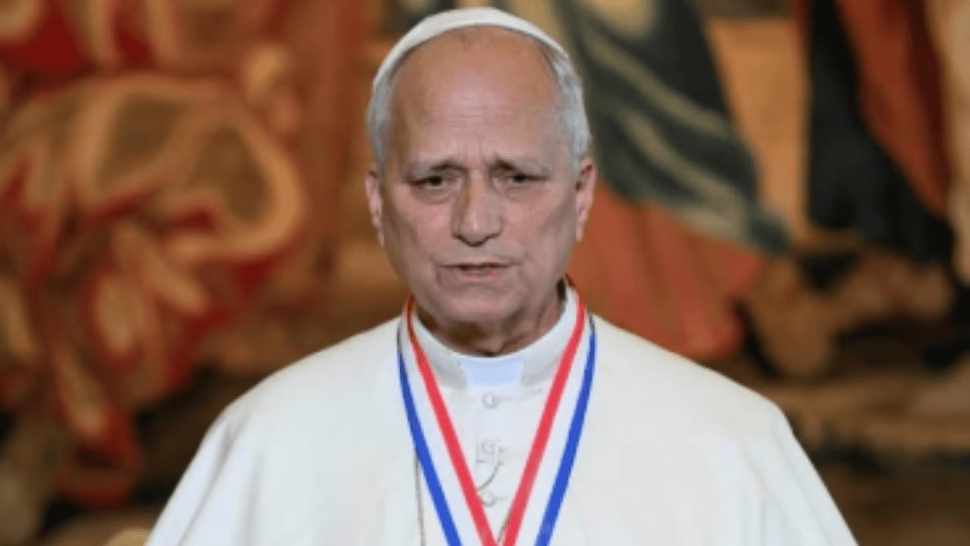
Pope Leo XIV took advantage of the 250th anniversary of the independence of the United States to send a clear message: he called on his native country to “welcome, protect and assist immigrants.” The statement came during his visit to the Italian island of Lampedusa, the main entry point for migrants crossing the Mediterranean.

“Receiving them with compassion and generosity is not only an act of charity, but also a recognition of the dignity that belongs to every human person,” he said in his speech to the United States. The pontiff stressed that the defense of life, a central principle of Catholic doctrine, implies welcoming those fleeing war, persecution or poverty.

Visit to Lampedusa

Leo XIV chose Lampedusa for this commemoration. The island has received more than 7 thousand migrants this year. During the visit, he asked European leaders to adopt a long-term strategy that combines immediate assistance with integration and cooperation policies with countries of origin.

The gesture recalled Francis’ visit in 2013, his first trip outside Rome. Leo XIV laid flowers in the cemetery where migrants who died during the crossing rest and toured the “Gate of Europe”, a monument dedicated to the victims of the Mediterranean. According to the International Organization for Migration, more than 1,400 people have lost their lives or disappeared this year trying to cross, including 28 minors.

Since his election in May 2025, Leo XIV has made the defense of migrants a central axis of his pontificate.

Continue reading