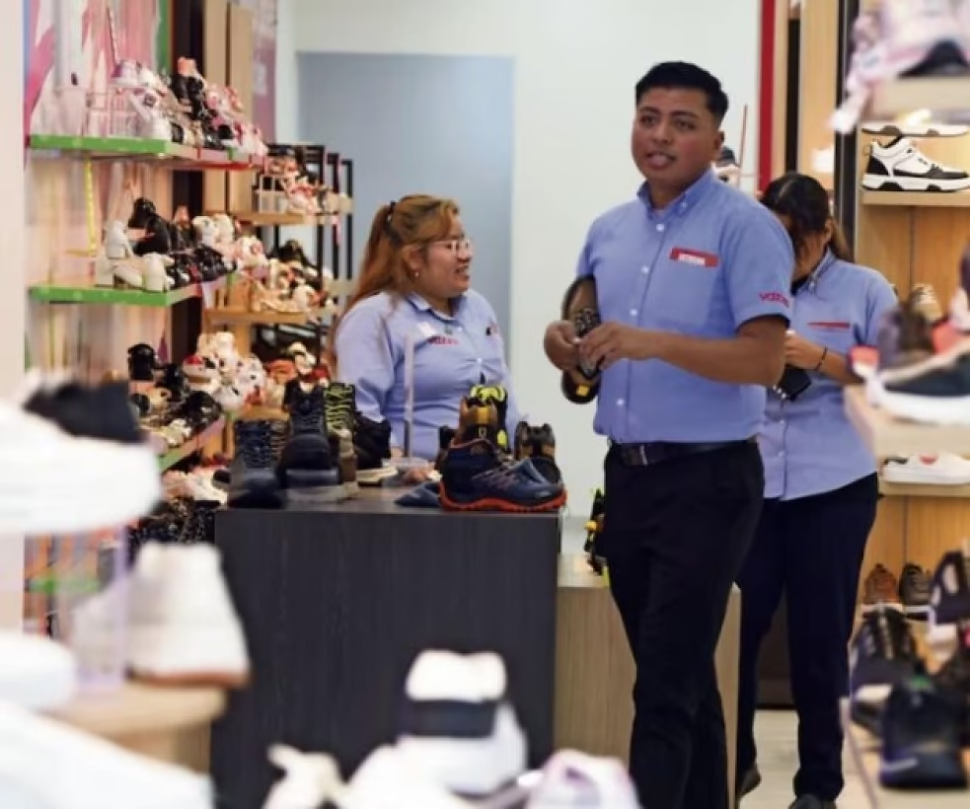
The reduction to 40 hours per week challenges the survival of microenterprises

Microenterprises face a critical dilemma in the face of possible reductions in hours: adapt or disappear.

A call to action with economic conscience

Entrepreneur friends and business leaders! Today we talk about an issue that is stirring up the world of work in Mexico: the reduction of the working day to 40 hours a week. But it is not just a policy, it is an opportunity to reinvent ourselves. According to Octavio de la Torre, president of Concanaco, this measure could cost a microenterprise up to 65,793 pesos annually. Sound alarming? Of course! But every challenge is a door to innovation.

The numbers that don’t lie

Let’s break down those costs with optimism: 6,854 pesos in bonuses, 5,672 in extra vacations, almost 30,000 in social security and 23,348 for tax adjustments. Yes, they are strong figures, but imagine the message we send by valuing workplace well-being. The tertiary sector, which generates 65% of employment, is in the crosshairs. How to balance survival and rights? With creativity and dialogue!

RelatedMexico is moving towards a 40-hour work week

De la Torre highlights something key: in Mexico they already work 45 real hours, not 48. Countries like Germany work 40 hours without including breaks. Here’s the key: intelligent flexibility. It proposes that the government assume extra tax costs and eliminate additional taxes for overtime. It’s time for policies that boost, not stifle!

Solutions that inspire

What if we talk about hourly salary or total payroll deductions for those who formalize it? Voluntary flexibility between employer and employee could be the answer. Imagine agreements where both parties choose between 48 or 40 hours, with joint days of rest. Rigidity only creates avoidance! Overtime should be regulated, not criminalized, especially when workers seek to earn more, not work less.

The International Labor Organization recommends implementing this in a progressive way. Let’s applaud that vision! At the Cancun forum it was made clear: trade, services and tourism need differentiated impacts by size and region. It is not about privileges, but about fair conditions to build rights on a solid foundation.

Final reflection: Each change requires adaptation, but it also opens unexplored paths. Are we ready to rethink models and co-create solutions? The future of work is not a burden, it is an invitation to evolve.

Share this vision! Spread how microbusinesses can transform challenges into opportunities. Do you want more content on economics and sustainable growth? Explore our posts and join the conversation. #FairWorkingDay #BusinessInnovation

Remember: Great revolutions begin with conscious steps. Be part of the change!

Citizens demand cancellation of water agreement with Israel

Thousands called to demonstrate on August 1 in several cities due to alleged opacity.

Civil unrest around the water cooperation agreement between the Chihuahua Central Water and Sanitation Board (JCAS) and the Israeli Mashav Agency has escalated to the national level. The mobilization, promoted on TikTok by the user @amigamagica, will take place on Saturday, August 1 at 9:30 a.m. in various cities across the country.

Meeting points include from the Estela de Luz towards the Zócalo in Mexico City, to concentrations in Tabasco, Pachuca, Ciudad Juárez and Jalisco. The agreement, signed in 2023 under the government of María Eugenia Campos Galván, is the center of the debate.

The legal vacuum of the agreement

According to Luis Andrés Rivera Levario, spokesperson for Save the Hills of Chihuahua, the Ministry of Foreign Affairs (SRE) confirmed that there are no legal instruments in force between Israel and Chihuahua. This, according to activists, violates the Law on the Conclusion of Treaties, which requires any inter-institutional agreement to be registered with the Foreign Ministry.

“It was left in a situation in limbo where it is impossible to request accounts, since it does not legally exist,” said Rivera Levario in an interview with IMER.

The civil organization maintains that the agreement operates in total opacity as it lacks registration with the Mexican Agency for International Development Cooperation (Amexcid).

Technical concern

Beyond the legal, protesters criticize the proposed technological model. Reverse osmosis, they explain, is not viable for Chihuahua due to the absence of the sea. They point out that aquifer wells are already becoming salinized due to poor management, and the technology would only aggravate soil salinization.

“They are coming to offer us a high-risk solution,” added the spokesperson.

The real solution, they insist, is to protect water recharge areas and carry out agricultural and industrial reconversion. The community demands that the authorities terminate the agreement, which they consider non-existent.

Continue reading

Gertrudis Bocanegra Scholarship: support for university transportation

Bimonthly support for public transportation for Zacatecas students.

New scholarship for university students in Zacatecas

President Claudia Sheinbaum announced the Gertrudis Bocanegra Scholarship, exclusive financial support for students from public universities in Zacatecas. The resource will be bimonthly and will cover transportation expenses, one of the items that most impacts the family economy.

Starting in September, informational assemblies will begin on campuses to detail rules and records. During the event, Sheinbaum handed out cards from the Rita Cetina Scholarship, annual support of 2,500 pesos for uniforms and primary school supplies, which will begin to be dispersed in August.

The Secretary of Education, Mario Delgado, reported that the fiscal year will close with 22 million scholarship recipients throughout the country, a historic figure. In Zacatecas, coordinator Julio César León detailed an active register of 180,627 students, with an investment of more than 1,600 million pesos.

The federal educational strategy includes a staggered scheme: supplies scholarship in primary school, bimonthly benefit in secondary school, Benito Juárez Scholarship in high school, and now transportation in university. In addition, a new campus will be built for the Rosario Castellanos National University and six for the Margarita Maza High School.

These announcements reinforce the government’s commitment to guaranteeing the constitutional right to economic stimuli from basic to higher.

Continue reading

Remains of missing child found in restaurant septic tank in Guasave

A 4-year-old child found dead in a septic tank at a restaurant on Las Glorias beach.

The Attorney General’s Office of the State of Sinaloa is investigating the death of a four-year-old minor, identified as Aldo Emilio N., who was reported not to be located for several hours in the tourist area of ​​Las Glorias beach, in the municipality of Guasave. The boy had gone to the scene accompanied by his parents.

Disappearance and search on the beach

According to the family story, the group came to spend the day and ate at the “Las Palomas” restaurant. After finishing the food, the parents noticed that the minor was no longer there. They immediately called emergencies and elements of the municipal police, civil protection and visitors joined an intense search throughout the beach and nearby businesses.

The authorities reviewed restaurants and businesses in the area, as well as versions on social networks about an unaccompanied minor, but none of them matched.

Finding in a septic tank

Almost four hours later, during a new inspection at the restaurant where the family ate, the child’s remains were found in a septic tank in the establishment. Experts from the Prosecutor’s Office collected evidence and testimonies to determine the causes of death.

The Prosecutor’s Office has not issued a preliminary ruling. The case remains under investigation.

Continue reading